
Dan Rockmore
Mathematical models power our civilization—but they have limits.
Read the full article at: www.newyorker.com
Networking the complexity community since 1999
Dan Rockmore
Mathematical models power our civilization—but they have limits.
Read the full article at: www.newyorker.com
Stuart Kauffman, Andrea Roli
We propose a novel definition of life in terms of which its emergence in the universe is expected, and its ever-creative open-ended evolution is entailed by no law. Living organisms are Kantian Wholes that achieve Catalytic Closure, Constraint Closure, and Spatial Closure. We here unite for the first time two established mathematical theories, namely Collectively Autocatalytic Sets and the Theory of the Adjacent Possible. The former establishes that a first-order phase transition to molecular reproduction is expected in the chemical evolution of the universe where the diversity and complexity of molecules increases; the latter posits that, under loose hypotheses, if the system starts with a small number of beginning molecules, each of which can combine with copies of itself or other molecules to make new molecules, over time the number of kinds of molecules increases slowly but then explodes upward hyperbolically. Together these theories imply that life is expected as a phase transition in the evolving universe. The familiar distinction between software and hardware loses its meaning in living cells. We propose new ways to study the phylogeny of metabolisms, new astronomical ways to search for life on exoplanets, new experiments to seek the emergence of the most rudimentary life, and the hint of a coherent testable pathway to prokaryotes with template replication and coding.
Read the full article at: arxiv.org
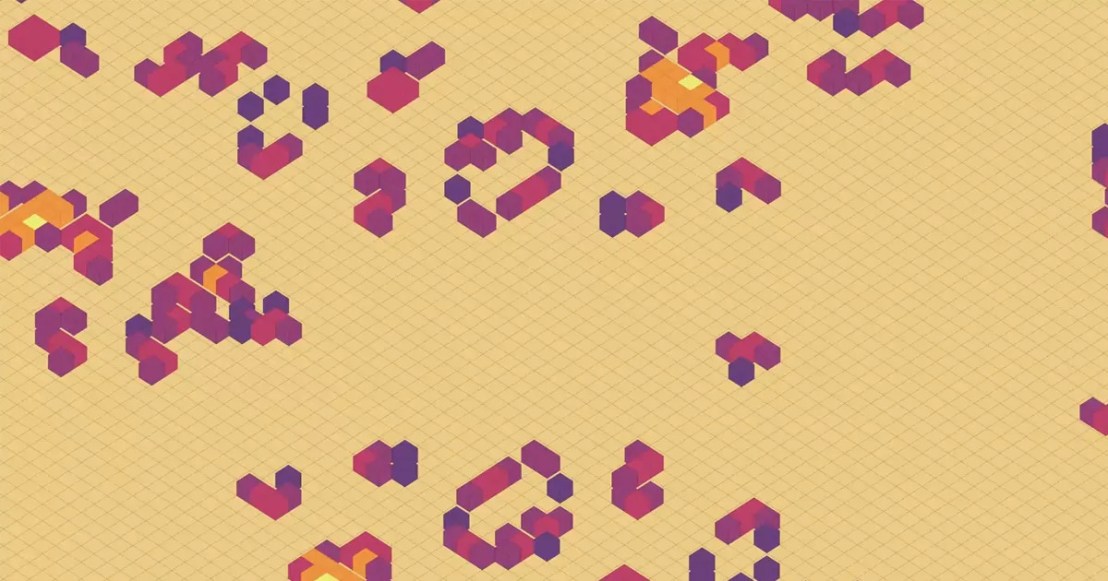 John Conway’s Game of Life, a famous cellular automaton, has been found to have periodic patterns of every possible length.
Read the full article at: www.quantamagazine.org
Tom Lenaerts, Marco Saponara, Jorge M. Pacheco, Francisco C. Santos
iScience
Even though Theory of Mind in upper primates has been under investigation for decades, how it may evolve remains an open problem. We propose here an evolutionary game theoretical model where a finite population of individuals may use reasoning strategies to infer a response to the anticipated behaviour of others within the context of a sequential dilemma, i.e., the centipede game. We show that strategies with bounded reasoning evolve and flourish under natural selection, provided they are allowed to make reasoning mistakes and a temptation for higher future gains is in place. We further show that non-deterministic reasoning co-evolves with an optimism bias that may lead to the selection of new equilibria, closely associated with average behaviour observed in experimental data. This work reveals both a novel perspective on the evolution of bounded rationality and a co-evolutionary link between the evolution of ToM and the emergence of misbeliefs.
Read the full article at: www.sciencedirect.com
Srdjan Kesić
Systems 2024, 12(1), 29
This article argues that complexity scientists have been searching for a universal complexity in the form of a “theory of everything” since some important theoretical breakthroughs such as Bertalanffy’s general systems theory, Wiener’s cybernetics, chaos theory, synergetics, self-organization, self-organized criticality and complex adaptive systems, which brought the study of complex systems into mainstream science. In this respect, much attention has been paid to the importance of a “reductionist complexity science” or a “reductionist theory of everything”. Alternatively, many scholars strongly argue for a holistic or emergentist “theory of everything”. The unifying characteristic of both attempts to account for complexity is an insistence on one robust explanatory framework to describe almost all natural and socio-technical phenomena. Nevertheless, researchers need to understand the conceptual historical background of “complexity science” in order to understand these longstanding efforts to develop a single all-inclusive theory. In this theoretical overview, I address this underappreciated problem and argue that both accounts of the “theory of everything” seem problematic, as they do not seem to be able to capture the whole of reality. This realization could mean that the idea of a single omnipotent theory falls flat. However, the prospects for a “holistic theory of everything” are much better than a “reductionist theory of everything”. Nonetheless, various forms of contemporary systems thinking and conceptual tools could make the path to the “theory of everything” much more accessible. These new advances in thinking about complexity, such as “Bohr’s complementarity”, Morin’s Complex thinking, and Cabrera’s DSRP theory, might allow the theorists to abandon the EITHER/OR logical operators and start thinking about BOTH/AND operators to seek reconciliation between reductionism and holism, which might lead them to a new “theory of everything”.
Read the full article at: www.mdpi.com
 Complexity Digest