
By treating molecules as geometric tessellations, scientists devised a new way to forecast how 2D materials might self-assemble.
Read the full article at: www.quantamagazine.org
Networking the complexity community since 1999
By treating molecules as geometric tessellations, scientists devised a new way to forecast how 2D materials might self-assemble.
Read the full article at: www.quantamagazine.org
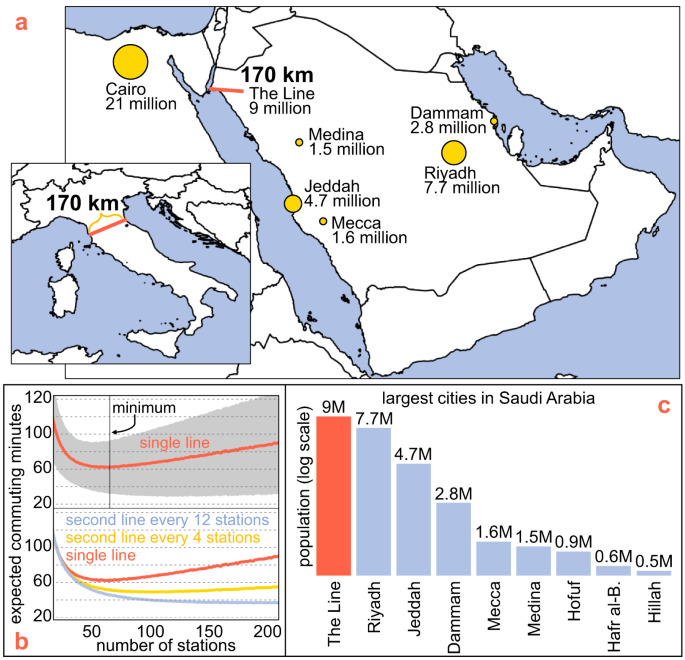
Rafael Prieto-Curiel & Dániel Kondor
npj Urban Sustainability volume 3, Article number: 35 (2023)
Saudi Arabia plans to construct a new city, home to 9 million people. The most relevant aspect is its form, a line with a surprising length of 170 km. We analyse whether this is the best plan for a new city and some inconveniences of the prolonged urban form.
Read the full article at: www.nature.com
Keith Farnsworth
This is an un-reviewed, unpublished pre-print of a paper written for a special issue of BioSystems on Code Biology. It explains why biological codes are essential for life to be autonomous. The first reason is that autonomy requires freedom from exogenous control (cause-effect) and this is achieved by stripping the force from efficient causes using transducers at the organism boundary (e.g. cell receptors) so they become signal-response: contingent influences, rather than controls. All transducers embody a cypher or a code. The second is that evolvable reproduction requires the maintenance of a separate formal information store (from Von Neumann’s replicator theory), which must be causally isolated from the rest of the replicating system. This is achieved by storing the information in a form that does not correlate with the rest of the system, hence it requires code-translation to become causal. These explanations rest on the idea of efficient cause being the result of empowering formal cause with a physical force-field (Farnsworth 2022 – BioSystems). They also provide a new and powerful way of understanding semiotic communications in general.
Read the full article at: www.researchgate.net
Alva Noë
From The Entanglement, which was published last month by Princeton University Press.
When she dances, a young child already moves her body with a sensitivity to what is expected of her. Perhaps she has seen videos of Billie Eilish or Taylor Swift; she has danced with her mom; she has a bank of personalities and images that supply her with a sense of what feels right. Remarkably, what feels right has everything to do with what would look right to others—with her sensitivity, however unarticulated, to how others would respond to her. What she actualizes is nothing less than the embodiment of choreographic ideas of which she is not the author. This is a distinctively human form of intelligence at work.
The child’s dancing is the location of what I want to call an entanglement between her native impulse to move and an artistic representation of what movement is supposed to be. We come to embody choreographic ideas when we dance. We do so naturally, and we cannot avoid doing so.
Read the full article at: harpers.org
Yan Leng , Xiaowen Dong, Esteban Moro, Alex Pentland
Information Systems Research
We use high-resolution mobile phone data with geolocation information and propose a novel technical framework to study how social influence propagates within a phone communication network and affects the offline decision to attend a performance event. Our fine-grained data are based on the universe of phone calls made in a European country between January and July 2016. We isolate social influence from observed and latent homophily by taking advantage of the rich spatial-temporal information and the social interactions available from the longitudinal behavioral data. We find that influence stemming from phone communication is significant and persists up to four degrees of separation in the communication network. Building on this finding, we introduce a new “influence” centrality measure that captures the empirical pattern of influence decay over successive connections. A validation test shows that the average influence centrality of the adopters at the beginning of each observational period can strongly predict the number of eventual adopters and has a stronger predictive power than other prevailing centrality measures such as the eigenvector centrality and state-of-the-art measures such as diffusion centrality. Our centrality measure can be used to improve optimal seeding strategies in contexts with influence over phone calls, such as targeted or viral marketing campaigns. Finally, we quantitatively demonstrate how raising the communication probability over each connection, as well as the number of initial seeds, can significantly amplify the expected adoption in the network and raise net revenue after taking into account the cost of these interventions.
Read the full article at: pubsonline.informs.org
 Complexity Digest