Networks of climate change: connecting causes and consequences

Petter Holme & Juan C. Rocha 

Applied Network Science volume 8, Article number: 10 (2023)

Understanding the causes and consequences of, and devising countermeasures to, global warming is a profoundly complex problem. Network representations are sometimes the only way forward, and sometimes able to reduce the complexity of the original problem. Networks are both necessary and natural elements of climate science. Furthermore, networks form a mathematical foundation for a multitude of computational and analytical techniques. We are only beginning to see the benefits of this connection between the sciences of climate change and network science. In this review, we cover the wide spectrum of network applications in the climate-change literature—what they represent, how they are analyzed, and what insights they bring. We also discuss network data, tools, and problems yet to be explored.

Read the full article at: appliednetsci.springeropen.com

BENCHMARKING THE INFLUENTIAL NODES IN COMPLEX NETWORKS

OWAIS A. HUSSAIN, MAAZ BIN AHMAD and FARAZ A. ZAIDI

Advances in Complex SystemsVol. 25, No. 07, 2250010

Among diverse topics in complex network analysis, the idea of extracting a small set of nodes which can maximally influence other nodes in the network has a variety of applications, especially for e-marketing and social networking. While there is an abundance of heuristics to identify such influential nodes, the method of quantifying the influence itself, has not been investigated in the research community. Most of the classical and state-of-the-art works use Diffusion tests for influence benchmark of a particular set of nodes in the network. The underlying study challenges this method and conducts thorough experiments to show that for real-world applications, the diffusion test alone is not only insufficient, but in some cases is also an inaccurate method of benchmarking. Using eight widely adopted heuristics, 25 networks were tested using Diffusion tests and compared with resilience test, we found out that no single algorithm performs consistently on both types of tests. Thus, we conclude that a more accurate way of benchmarking a set of influential nodes is to run diffusion tests alongside resilience test, in order to label a certain technique as best performer.

Read the full article at: www.worldscientific.com

Scaling up the self-optimization model by means of on-the-fly computation of weights

Natalya Weber; Werner Koch; Tom Froese

The Self-Optimization (SO) model is a useful computational model for investigating self-organization in “soft” Artificial life (ALife) as it has been shown to be general enough to model various complex adaptive systems. So far, existing work has been done on relatively small network sizes, precluding the investigation of novel phenomena that might emerge from the complexity arising from large numbers of nodes interacting in interconnected networks. This work introduces a novel implementation of the SO model that scales as O(N2) with respect to the number of nodes N, and demonstrates the applicability of the SO model to networks with system sizes several orders of magnitude higher than previously was investigated. Removing the prohibitive computational cost of the naive O(N3) algorithm, our on-the-fly computation paves the way for investigating substantially larger system sizes, allowing for more variety and complexity in future studies.

Read the full article at: ieeexplore.ieee.org

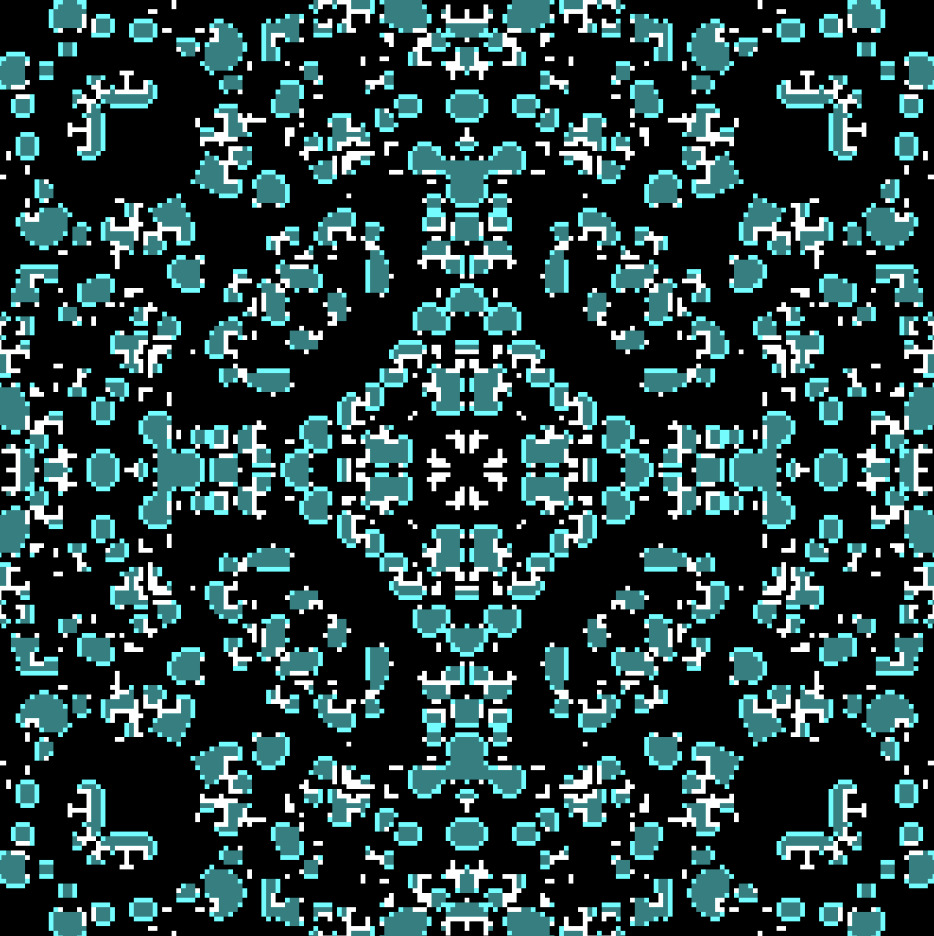
Complexity Explorables | The Prisoner’s Kaleidoscope

This explorable illustrates beautiful dynamical patterns that can be generated by a simple game theoretic model on a lattice. The core of the model is the Prisoner’s Dilemma, a legendary game analyzed in game theory. In the game, two players can choose to cooperate or defect. Depending on their choice, they receive a pre-specified payoffs. The payoffs are chosen such that it seems difficult to make the right strategy choice.

Read the full article at: www.complexity-explorables.org