
Urban Mobility

Laura Alessandretti, Michael Szell
In this chapter, we discuss urban mobility from a complexity science perspective. First, we give an overview of the datasets that enable this approach, such as mobile phone records, location-based social network traces, or GPS trajectories from sensors installed on vehicles. We then review the empirical and theoretical understanding of the properties of human movements, including the distribution of travel distances and times, the entropy of trajectories, and the interplay between exploration and exploitation of locations. Next, we explain generative and predictive models of individual mobility, and their limitations due to intrinsic limits of predictability. Finally, we discuss urban transport from a systemic perspective, including system-wide challenges like ridesharing, multimodality, and sustainable transport.

Read the full article at: arxiv.org
Autocatalytic Sets Arising in a Combinatorial Model of Chemical Evolution

Wim Hordijk, Mike Steel, and Stuart Kauffman

Life 2022, 12(11), 1703;

The idea that chemical evolution led to the origin of life is not new, but still leaves open the question of how exactly it could have led to a coherent and self-reproducing collective of molecules. One possible answer to this question was proposed in the form of the emergence of an autocatalytic set: a collection of molecules that mutually catalyze each other’s formation and that is self-sustaining given some basic “food” source. Building on previous work, here we investigate in more detail when and how autocatalytic sets can arise in a simple model of chemical evolution based on the idea of combinatorial innovation with random catalysis assignments. We derive theoretical results, and compare them with computer simulations. These results could suggest a possible step towards the (or an) origin of life.

Read the full article at: www.mdpi.com

Collective gradient perception with a flying robot swarm

Tugay Alperen Karagüzel, Ali Emre Turgut, A. E. Eiben & Eliseo Ferrante
Swarm Intelligence (2022)

In this paper, we study the problem of collective and emergent sensing with a flying robot swarm in which social interactions among individuals lead to following the gradient of a scalar field in the environment without the need of any gradient sensing capability. We proposed two methods—desired distance modulation and speed modulation—with and without alignment control. In the former, individuals modulate their desired distance to their neighbors and in the latter, they modulate their speed depending on the social interactions with their neighbors and measurements from the environment. Methods are systematically tested using two metrics with different scalar field models, swarm sizes and swarm densities. Experiments are conducted using: (1) a kinematic simulator, (2) a physics-based simulator, and (3) real nano-drone swarm. Results show that using the proposed methods, a swarm—composed of individuals lacking gradient sensing ability—is able to follow the gradient in a scalar field successfully. Results show that when individuals modulate their desired distances, alignment control is not needed but it still increases the performance. However, when individuals modulate their speed, alignment control is needed for collective motion. Real nano-drone experiments reveal that the proposed methods are applicable in real-life scenarios.

Read the full article at: link.springer.com

THE BACKBONE OF THE FINANCIAL INTERACTION NETWORK USING A MAXIMUM ENTROPY DISTRIBUTION

MAURICIO A. VALLE and FELIPE URBINA

Advances in Complex SystemsVol. 25, No. 04, 2250006 (2022)

We modeled the stocks of the financial system as a set of many interacting like spins derived from binary daily returns. From the empirical observation of these returns, we used a Boltzmann machine to infer a distribution of states equivalent to a maximum entropy distribution. This model describes the interaction couplings between each stock pair in the system, which can be considered a complete network with 𝑁(𝑁−1)/2 couplings. We then engage in a coupling removal process to find a critical graph that can describe the observed states of the system with the minimum number of edges. We interpret the critical graph as the backbone of the system, and it allows us to evaluate the importance of markets in their relation to others in the system. We also found that the structure of this critical graph is highly variable over time and appears to be dependent on the level of entropy of the system.

Read the full article at: www.worldscientific.com

Observing many researchers using the same data and hypothesis reveals a hidden universe of uncertainty

Nate Breznau, et al.

PNAS 119 (44) e2203150119

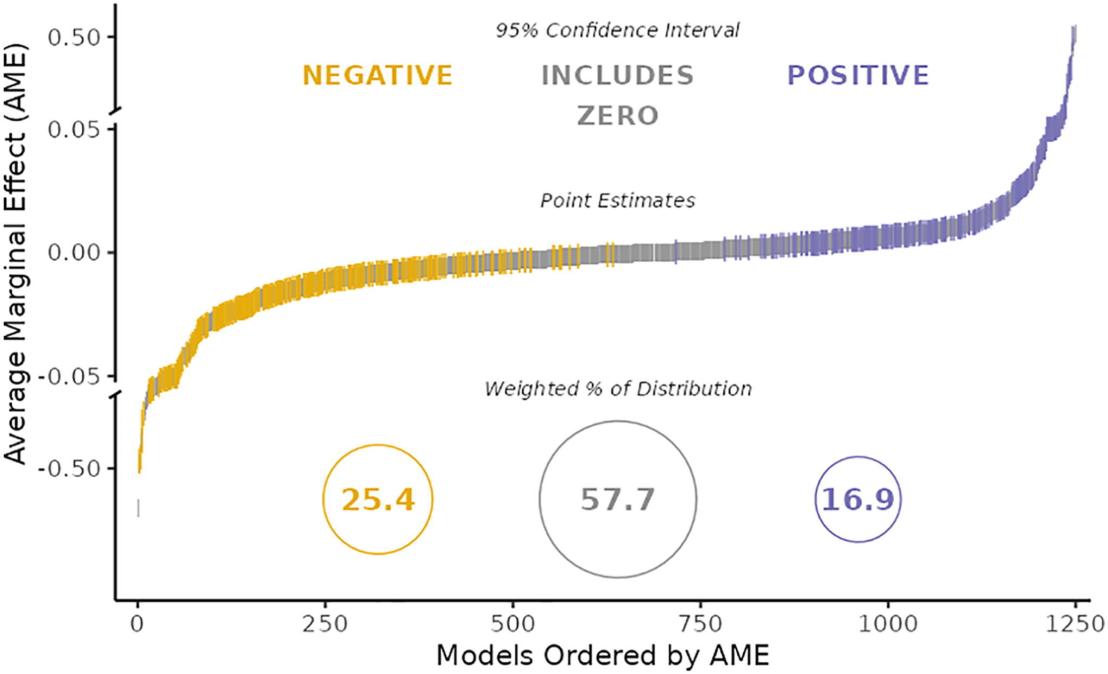
Will different researchers converge on similar findings when analyzing the same data? Seventy-three independent research teams used identical cross-country survey data to test a prominent social science hypothesis: that more immigration will reduce public support for government provision of social policies. Instead of convergence, teams’ results varied greatly, ranging from large negative to large positive effects of immigration on social policy support. The choices made by the research teams in designing their statistical tests explain very little of this variation; a hidden universe of uncertainty remains. Considering this variation, scientists, especially those working with the complexities of human societies and behavior, should exercise humility and strive to better account for the uncertainty in their work.

Read the full article at: www.pnas.org