
Online misinformation is linked to early COVID-19 vaccination hesitancy and refusal

Francesco Pierri, Brea L. Perry, Matthew R. DeVerna, Kai-Cheng Yang, Alessandro Flammini, Filippo Menczer & John Bryden
Scientific Reports volume 12, Article number: 5966 (2022)

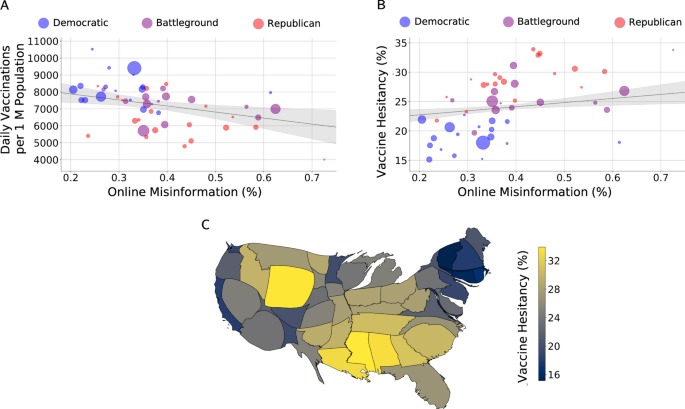
Widespread uptake of vaccines is necessary to achieve herd immunity. However, uptake rates have varied across U.S. states during the first six months of the COVID-19 vaccination program. Misbeliefs may play an important role in vaccine hesitancy, and there is a need to understand relationships between misinformation, beliefs, behaviors, and health outcomes. Here we investigate the extent to which COVID-19 vaccination rates and vaccine hesitancy are associated with levels of online misinformation about vaccines. We also look for evidence of directionality from online misinformation to vaccine hesitancy. We find a negative relationship between misinformation and vaccination uptake rates. Online misinformation is also correlated with vaccine hesitancy rates taken from survey data. Associations between vaccine outcomes and misinformation remain significant when accounting for political as well as demographic and socioeconomic factors. While vaccine hesitancy is strongly associated with Republican vote share, we observe that the effect of online misinformation on hesitancy is strongest across Democratic rather than Republican counties. Granger causality analysis shows evidence for a directional relationship from online misinformation to vaccine hesitancy. Our results support a need for interventions that address misbeliefs, allowing individuals to make better-informed health decisions.

Read the full article at: www.nature.com
Evolution of metamemory based on self-reference to own memory in artificial neural network with neuromodulation

Yusuke Yamato, Reiji Suzuki & Takaya Arita
Scientific Reports volume 12, Article number: 6233 (2022)

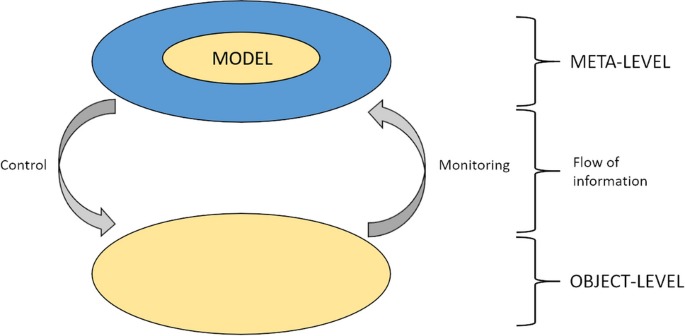
The ability of humans to self-monitor and control their memory processes is called metamemory and has been widely studied as a component of metacognition in cognitive psychology. Metamemory in non-human animals has also been investigated in recent years, although it had been regarded as a truly unique characteristic of human memory. We attempt to evolve artificial neural networks with neuromodulation, which have a metamemory function. Our constructive approach is expected to contribute, by introducing a novel dimension of evolutionary plausibility, to the discussion of animal experiments to detect metamemory. In this study, we demonstrate the evolution of neural networks that have a metamemory function based on the self-reference of memory, including the analysis of the evolved mechanism of metamemory. In addition, we discuss the similarity between the structure of the evolved neural network and the metamemory model defined by Nelson and Narens.

Read the full article at: www.nature.com
The probabilistic pool punishment proportional to the difference of payoff outperforms previous pool and peer punishment

Tetsushi Ohdaira 
Scientific Reports volume 12, Article number: 6604 (2022

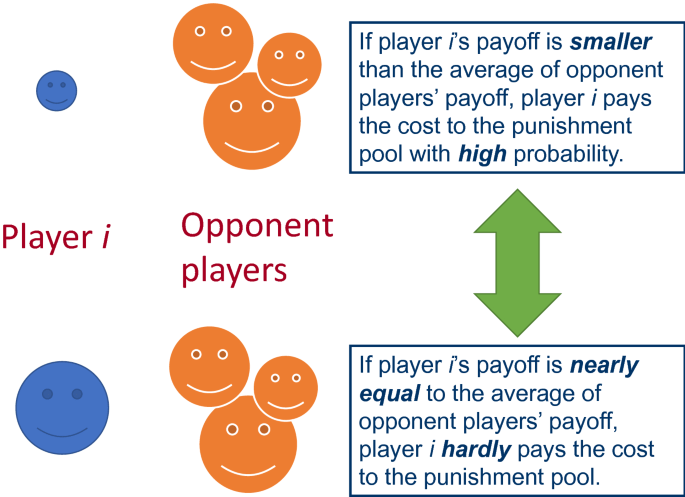
The public goods game is a multiplayer version of the prisoner’s dilemma game. In the public goods game, punishment on defectors is necessary to encourage cooperation. There are two types of punishment: peer punishment and pool punishment. Comparing pool punishment with peer punishment, pool punishment is disadvantageous in comparison with peer punishment because pool punishment incurs fixed costs especially if second-order free riders (those who invest in public goods but do not punish defectors) are not punished. In order to eliminate such a flaw of pool punishment, this study proposes the probabilistic pool punishment proportional to the difference of payoff. In the proposed pool punishment, each punisher pays the cost to the punishment pool with the probability proportional to the difference of payoff between his/her payoff and the average payoff of his/her opponents. Comparing the proposed pool punishment with previous pool and peer punishment, in pool punishment of previous studies, cooperators who do not punish defectors become dominant instead of pool punishers with fixed costs. However, in the proposed pool punishment, more punishers and less cooperators coexist, and such state is more robust against the invasion of defectors due to mutation than those of previous pool and peer punishment. The average payoff is also comparable to peer punishment of previous studies.

Read the full article at: www.nature.com

Biocosmology: Biology from a cosmological perspective

Marina Cortês, Stuart A. Kauffman, Andrew R. Liddle, Lee Smolin
The Universe contains everything that exists, including life. And all that exists, including life, obeys universal physical laws. Do those laws then give adequate foundations for a complete explanation of biological phenomena? We discuss whether and how cosmology and physics must be modified to be able to address certain questions which arise at their intersection with biology. We show that a universe that contains life, in the form it has on Earth, is in a certain sense radically non-ergodic, in that the vast majority of possible organisms will never be realized. We argue from this that complete explanations in cosmology require a mixture of reductionist and functional explanations.

Read the full article at: arxiv.org