Higher-Order Systems

Edited by Federico Battiston, Giovanni Petri

This book discusses its potential to model real-world systems and how considering their higher-order organization can lead to the emergence of novel dynamical behavior. Over the last decades, networks have emerged as the paradigmatic framework to model complex systems. Yet, as simple collections of nodes and links, they are intrinsically limited to pairwise interactions, limiting our ability to describe, understand, and predict complex phenomena which arise from higher-order interactions. Here we introduce the new modeling framework of higher-order systems, where hypergraphs and simplicial complexes are used to describe complex patterns of interactions among any number of agents. This book is intended both as a first introduction and an overview of the state of the art of this rapidly emerging field, serving as a reference for network scientists interested in better modeling the interconnected world we live in.

Read the full article at: link.springer.com
Recovery coupling in multilayer networks

Michael M. Danziger & Albert-László Barabási
Nature Communications volume 13, Article number: 955 (2022)

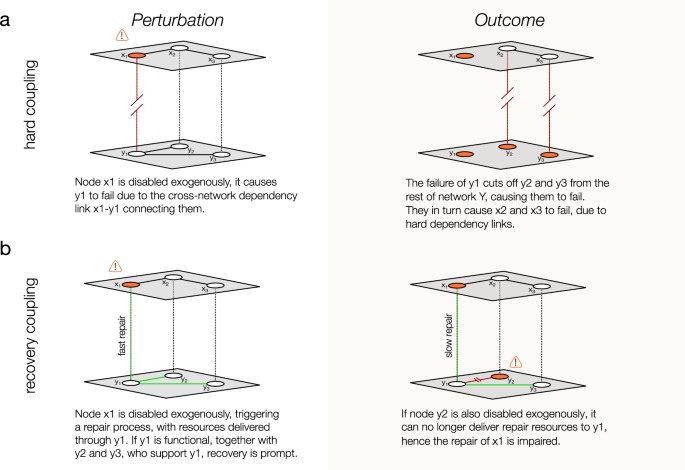
The increased complexity of infrastructure systems has resulted in critical interdependencies between multiple networks—communication systems require electricity, while the normal functioning of the power grid relies on communication systems. These interdependencies have inspired an extensive literature on coupled multilayer networks, assuming a hard interdependence, where a component failure in one network causes failures in the other network, resulting in a cascade of failures across multiple systems. While empirical evidence of such hard failures is limited, the repair and recovery of a network requires resources typically supplied by other networks, resulting in documented interdependencies induced by the recovery process. In this work, we explore recovery coupling, capturing the dependence of the recovery of one system on the instantaneous functional state of another system. If the support networks are not functional, recovery will be slowed. Here we collected data on the recovery time of millions of power grid failures, finding evidence of universal nonlinear behavior in recovery following large perturbations. We develop a theoretical framework to address recovery coupling, predicting quantitative signatures different from the multilayer cascading failures. We then rely on controlled natural experiments to separate the role of recovery coupling from other effects like resource limitations, offering direct evidence of how recovery coupling affects a system’s functionality.

Read the full article at: www.nature.com

Indirect influence in social networks as an induced percolation phenomenon

Jiarong Xie, Xiangrong Wang, Ling Feng, Jin-Hua Zhao, Wenyuan Liu, Yamir Moreno, and Yanqing Hu

PNAS Vol. 119 | No. 9

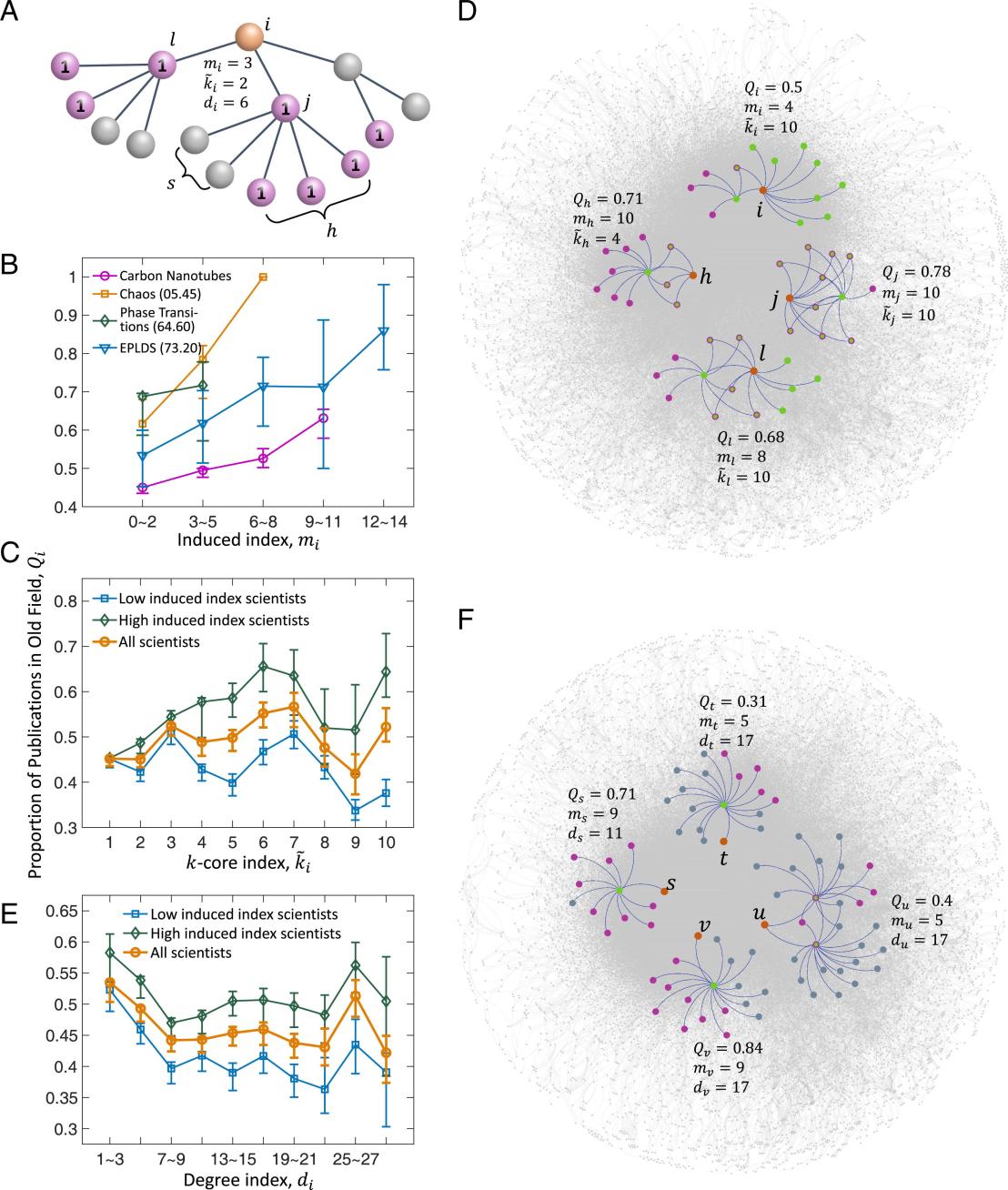
Increasing empirical evidence in diverse social and ecological systems has shown that indirect interactions play a pivotal role in shaping systems’ dynamical behavior. Our empirical study on collaboration networks of scientists further reveals that an indirect effect can dominate over direct influence in behavioral spreading. However, almost all models in existence focus on direct interactions, and the general impact of indirect interactions has not been studied. We propose a new percolation process, termed induced percolation, to characterize indirect interactions and find that indirect interactions raise a plethora of new phenomena, including the wide range of possible phase transitions. Such an indirect mechanism leads to very different spreading outcomes from that of direct influences.

Read the full article at: www.pnas.org

Measuring the seasonality of human contact patterns and its implications for the spread of respiratory infectious diseases 

Allisandra G. Kummer, Juanjuan Zhang, Maria Litvinova, Alessandro Vespignani, Hongjie Yu, Marco Ajelli

Considerable uncertainties surround the seasonality of respiratory infectious diseases. To which extent the observed seasonality is associated with biological reasons (e.g., virus survival rates, host immune dynamics) or human behavior remains unclear. Here, we investigate the association between temperature and human contact patterns using data collected through a contact diary-based survey between December 24, 2017 and May 30, 2018 in Shanghai, China. We found a significant inverse relationship between number of contacts and temperature seasonal trend (p=0.003) and temperature daily variation (p=0.009), with contacts increasing from 19.6 (95%CI: 14.9-22.2) in December to 24.4 (95%CI: 19.0-28.0) in January and declining to 10.9 (95%CI: 10.1-11.9) in May. This seasonal trend in number of contacts translates into a seasonal trend in the basic reproduction number – mean number of secondary cases generated by a typical infector in a fully susceptible population. By setting the basic reproduction number at 1.4 on December 24, weekly mean estimates showed a clear increasing trend during the fall, beginning at 1.14 (95%CI: 0.78-1.39) in October and reaching 2.02 (95%CI: 1.60-1.35) in February and then remaining below 1 in the summer. Epidemic dynamics comparable with those of seasonal influenza are obtained through model simulations when the infection is seeded during the fall; however, their dynamics become more complex when seeded after February (e.g., double peaks or no epidemic until after the summer). Our findings indicate a distinct seasonal trend among human contact patterns and highlight a behavioral mechanism contributing to the seasonality of respiratory infectious diseases.

Read the full article at: www.medrxiv.org