
Reintroducing Pierre Teilhard de Chardin to Modern Evolutionary Science

David Sloan Wilson

Pierre Teilhard Chardin (1881-1955) developed an evolutionary worldview that was both spiritual and consistent with the scientific knowledge of his day. He has been largely forgotten by modern evolutionary scientists but remains widely read by those who are inspired by his vision of conscious evolution leading to a planetary superorganism. This working paper examines the major tenets of Teilhard’s vision from a modern evolutionary perspective in an effort to integrate “hard” evolutionary science with conscious efforts to manage cultural change.

Read the full article at: humanenergy.io
Introduction to Chemical Organization Theory and Goal Directedness, Dr. Tomas Veloz

https://www.youtube.com/watch?v=j0reEVPsDvc

The “Origins of Goal-directedness” is a large research project of the Center Leo Apostel, supported by the John Templeton foundation. The project uses the formalism of Chemical Organization Theory (COT) to model self-organization and the emergence of autopoietic systems. Dr. Tomas Veloz is the co-leader of the project. Tomas iintroduces the basics of Chemical Organization Theory (COT) in a technical manner, and discuss relations with the notion of goal-directedness.

Watch at: www.youtube.com

How to fix democracy to fix health care

Vittoradolfo Tambone, Paola Frati, Francesco De Micco, Giampaolo Ghilardi, Vittorio Fineschi

The Lancet

Globally, we are seeing a side-effect of COVID-19: political violence.1 This effect usually shows itself in three steps: denial of scientific evidence, judgement of the intentions of political decision makers as a conspiracy, and civil disobedience and street violence.
This dynamic embodies violence on an intellectual, institutional, and physical level. Intellectual violence tends to break the trust between the scientific world and public opinion, institutional violence aims to divide politics from society, and physical violence shatters civil coexistence. In other words, it is the best strategy to destroy the idea of basic democracy, as recalled by Josiah Ober.2

Read the full article at: www.thelancet.com

Political audience diversity and news reliability in algorithmic ranking

Saumya Bhadani, Shun Yamaya, Alessandro Flammini, Filippo Menczer, Giovanni Luca Ciampaglia & Brendan Nyhan
Nature Human Behaviour (2022)

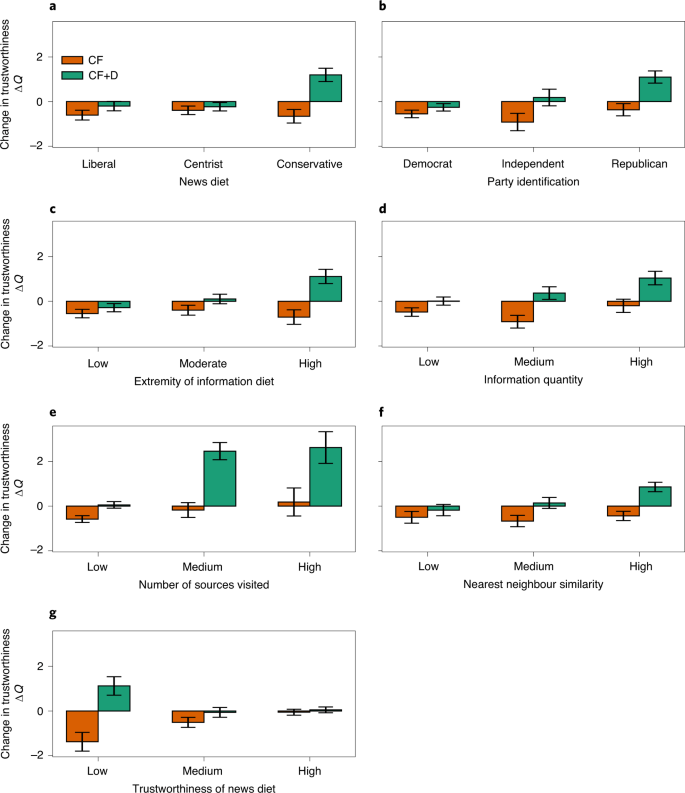
Newsfeed algorithms frequently amplify misinformation and other low-quality content. How can social media platforms more effectively promote reliable information? Existing approaches are difficult to scale and vulnerable to manipulation. In this paper, we propose using the political diversity of a website’s audience as a quality signal. Using news source reliability ratings from domain experts and web browsing data from a diverse sample of 6,890 US residents, we first show that websites with more extreme and less politically diverse audiences have lower journalistic standards. We then incorporate audience diversity into a standard collaborative filtering framework and show that our improved algorithm increases the trustworthiness of websites suggested to users—especially those who most frequently consume misinformation—while keeping recommendations relevant. These findings suggest that partisan audience diversity is a valuable signal of higher journalistic standards that should be incorporated into algorithmic ranking decisions. 

Read the full article at: www.nature.com