
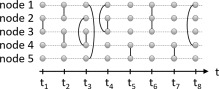
The synchronized dynamics of time-varying networks

Dibakar Ghosh, et al.

Physics Reports
Volume 949, 23 February 2022, Pages 1-63

Over the past two decades, complex network theory provided the ideal framework for investigating the intimate relationships between the topological properties characterizing the wiring of connections among a system’s unitary components and its emergent synchronized functioning. An increased number of setups from the real world found therefore a representation in terms of graphs, while more and more sophisticated methods were developed with the aim of furnishing a realistic description of the connectivity patterns under study. In particular, a significant number of systems in physics, biology and social science features a time-varying nature of the interactions among their units. We here give a comprehensive review of the major results obtained by contemporary studies on the emergence of synchronization in time-varying networks. In particular, two paradigmatic frameworks will be described in detail. The first encompasses those systems where the time dependence of the nodes’ connections is due to adaptation, external forces, or any other process affecting each of the links of the network. The second framework, instead, corresponds to the case in which the structural evolution of the graph is due to the movement of the nodes, or agents, in physical spaces and to the fact that interactions may be ruled by space-dependent laws in a way that connections are continuously switched on and off in the course of the time. Finally, our report ends with a short discussion on promising directions and open problems for future studies.

Read the full article at: www.sciencedirect.com
Membrane rigidity regulates E. coli proliferation rates

Samuel Salinas-Almaguer, Michael Mell, Victor G. Almendro-Vedia, Macarena Calero, Kevin Carlo Martín Robledo-Sánchez, Carlos Ruiz-Suarez, Tomás Alarcón, Rafael A. Barrio, Aurora Hernández-Machado & Francisco Monroy 
Scientific Reports volume 12, Article number: 933 (2022)

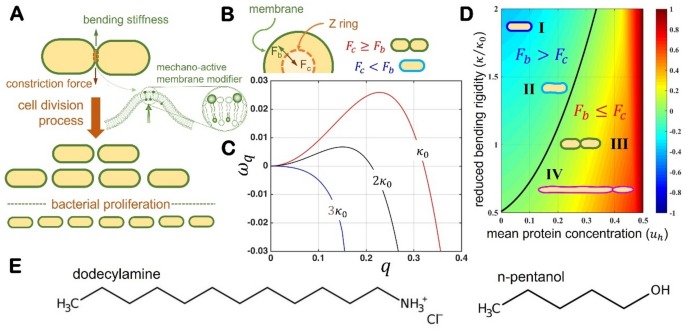
Combining single cell experiments, population dynamics and theoretical methods of membrane mechanics, we put forward that the rate of cell proliferation in E. coli colonies can be regulated by modifiers of the mechanical properties of the bacterial membrane. Bacterial proliferation was modelled as mediated by cell division through a membrane constriction divisome based on FtsZ, a mechanically competent protein at elastic interaction against membrane rigidity. Using membrane fluctuation spectroscopy in the single cells, we revealed either membrane stiffening when considering hydrophobic long chain fatty substances, or membrane softening if short-chained hydrophilic molecules are used. Membrane stiffeners caused hindered growth under normal division in the microbial cultures, as expected for membrane rigidification. Membrane softeners, however, altered regular cell division causing persistent microbes that abnormally grow as long filamentous cells proliferating apparently faster. We invoke the concept of effective growth rate under the assumption of a heterogeneous population structure composed by distinguishable individuals with different FtsZ-content leading the possible forms of cell proliferation, from regular division in two normal daughters to continuous growing filamentation and budding. The results settle altogether into a master plot that captures a universal scaling between membrane rigidity and the divisional instability mediated by FtsZ at the onset of membrane constriction.

Read the full article at: www.nature.com

Open Call – Conference Complex Systems (CCS 2023)

The Complex Systems Society (CSS) organizes every year a main conference (CCS) – the most important annual meeting for the complex systems research community.

The Complex Systems Society invites bids to host CCS2023.

The conference is generally held in September/October of each year.

The deadline for proposals submission is March 15, 2022.

Read the full article at: cssociety.org

Mediterranean School of Complex Networks 2022

we are calling for applications from students and young researchers in Network Science for the 7th edition of the Mediterranean School of Complex Networks, which will take place in Salina (Italy), 25 Jun – 02 Jul 2022.

From 2022 the Mediterranean School of Complex Networks and the International School of Informatics and Dynamics in Complex Networks have joined their forces into a single event.
The new board of directors include, in alphabetic order: Prof. Alex Arenas (URV, Spain), Prof. Vincenza Carchiolo (UniCT, Italy), Prof. Manlio De Domenico (UniPD, Italy), Prof. Mattia Frasca (UniCT, Italy) and Prof. Giuseppe Mangioni (UniCT, Italy)

Early applications are expected before 15 March 2022 (no payment required at this step). Seats are limited to 30 in-person attendants and 70 online attendants, due to COVID19 restrictions.

Since its first edition in 2014, our School trained more than 230 early-career researchers in Network Science from 4 continents. All details about previous editions, location, important dates and travel are available at the official website: http://mediterraneanschoolcomplex.net/
You might also want to watch the School teaser: https://www.youtube.com/watch?v=dR1apC8-HZY

Please, note that for the youngest researchers (no more than two years from their PhD completion) who are members of the Complex Systems Society, we will grant up to two scholarships covering the registration fee. Prizes are kindly sponsored by the MDPI journal Condensed Matter

More at: mediterraneanschoolcomplex.net

Nanowars can cause epidemic resurgence and fail to promote cooperation

Dirk Helbing, Matjaž Perc
In a non-sustainable, “over-populated” world, what might the use of nanotechnology-based targeted, autonomous weapons mean for the future of humanity? In order to gain some insights, we make a simplified game-theoretical thought experiment. We consider a population where agents play the public goods game, and where in parallel an epidemic unfolds. Agents that are infected defectors are killed with a certain probability and replaced by susceptible cooperators. We show that such “nanowars”, even if aiming to promote good behavior and planetary health, fail not only to promote cooperation, but they also significantly increase the probability of repetitive epidemic waves. In fact, newborn cooperators turn out to be easy targets for defectors in their neighborhood. Therefore, counterintuitively, the discussed intervention may even have the opposite effect as desired, promoting defection. We also find a critical threshold for the death rate of infected defectors, beyond which resurgent epidemic waves become a certainty. In conclusion, we urgently call for international regulation of nanotechnology and autonomous weapons.

Read the full article at: arxiv.org