
In nonreciprocal systems, where Newton’s third law falls apart, “exceptional points” are helping researchers understand phase transitions and possibly other phenomena.
Read the full article at: www.quantamagazine.org
Networking the complexity community since 1999
In nonreciprocal systems, where Newton’s third law falls apart, “exceptional points” are helping researchers understand phase transitions and possibly other phenomena.
Read the full article at: www.quantamagazine.org

Investigations of the simplest possible clocks have revealed their fundamental limitations — as well as insights into the nature of time itself.
Read the full article at: www.quantamagazine.org
A transdisciplinary group of thinkers consider time and its relation to an Interplanetary future.
~~~
When imagining interplanetary life and human civilization in space, it’s always a matter of time. Philosophers and physicists from Aristotle to Carlo Rovelli have deeply considered the nature of time. Given the scale of the social-technical systems required for any off-Earth endeavor, however, this age-old discussion requires broader input.
Complex systems emerge from a multitude of time-scales, clocks, arrows of time, and therefore a multitude of rates at which things come together and fall apart. But our experience of time seems to vary with the perspective we take on a subject: the lifespan of an organism seems to be the result of constraints of mass and energy; a firm, the flows and stocks of capital and labor; a state, the developments of its people and their political economy.
How do these different time-scales interrelate and inform one another on Earth today? What might a reconsideration of the complexity of time add to our collective effort to sustain life on and with other planets? And how can we create scalable yet adaptable social-technical systems that work together to achieve our interplanetary futures?
This panel will bring together researchers, scientists and theorists to attempt an answer to these questions. They will explore the possible methods and tools for complex collaboration, and consider what it will take to support and grow life beyond the Earth while keeping, at the center of it all, the beating heart of time.
Participants:
Laura Maguire
Zara Mirmalek
Geoffrey West
Sean Carroll
Moderator: David Krakauer
Watch at: www.youtube.com
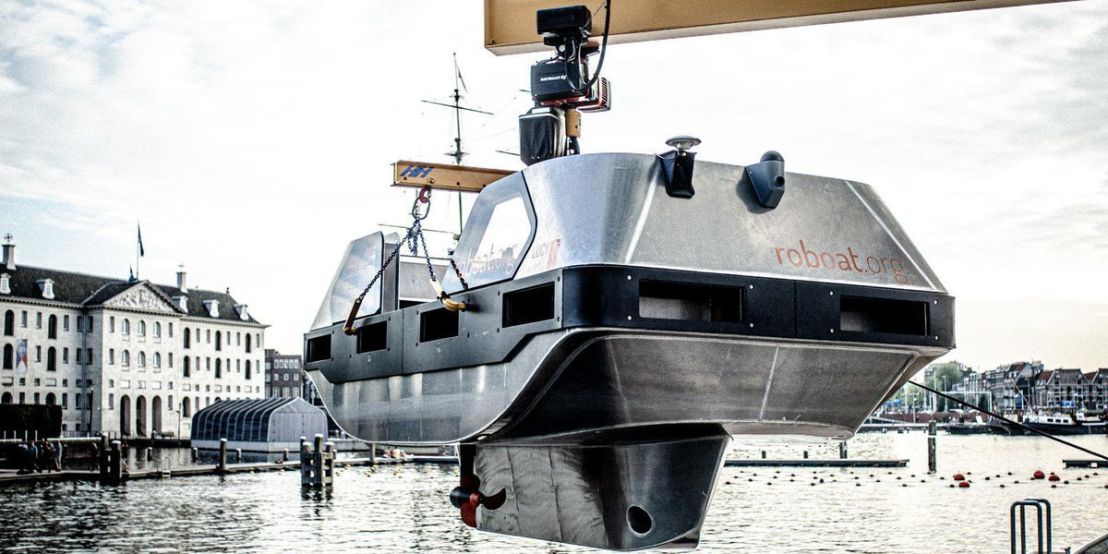
It’s become painfully obvious over the past few years just how difficult fully autonomous cars are. This isn’t a dig at any of the companies developing autonomous cars (unless they’re the sort of company who keeps on making ludicrous promises about full autonomy, of course)— it’s just that the real world is a complex place for full autonomy, and despite the relatively well constrained nature of roads, there’s still too much unpredictability for robots to operate comfortably outside of relatively narrow restrictions.
Where autonomous vehicles have had the most success is in environments with a lot of predictability and structure, which is why I really like the idea of autonomous urban boats designed for cities with canals. MIT has been working on these for years, and they’re about to introduce them to the canals of Amsterdam as cargo shuttles and taxis.
Read the full article at: spectrum.ieee.org
With prospects of herd immunity fading, endemic COVID-19 is upon us, and new “whole of society” approaches are needed.
Read the full article at: www.mckinsey.com

