Basins with Tentacles

Yuanzhao Zhang and Steven H. Strogatz
Phys. Rev. Lett. 127, 194101

To explore basin geometry in high-dimensional dynamical systems, we consider a ring of identical Kuramoto oscillators. Many attractors coexist in this system; each is a twisted periodic orbit characterized by a winding number q, with basin size proportional to e^−(kq^2). We uncover the geometry behind this size distribution and find the basins are octopuslike, with nearly all their volume in the tentacles, not the head of the octopus (the ball-like region close to the attractor). We present a simple geometrical reason why basins with tentacles should be common in high-dimensional systems.

Read the full article at: link.aps.org

Systematic shifts in scaling behavior based on organizational strategy in universities

Taylor RC, Liang X, Laubichler MD, West GB, Kempes CP, Dumas M (2021) Systematic shifts in scaling behavior based on organizational strategy in universities. PLoS ONE 16(10): e0254582. https://doi.org/10.1371/journal.pone.0254582

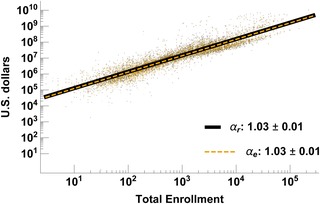
To build better theories of cities, companies, and other social institutions such as universities, requires that we understand the tradeoffs and complementarities that exist between their core functions, and that we understand bounds to their growth. Scaling theory has been a powerful tool for addressing such questions in diverse physical, biological and urban systems, revealing systematic quantitative regularities between size and function. Here we apply scaling theory to the social sciences, taking a synoptic view of an entire class of institutions. The United States higher education system serves as an ideal case study, since it includes over 5,800 institutions with shared broad objectives, but ranges in strategy from vocational training to the production of novel research, contains public, nonprofit and for-profit models, and spans sizes from 10 to roughly 100,000 enrolled students. We show that, like organisms, ecosystems and cities, universities and colleges scale in a surprisingly systematic fashion following simple power-law behavior. Comparing seven commonly accepted sectors of higher education organizations, we find distinct regimes of scaling between a school’s total enrollment and its expenditures, revenues, graduation rates and economic added value. Our results quantify how each sector leverages specific economies of scale to address distinct priorities. Taken together, the scaling of features within a sector along with the shifts in scaling across sectors implies that there are generic mechanisms and constraints shared by all sectors, which lead to tradeoffs between their different societal functions and roles. We highlight the strong complementarity between public and private research universities, and community and state colleges, that all display superlinear returns to scale. In contrast to the scaling of biological systems, our results highlight that much of the observed scaling behavior is modulated by the particular strategies of organizations rather than an immutable set of constraints.

Read the full article at: journals.plos.org

Mathematical models to explain the origin of urban scaling laws: a synthetic review

Fabiano L. Ribeiro, Diego Rybski
The quest for a theory of cities that could offer a quantitative and systematic approach to manage cities is at the top priority, given the challenges humanity faces due to the increasing urbanization and densification of cities. If such a theory is feasible, then its formulation must be in a mathematical way. As a contribution to organizing the mathematical ideas that deal with such a systematic way of understanding urban phenomena, we present this material, concentrating on one important aspect of what recently has been called the new science of cities. In this paper, we review the main mathematical models present in the literature that aim at explaining the origin and emergence of urban scaling. We intend to present the models, identify similarities and connections between them, and find situations in which different models lead to the same output. In addition, we report situations in which some ideas initially introduced in a particular model can also be introduced in another model, generating more diversification and increasing the scope of the models. The models treated in this paper explain urban scaling from different premises: from gravity ideas, passing through densification ideas and cites’ geometry, to a hierarchical organization and socio-network properties. We also investigate scenarios in which these different fundamental ideas could be interpreted as similar — where the similarity is likely but not obvious. Furthermore, in what concerns the gravity idea, we propose a general framework that includes all gravity models analyzed as a particular case.

Read the full article at: arxiv.org

Complex Networks: Theory, Methods, and Applications – Lake Como School of Advanced Studies – May 16-20, 2022

Many real systems can be modeled as networks, where the elements of the system are nodes and interactions between elements are edges. An even larger set of systems can be modeled using dynamical processes on networks, which are in turn affected by the dynamics. Networks thus represent the backbone of many complex systems, and their theoretical and computational analysis makes it possible to gain insights into numerous applications. Networks permeate almost every conceivable discipline —including sociology, transportation, economics and finance, biology, and myriad others — and the study of “network science” has thus become a crucial component of modern scientific education.

The school “Complex Networks: Theory, Methods, and Applications” offers a succinct education in network science. It is open to all aspiring scholars in any area of science or engineering who wish to study networks of any kind (whether theoretical or applied), and it is especially addressed to doctoral students and young postdoctoral scholars. The aim of the school is to deepen into both theoretical developments and applications in targeted fields.

Read the full article at: ntmf.lakecomoschool.org

From Liveness to “Lifeness”: Autopoiesis and an Enactive View of Performance

Maiya Murphy

Constructivist Foundations 17(1): 070–081

Context: Unsettled issues within the theatre and performance liveness debates include how to account for co-presence, what to make of intangible and elusive qualities often attributed to live encounters, and how to account for the coexistence of concrete and intangible phenomena within liveness. Problem: The problem is two-pronged: (a) the liveness debates in theatre and performance remain ripe for further development beyond these unsettled issues and (b) theatre has not yet been fully explored as an experimental platform for researching human-made systems and their consequences. Method: Through three case studies of different kinds of performance, I home in on three main conceptions of systemic life in performance – biological, cybernetic, and enactive – anchored in conceptions of autopoiesis. Results: I show how an enactive view with a cybernetic flair can usefully redefine the elusive phenomena of “liveness” as concrete biocognitive synchronicities between the larger system of the performance and the individual system of the spectator, no matter the performance style. Implications: This systemic view reorients what might be considered “live” in the discipline of theatre and performance, moving the liveness debates to matters of process, organizational structure, and observation. By resituating these debates in theatre and performance, performance events themselves are revealed as robust and diverse platforms for researching processes and consequences of systemic resonances between human and human-made systems. Constructivist content: This article suggests that an enactive view of “liveness” in performance, complemented with the cybernetic interest in observation, can make use of the explanatory power of biological and cybernetic accounts of autopoiesis, while explicitly pointing toward the resonances between biology, cognition, and the sense-making practices of theatre and performance.

Read the full article at: constructivist.info