Coevolution of actions, personal norms, and beliefs about others in social dilemmas

Sergey Gavrilets

Human decision-making is affected by a diversity of factors including material cost-benefit considerations, normative and cultural influences, learning, and conformity with peers and external authorities (e.g., cultural, religious, political, organizational). Also important are their dynamically changing personal perception of the situation and beliefs about actions and expectations of others as well as psychological phenomena such as cognitive dissonance, and social projection. To better understand these processes, I develop a modeling framework describing the joint dynamics of actions and attitudes of individuals and their beliefs about actions and attitudes of their group-mates. I consider which norms get internalized and which factors control beliefs about others. I predict that the long-term average characteristics of groups are largely determined by a balance between material payoffs and the values promoted by the external authority. Variation around these averages largely reflects variation in individual costs and benefits mediated by individual psychological characteristics. The efforts of an external authority to change the group behavior in a certain direction can, counter-intuitively, have an opposite effect on individual behavior. I consider how various factors can affect differences between groups and societies in tightness/looseness of their social norms. I show that the most important factors are social heterogeneity, societal threat, effects of the authority, cultural variation in the degree of collectivism/individualism, the population size, and the subsistence style. My results can be useful for achieving a better understanding of human social behavior, historical and current social processes, and in developing more efficient policies aiming to modify social behavior

Read the full article at: osf.io

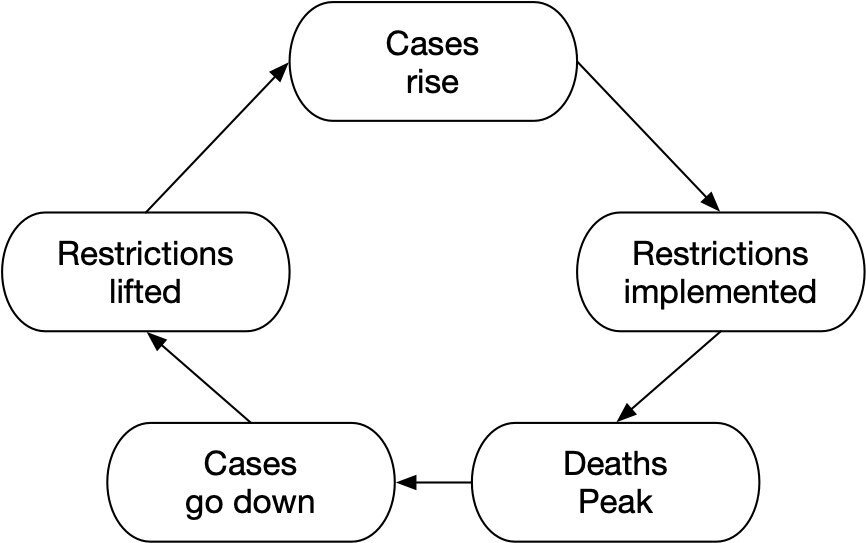
When will the COVID-19 pandemic end?

This article updates our perspectives on when the coronavirus pandemic will end to reflect the latest information on vaccine rollout, variants of concern, and disease progression. In the United Kingdom and the United States, we see progress toward a transition to normalcy during the second quarter of 2021. The new wave of cases in the European Union means that a similar transition is likely to come later there, in the late second or third quarter. Improved vaccine availability makes herd immunity most likely in the third quarter for the United Kingdom and the United States and in the fourth quarter for the European Union, but risks threaten that timeline. The timeline in other countries will depend on seven crucial variables. And when herd immunity is reached, the risks will not vanish; herd immunity may prove temporary or be limited to regions in a country.

Read the full article at: www.mckinsey.com

Modularity and dynamics on complex networks

Lambiotte, R & Schaub, M

Complex networks are typically not homogeneous, as they tend to display an array of structures at different scales. A feature that has attracted a lot of research is their modular organisation, i.e., networks may often be considered as being composed of certain building blocks, or modules. In this book, we discuss a number of ways in which this idea of modularity can be conceptualised, focusing specifically on the interplay between modular network structure and dynamics taking place on a network. We discuss, in particular, how modular structure and symmetries may impact on network dynamics and, vice versa, how observations of such dynamics may be used to infer the modular structure. We also revisit several other notions of modularity that have been proposed for complex networks and show how these can be related to and interpreted from the point of view of dynamical processes on networks. Several references and pointers for further discussion and future work should inform practitioners and researchers, and may motivate further studies in this area at the core of Network Science.

Download the book at: ora.ox.ac.uk

Editorial: Complexity and Self-Organization

Carlos Gershenson, Daniel Polani and Georg Martius

Front. Robot. AI, 26 March 2021

Complexity occurs when relevant interactions prevent the study of elements of a system in isolation. These interactions between elements may lead to the self-organization of the system. A system can be described as self-organizing when its global properties are a product of the interactions of its components. Complexity and self-organization are prevalent in a broad variety of systems. Because of this, they have been studied from multiple perspectives and disciplines, leading naturally to transdisciplinary studies.

The scientific study of complexity and self-organization was limited before the popularization of computers in the 1980s, as previous tools were insufficient to deal with hundreds or thousands of variables. Thus, computer science has been essential for these studies.

In computational intelligence, complexity and self-organization have been studied and exploited with different purposes. The aim of this Research Topic was to bring together novel research into a coherent collection, spanning from theory and methods to simulations and applications.

Read the full article at: www.frontiersin.org