
Navigating the landscape of multiplayer games

Shayegan Omidshafiei, Karl Tuyls, Wojciech M. Czarnecki, Francisco C. Santos, Mark Rowland, Jerome Connor, Daniel Hennes, Paul Muller, Julien Pérolat, Bart De Vylder, Audrunas Gruslys & Rémi Munos
Nature Communications volume 11, Article number: 5603 (2020) https://www.nature.com/articles/s41467-020-19244-4

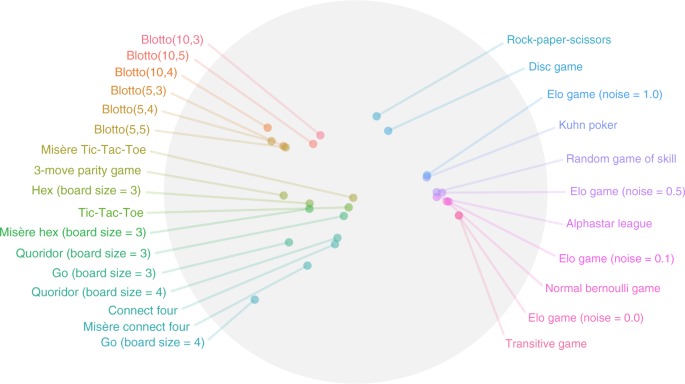
Multiplayer games have long been used as testbeds in artificial intelligence research, aptly referred to as the Drosophila of artificial intelligence. Traditionally, researchers have focused on using well-known games to build strong agents. This progress, however, can be better informed by characterizing games and their topological landscape. Tackling this latter question can facilitate understanding of agents and help determine what game an agent should target next as part of its training. Here, we show how network measures applied to response graphs of large-scale games enable the creation of a landscape of games, quantifying relationships between games of varying sizes and characteristics. We illustrate our findings in domains ranging from canonical games to complex empirical games capturing the performance of trained agents pitted against one another. Our results culminate in a demonstration leveraging this information to generate new and interesting games, including mixtures of empirical games synthesized from real world games.

Patterns of ties in problem-solving networks and their dynamic properties

Dan Braha 
Scientific Reports volume 10, Article number: 18137 (2020) 

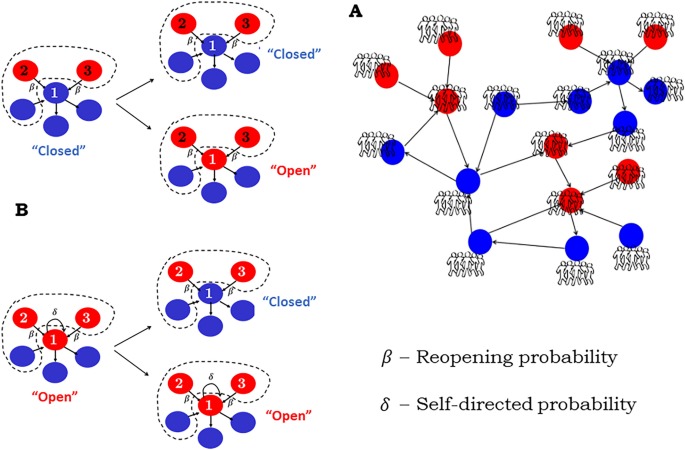
Understanding the functions carried out by network subgraphs is important to revealing the organizing principles of diverse complex networks. Here, we study this question in the context of collaborative problem-solving, which is central to a variety of domains from engineering and medicine to economics and social planning. We analyze the frequency of all three- and four-node subgraphs in diverse real problem-solving networks. The results reveal a strong association between a dynamic property of network subgraphs—synchronizability—and the frequency and significance of these subgraphs in problem-solving networks. In particular, we show that highly-synchronizable subgraphs are overrepresented in the networks, while poorly-synchronizable subgraphs are underrepresented, suggesting that dynamical properties affect their prevalence, and thus the global structure of networks. We propose the possibility that selective pressures that favor more synchronizable subgraphs could account for their abundance in problem-solving networks. The empirical results also show that unrelated problem-solving networks display very similar local network structure, implying that network subgraphs could represent organizational routines that enable better coordination and control of problem-solving activities. The findings could also have potential implications in understanding the functionality of network subgraphs in other information-processing networks, including biological and social networks.

The Manufacture of Political Echo Chambers by Follow Train Abuse on Twitter

Christopher Torres-Lugo, Kai-Cheng Yang, Filippo Menczer

A growing body of evidence points to critical vulnerabilities of social media, such as the emergence of partisan echo chambers and the viral spread of misinformation. We show that these vulnerabilities are amplified by abusive behaviors associated with so-called ”follow trains” on Twitter, in which long lists of like-minded accounts are mentioned for others to follow. This leads to the formation of highly dense and hierarchical echo chambers. We present the first systematic analysis of U.S. political train networks, which involve many thousands of hyper-partisan accounts. These accounts engage in various suspicious behaviors, including some that violate platform policies: we find evidence of inauthentic automated accounts, artificial inflation of friends and followers, and abnormal content deletion. The networks are also responsible for amplifying toxic content from low-credibility and conspiratorial sources. Platforms may be reluctant to curb this kind of abuse for fear of being accused of political bias. As a result, the political echo chambers manufactured by follow trains grow denser and train accounts accumulate influence; even political leaders occasionally engage with them.

Social Trajectory Planning for Urban Autonomous Surface Vessels

Shinkyu Park; Michal Cap; Javier Alonso-Mora; Carlo Ratti; Daniela Rus

IEEE Transactions on Robotics

In this article, we propose a trajectory planning algorithm that enables autonomous surface vessels to perform socially compliant navigation in a city’s canal. The key idea behind the proposed algorithm is to adopt an optimal control formulation in which the deviation of movements of the autonomous vessel from nominal movements of human-operated vessels is penalized. Consequently, given a pair of origin and destination points, it finds vessel trajectories that resemble those of human-operated vessels. To formulate this, we adopt kernel density estimation (KDE) to build a nominal movement model of human-operated vessels from a prerecorded trajectory dataset, and use a Kullback–Leibler control cost to measure the deviation of the autonomous vessel’s movements from the model. We establish an analogy between our trajectory planning approach and the maximum entropy inverse reinforcement learning (MaxEntIRL) approach to explain how our approach can learn the navigation behavior of human-operated vessels. On the other hand, we distinguish our approach from the MaxEntIRL approach in that it does not require well-defined bases, often referred to as features, to construct its cost function as required in many of inverse reinforcement learning approaches in the trajectory planning context. Through experiments using a dataset of vessel trajectories collected from the automatic identification system, we demonstrate that the trajectories generated by our approach resemble those of human-operated vessels and that using them for canal navigation is beneficial in reducing head-on encounters between vessels and improving navigation safety.

How Do You Know When Society Is About to Fall Apart?

“Civilizations are fragile, impermanent things,” Tainter writes. Nearly every one that has ever existed has also ceased to exist, yet “understanding disintegration has remained a distinctly minor concern in the social sciences.” It is only a mild overstatement to suggest that before Tainter, collapse was simply not a thing.

Source: https://www.nytimes.com/2020/11/04/magazine/societal-collapse.html