
Tag: networks

The Brain We Still Don’t Understand | Gabriele Scheler

On this episode of BeyondPhrenology, I speak with Dr. Gabriele Scheler (Carl Correns Foundation for Mathematical Biology) about the state of AI and neuroscience—past the hype, and closer to their limits.

We begin by revisiting what AI once meant: symbolic systems, logic, early neural networks, and the long-standing divide between learning and reasoning. Against that backdrop, we examine the current moment, where large language models dominate the conversation but remain, in many ways, underwhelming relative to the broader ambitions of artificial intelligence.

The discussion then turns to neuroscience, where despite decades of experimental progress, a central problem remains unresolved: the absence of integrated, functional models of cognition. We explore the consequences of a synapse-centric view, the limits of current theoretical approaches, and why accumulating more data—without perspective—fails to move the field forward. Along the way, we touch on issues that rarely make it into official narratives: the role of funding structures, the drift toward mediocrity, and the persistence of poorly framed questions.

From there, we consider an alternative direction. Dr. Scheler outlines a neuron-centric, function-driven approach to modeling the brain—one that emphasizes modularity, one-shot learning, internal inference, and decision-making as a unifying principle across cognition and emotion. Framed through evolution, this perspective highlights how biological systems bridge scales of structure and function in ways current models largely fail to capture.

The episode closes by reflecting on what this means for the future: not just for AI, but for science itself—how research cultures shift, why fascination alone is not enough, and what it would take to build models that are not just complex, but actually explanatory.
Watch at: www.youtube.com
Diffusion of complex contagions is shaped by a trade-off between reach and reinforcement

Allison Wan, Christoph Riedl, and David Lazer
PNAS 122 (28) e2422892122
How does social network structure amplify or stifle behavior diffusion? Existing theory suggests that when social reinforcement makes the adoption of behavior more likely, it should spread more—both farther and faster—on clustered networks with redundant ties. Conversely, if adoption does not benefit from social reinforcement, it should spread more on random networks which avoid such redundancies. We develop a model of behavior diffusion with tunable probabilistic adoption and social reinforcement parameters to systematically evaluate the conditions under which clustered networks spread behavior better than random networks. Using simulations and analytical methods, we identify precise boundaries in the parameter space where one network type outperforms the other or they perform equally. We find that, in most cases, random networks spread behavior as far or farther than clustered networks, even when social reinforcement increases adoption. Although we find that probabilistic, socially reinforced behaviors can spread farther on clustered networks in some cases, this is not the dominant pattern. Clustered networks are even less advantageous when individuals remain influential for longer after adopting, have more neighbors, or need more neighbors before social reinforcement takes effect. Under such conditions, clustering tends to help only when adoption is nearly deterministic, which is not representative of socially reinforced behaviors more generally. Clustered networks outperform random networks by a 5% margin in only 22% of the parameter space under its most favorable conditions. This pattern reflects a fundamental trade-off: Random ties enhance reach, while clustered ties enhance social reinforcement.

https://www.pnas.org/doi/abs/10.1073/pnas.2422892122

Account credibility inference based on news-sharing networks

Bao Tran Truong, Oliver Melbourne Allen & Filippo Menczer
EPJ Data Science volume 13, Article number: 10 (2024)

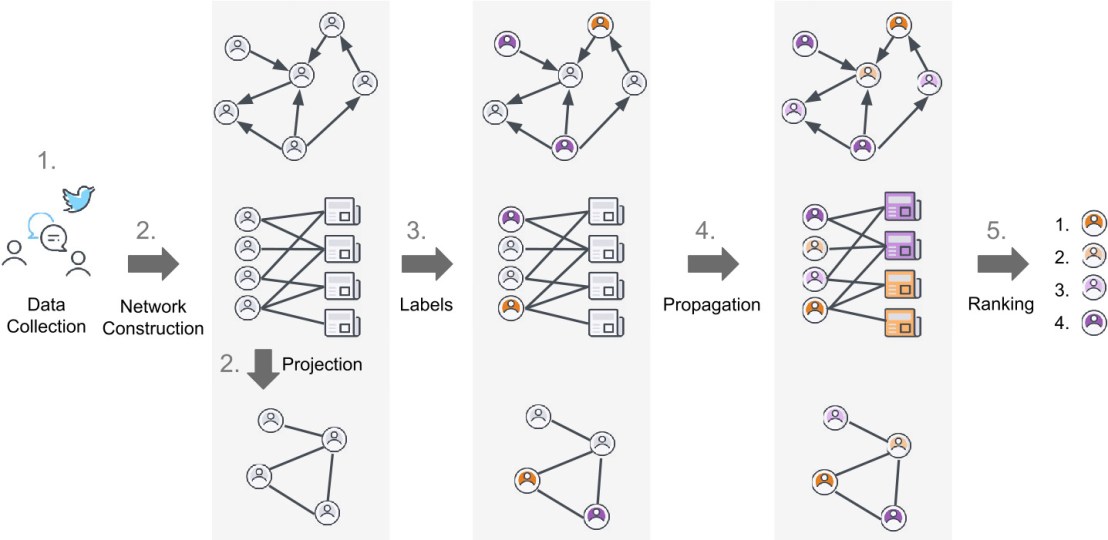
The spread of misinformation poses a threat to the social media ecosystem. Effective countermeasures to mitigate this threat require that social media platforms be able to accurately detect low-credibility accounts even before the content they share can be classified as misinformation. Here we present methods to infer account credibility from information diffusion patterns, in particular leveraging two networks: the reshare network, capturing an account’s trust in other accounts, and the bipartite account-source network, capturing an account’s trust in media sources. We extend network centrality measures and graph embedding techniques, systematically comparing these algorithms on data from diverse contexts and social media platforms. We demonstrate that both kinds of trust networks provide useful signals for estimating account credibility. Some of the proposed methods yield high accuracy, providing promising solutions to promote the dissemination of reliable information in online communities. Two kinds of homophily emerge from our results: accounts tend to have similar credibility if they reshare each other’s content or share content from similar sources. Our methodology invites further investigation into the relationship between accounts and news sources to better characterize misinformation spreaders.

Read the full article at: epjdatascience.springeropen.com

How Output Outweighs Input and Interlocutors Matter for Study-Abroad SLA: Computational Social Network Analysis of Learner Interactions (winner, Best of MLJ for 2022 paper award)

MICHAŁ B. PARADOWSKI, AGNIESZKA CIERPICH–KOZIEŁ, CHIH–CHUN CHEN, JEREMI K. OCHAB

MLJ Volume106, Issue4 Winter 2022 Pages 694-725

This data-driven study framed in the interactionist approach investigates the influence of social graph topology and peer interaction dynamics among foreign exchange students enrolled in an intensive German language course on second language acquisition (SLA) outcomes. Applying the algorithms and metrics of computational social network analysis (SNA), we find that (a) the best predictor of target language (TL) performance is reciprocal interactions in the language being acquired, (b) the proportion of output in the TL is a stronger predictor than input (Principle of Proportional Output), (c) there is a negative relationship between performance and interactions with same-first-language speakers, (d) a significantly underperforming English native-speaker dominated cluster is present, and (e) there are more intense interactions taking place between students of different proficiency levels. Unlike previous study abroad social network research concentrating on the microlevel of individual learners’ egocentric networks and presenting an emic view only, this study constitutes the first application of computational SNA to a complete learner network (sociogram). It provides new insights into the link between social relations and SLA with an etic perspective, showing how social network configuration and peer learner interaction are stronger predictors of TL performance than individual factors such as attitude or motivation, and offering a rigorous methodology for investigating the phenomenon.

Read the full article at: onlinelibrary.wiley.com