The Sci-hub Effect: Sci-hub downloads lead to more article citations

J.C. Correa, H. Laverde-Rojas, F. Marmolejo-Ramos, J. Tejada, Š. Bahník


Citations are often used as a metric of the impact of scientific publications. Here, we examine how the number of downloads from Sci-hub as well as various characteristics of publications and their authors predicts future citations. Using data from 12 leading journals in economics, consumer research, neuroscience, and multidisciplinary research, we found that articles downloaded from Sci-hub were cited 1.72 times more than papers not downloaded from Sci-hub and that the number of downloads from Sci-hub was a robust predictor of future citations. Among other characteristics of publications, the number of figures in a manuscript consistently predicts its future citations. The results suggest that limited access to publications may limit some scientific research from achieving its full impact.

Source: arxiv.org

Algorithmic Complexity of Multiplex Networks

Andrea Santoro and Vincenzo Nicosia
Phys. Rev. X 10, 021069 (2020)

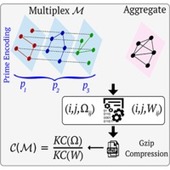
A new measure of complexity of multilayer networks shows that these systems can encode an optimal amount of additional information compared to their single-layer counterparts and provides a powerful tool for their analysis.

Source: journals.aps.org

Random walks on networks with stochastic resetting

Alejandro P. Riascos, Denis Boyer, Paul Herringer, and José L. Mateos
Phys. Rev. E 101, 062147


We study random walks with stochastic resetting to the initial position on arbitrary networks. We obtain the stationary probability distribution as well as the mean and global first passage times, which allow us to characterize the effect of resetting on the capacity of a random walker to reach a particular target or to explore a finite network. We apply the results to rings, Cayley trees, and random and complex networks. Our formalism holds for undirected networks and can be implemented from the spectral properties of the random walk without resetting, providing a tool to analyze the search efficiency in different structures with the small-world property or communities. In this way, we extend the study of resetting processes to the domain of networks.

Source: journals.aps.org

Finding Patient Zero: Learning Contagion Source with Graph Neural Networks

Chintan Shah, Nima Dehmamy, Nicola Perra, Matteo Chinazzi, Albert-László Barabási, Alessandro Vespignani, Rose Yu


Locating the source of an epidemic, or patient zero (P0), can provide critical insights into the infection’s transmission course and allow efficient resource allocation. Existing methods use graph-theoretic centrality measures and expensive message-passing algorithms, requiring knowledge of the underlying dynamics and its parameters. In this paper, we revisit this problem using graph neural networks (GNNs) to learn P0. We establish a theoretical limit for the identification of P0 in a class of epidemic models. We evaluate our method against different epidemic models on both synthetic and a real-world contact network considering a disease with history and characteristics of COVID-19.

We observe that GNNs can identify P0 close to the theoretical bound on accuracy, without explicit input of dynamics or its parameters. In addition, GNN is over 100 times faster than classic methods for inference on arbitrary graph topologies. Our theoretical bound also shows that the epidemic is like a ticking clock, emphasizing the importance of early contact-tracing. We find a maximum time after which accurate recovery of the source becomes impossible, regardless of the algorithm used.

Source: arxiv.org