Information arms race explains plant-herbivore chemical communication in ecological communities

Pengjuan Zu, Karina Boege, Ek del-Val, Meredith C. Schuman, Philip C. Stevenson, Alejandro Zaldivar-Riverón, Serguei Saavedra

Science  19 Jun 2020:
Vol. 368, Issue 6497, pp. 1377-1381
DOI: 10.1126/science.aba2965


Plants emit an extraordinary diversity of chemicals that provide information about their identity and mediate their interactions with insects. However, most studies of this have focused on a few model species in controlled environments, limiting our capacity to understand plant-insect chemical communication in ecological communities. Here, by integrating information theory with ecological and evolutionary theories, we show that a stable information structure of plant volatile organic compounds (VOCs) can emerge from a conflicting information process between plants and herbivores. We corroborate this information “arms race” theory with field data recording plant-VOC associations and plant-herbivore interactions in a tropical dry forest. We reveal that plant VOC redundancy and herbivore specialization can be explained by a conflicting information transfer. Information-based communication approaches can increase our understanding of species interactions across trophic levels.

Source: science.sciencemag.org
Globalization and the rise and fall of cognitive control

Mohsen Mosleh, Katelynn Kyker, Jonathan D. Cohen & David G. Rand

Nature Communications volume 11, Article number: 3099 (2020)


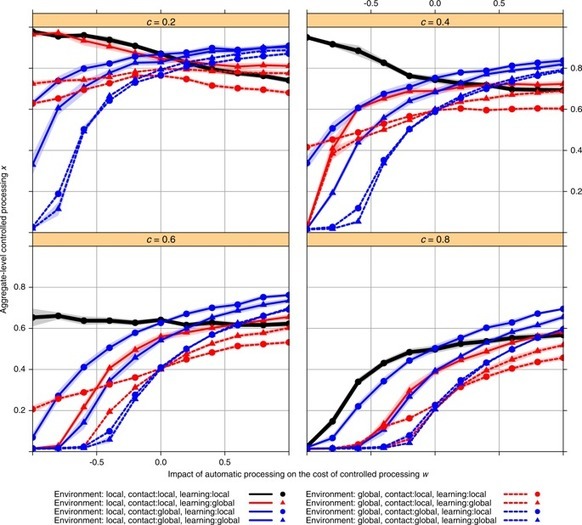
The scale of human interaction is larger than ever before—people regularly interact with and learn from others around the world, and everyone impacts the global environment. We develop an evolutionary game theory model to ask how the scale of interaction affects the evolution of cognition. Our agents make decisions using automatic (e.g., reflexive) versus controlled (e.g., deliberative) cognition, interact with each other, and influence the environment (i.e., game payoffs). We find that globalized direct contact between agents can either favor or disfavor control, depending on whether controlled agents are harmed or helped by contact with automatic agents; globalized environment disfavors cognitive control, while also promoting strategic diversity and fostering mesoscale communities of more versus less controlled agents; and globalized learning destroys mesoscale communities and homogenizes the population. These results emphasize the importance of the scale of interaction for the evolution of cognition, and help shed light on modern challenges. Humankind is in a period of unprecedented cognitive sophistication as well as globalization. Here, using an evolutionary game theory model, the authors reveal ways in which the transition from local to global interaction can have both positive and potentially negative consequences for the prevalence of cognitive sophistication in the population.

Source: www.nature.com

Flow-Mediated Olfactory Communication in Honey Bee Swarms

Dieu My T. Nguyen, Michael L. Iuzzolino, Aaron Mankel, Katarzyna Bozek, Greg J. Stephens, Orit Peleg


Honey bee swarms are a landmark example of collective behavior. To become a coherent swarm, bees locate their queen by tracking her pheromones, but how can distant individuals exploit these chemical signals which decay rapidly in space and time? Here, we combine a novel behavioral assay with the machine vision detection of organism location and scenting behavior to track the search and aggregation dynamics of the honey bee Apis mellifera L. We find that bees collectively create a communication network to propagate pheromone signals, by arranging in a specific spatial distribution where there is a characteristic distance between individuals and a characteristic direction in which individuals broadcast the signals. To better understand such a flow–mediated directional communication strategy, we connect our experimental results to an agent–based model where virtual bees with simple, local behavioral rules, exist in a flow environment. Our model shows that increased directional bias leads to a more efficient aggregation process that avoids local equilibrium configurations of isotropic communication, such as small bee clusters that persist throughout the simulation. Our results highlight a novel example of extended classical stigmergy: rather than depositing static information in the environment, individual bees locally sense and globally manipulate the physical fields of chemical concentration and airflow.

Source: www.biorxiv.org

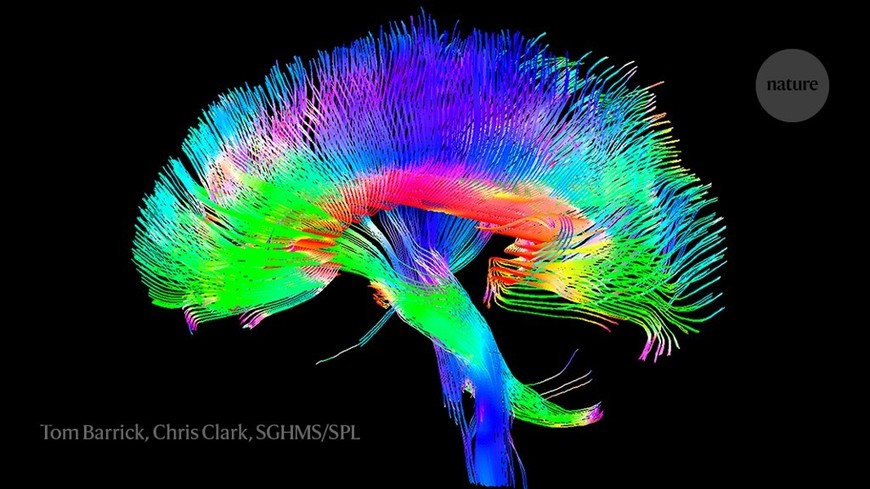
Neuroscience needs some new ideas

The Idea of the Brain: A History. Matthew Cobb. Profile (2020)


The Idea of the Brain puts our current predicament in context and synthesizes much that needs attention. It is a very good book. It could have done more in a time when science is coming to terms with the limitations of the straight, white, wealthy, Western, non-disabled, male perspective. But I hope it provokes contemplation about why certain metaphors linger, where they come from, how they persist, and in what ways they burden us with the invisible assumptions of past cultures.

Source: www.nature.com

Planning within Complex Urban Systems – 1st Edition – Shih-Kung Lai –

Imagine living in a city where people could move freely and buildings could be replaced at minimal cost. Reality cannot be further from such. Despite this imperfect world in which we live, urban planning has become integral and critical especially in the face of rapid urbanization in many developing and developed countries. This book introduces the axiomatic/experimental approach to urban planning and addresses the criticism of the lack of a theoretical foundation in urban planning.

With the rise of the complexity movement, the book is timely in its depiction of cities as complex systems and explains why planning from within is useful in the face of urban complexity. It also includes policy implications for the Chinese cities in the context of axiomatic/experimental planning theory.

Source: www.routledge.com