Top rank statistics for Brownian reshuffling

Zdzislaw Burda, Mario Kieburg

Phys. Rev. E 112, 014114

We study the dynamical aspects of the top rank statistics of particles, performing Brownian motions on a half-line, which are ranked by their distance from the origin. For this purpose, we introduce an observable Ω⁡(𝑡) which we call the overlap ratio. The average overlap ratio is equal to the probability that a particle that is on the top-𝑛 list at some time will also be on the top-𝑛 list after time 𝑡. The overlap ratio is a local observable which is concentrated at the top of the ranking and does not require the full ranking of all particles. In practice, the overlap ratio is easy to measure. We derive an analytical formula for the average overlap ratio for a system of 𝑁 particles in the stationary state that undergo independent Brownian motion on the positive real half-axis with a reflecting wall at the origin and a drift towards the wall. In particular, we show that for 𝑁→∞, the overlap ratio takes a rather simple form ⟨Ω⁡(𝑡)⟩=erfc⁡(𝑎⁢√𝑡) for 𝑛≫1 with some scaling parameter 𝑎>0. This result is a very good approximation even for moderate sizes of the top-𝑛 list such as 𝑛=10. Moreover, we observe in numerical studies that the overlap ratio exhibits universal behavior in many dynamical systems including geometric Brownian motion, Brownian motion with asymptotically linear drift, the Bouchaud-Mézard wealth distribution model, and Kesten processes. We conjecture the universality to hold for a broad class of one-dimensional stochastic processes.

Read the full article at: link.aps.org
Collective cooperative intelligence

W. Barfuss, J. Flack, C.S. Gokhale, L. Hammond, C. Hilbe, E. Hughes, J.Z. Leibo, T. Lenaerts, N. Leonard, S. Levin, U. Madhushani Sehwag, A. McAvoy, J.M. Meylahn, & F.P. Santos

PNAS 122 (25) e2319948121

Cooperation at scale is critical for achieving a sustainable future for humanity. However, achieving collective, cooperative behavior—in which intelligent actors in complex environments jointly improve their well-being—remains poorly understood. Complex systems science (CSS) provides a rich understanding of collective phenomena, the evolution of cooperation, and the institutions that can sustain both. Yet, much of the theory in this area fails to fully consider individual-level complexity and environmental context—largely for the sake of tractability and because it has not been clear how to do so rigorously. These elements are well captured in multiagent reinforcement learning (MARL), which has recently put focus on cooperative (artificial) intelligence. However, typical MARL simulations can be computationally expensive and challenging to interpret. In this perspective, we propose that bridging CSS and MARL affords new directions forward. Both fields can complement each other in their goals, methods, and scope. MARL offers CSS concrete ways to formalize cognitive processes in dynamic environments. CSS offers MARL improved qualitative insight into emergent collective phenomena. We see this approach as providing the necessary foundations for a proper science of collective, cooperative intelligence. We highlight work that is already heading in this direction and discuss concrete steps for future research.

Read the full article at: www.pnas.org

Why collective behaviours self-organize to criticality: a primer on information-theoretic and thermodynamic utility measures

Qianyang Chen and Mikhail Prokopenko

Roy. Soc. Open Science

Collective behaviours are frequently observed to self-organize to criticality. Existing proposals to explain these phenomena are fragmented across disciplines and only partially answer the question. This primer compares the underlying, intrinsic, utilities that may explain the self-organization of collective behaviours near criticality. We focus on information-driven approaches (predictive information, empowerment and active inference), as well as an approach incorporating both information theory and thermodynamics (thermodynamic efficiency). By interpreting the Ising model as a perception-action loop, we compare how different intrinsic utilities shape collective behaviour and analyse the distinct characteristics that arise when each is optimized. In particular, we highlight that thermodynamic efficiency—measuring the ratio of predictability gained by the system to its energy costs—reaches its maximum at the critical regime. Finally, we propose the Principle of Super-efficiency, suggesting that collective behaviours self-organize to the critical regime where optimal efficiency is achieved with respect to the entropy reduction relative to the thermodynamic costs.

Read the full article at: royalsocietypublishing.org

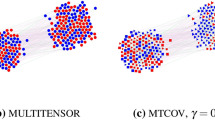
Probabilistic alignment of multiple networks

Teresa Lázaro, Roger Guimerà & Marta Sales-Pardo 
Nature Communications volume 16, Article number: 3949 (2025)

The network alignment problem appears in many areas of science and involves finding the optimal mapping between nodes in two or more networks, so as to identify corresponding entities across networks. We propose a probabilistic approach to the problem of network alignment, as well as the corresponding inference algorithms. Unlike heuristic approaches, our approach is transparent in that all model assumptions are explicit; therefore, it is susceptible of being extended and fine tuned by incorporating contextual information that is relevant to a given alignment problem. Also in contrast to current approaches, our method does not yield a single alignment, but rather the whole posterior distribution over alignments. We show that using the whole posterior leads to correct matching of nodes, even in situations where the single most plausible alignment mismatches them. Our approach opens the door to a whole new family of network alignment algorithms, and to their application to problems for which existing methods are perhaps inappropriate.

Read the full article at: www.nature.com

Unifying Systems : Information, Feedback, and Self-Organization, by Aarne Mämmelä

Interdisciplinary systems thinking is complementary but does not replace conventional disciplinary analytical thinking. The book is valuable for researchers, their advisors, and other thinkers interested in deep knowledge of science. Interdisciplinary systems thinking is valuable for three reasons: The goal of all science is a unified view of the world; we cannot solve the significant problems of our time without interdisciplinary collaboration; and general theories of systems and system archetypes support the solution to those problems. System archetypes are generic system models that have stood the test of time. As specialists within a discipline, we must be able to communicate between disciplines.
Interdisciplinary generalists can offer us reliable visions and relevant research problems. The goal of interdisciplinary research is to find unified solutions to those problems. The book provides a lot of information from over a thousand sources in a structured manner to help the reader. The book includes a comprehensive chronology, vocabulary, and bibliography. The author has been a research professor in information engineering for over 25 years. During his career, he became interested in systems thinking, which is closely related to the philosophy and history of science.

More at: link.springer.com