The Second Urban Revolution:  Complexity, Cognition and the View From the Israeli-Palestinian Periphery, by Juval Portugali

In this timely book, Juval Portugali ties together ancient archaeology with the present to explore the city as a phenomenon that has been rapidly increasing in power and importance since its earliest emergence. He links the walled cities of ancient civilization with modern-day borderless cities, while providing connections between modern nationalism and postmodern urbanism.

More at: www.e-elgar.com

European Financial Ecosystems. Comparing France, Sweden, UK and Italy

Stefano Caselli, Marta Zava

The study examines the structure, functioning, and strategic implications of financial ecosystems across four European countries-France, Sweden, the United Kingdom, and Italy-to identify institutional best practices relevant to the ongoing transformation of Italy’s financial system. Building on a comparative analysis of legislation and regulation, taxation, investor bases, and financial intermediation, the report highlights how distinct historical and institutional trajectories have shaped divergent models: the French dirigiste system anchored by powerful state-backed institutions and deep asset management pools; the Swedish social-democratic ecosystem driven by broad household equity participation, taxefficient savings vehicles, and equity-oriented pension funds; and the British liberal model, characterized by deep capital markets, strong institutional investor engagement, and globally competitive listing infrastructure. In contrast, Italy remains predominantly bank-centric, with fragmented institutional investment, limited retail equity participation, underdeveloped public markets, and a structural reliance on domestic banking channels for corporate finance.

Read the full article at: papers.ssrn.com

Infodynamics, Economics, Energy, and Life: An Interdisciplinary Approach, by Klaus Jaffe

The scientific understanding of energy, matter, and spacetime has advanced rapidly, whereas the study of information—its properties, behavior, and dynamics—remains underdeveloped. Despite the complexity of knowledge and information, our conceptual and empirical grasp of its evolution lags significantly behind. Progress in disciplines such as artificial intelligence, genomics, cognitive science, cyber governance, global ecology, and quantum mechanics depends critically on a more rigorous understanding of information dynamics. Absent such insight, humanity risks succumbing to entropic forces that threaten systemic stability and long-term survival.

In this book, Klaus Jaffe addresses the limitations of prior treatments of infodynamics, many of which have been incomplete, imprecise, or conceptually flawed. It offers an interdisciplinary investigation into the relationship between information and energy, drawing on theoretical and empirical contributions from economics, biology, and physics. By challenging conventional paradigms, the book constructs a conceptual framework that bridges disparate scientific domains and societal processes. The resulting synthesis opens new avenues for empirical inquiry and policy-relevant research, with implications for both academic scholarship and public discourse.

Inviting readers to explore the evolving frontier of information science, the book highlights the role of information and its impact on both natural and social systems.

More at: link.springer.com

Decoding the architecture of living systems

Manlio De Domenico

The possibility that evolutionary forces — together with a few fundamental factors such as thermodynamic constraints, specific computational features enabling information processing, and ecological processes — might constrain the logic of living systems is tantalizing. However, it is often overlooked that any practical implementation of such a logic requires complementary circuitry that, in biological systems, happens through complex networks of genetic regulation, metabolic reactions, cellular signalling, communication, social and eusocial non-trivial organization. Here, we review and discuss how circuitries are not merely passive structures, but active agents of change that, by means of hierarchical and modular organization, are able to enhance and catalyze the evolution of evolvability. By analyzing the role of non-trivial topologies in major evolutionary transitions under the lens of statistical physics and nonlinear dynamics, we show that biological innovations are strictly related to circuitry and its deviation from trivial structures and (thermo)dynamic equilibria. We argue that sparse heterogeneous networks such as hierarchical modular, which are ubiquitously observed in nature, are favored in terms of the trade-off between energetic costs for redundancy, error-correction and mantainance. We identify three main features — namely, interconnectivity, plasticity and interdependency — pointing towards a unifying framework for modeling the phenomenology, discussing them in terms of dynamical systems theory, non-equilibrium thermodynamics and evolutionary dynamics. Within this unified picture, we also show that “slow” evolutionary dynamics is an emergent phenomenon governed by the replicator-mutator equation as the direct consequence of a constrained variational nonequilibrium process. Overall, this work highlights how dynamical systems theory and nonequilibrium thermodynamics provide powerful analytical techniques to study biological complexity.

Read the full article at: iopscience.iop.org

Higher-order interactions shape collective human behaviour

Federico Battiston, Valerio Capraro, Fariba Karimi, Sune Lehmann, Andrea Bamberg Migliano, Onkar Sadekar, Angel Sánchez & Matjaž Perc
Nature Human Behaviour volume 9, pages 2441–2457 (2025

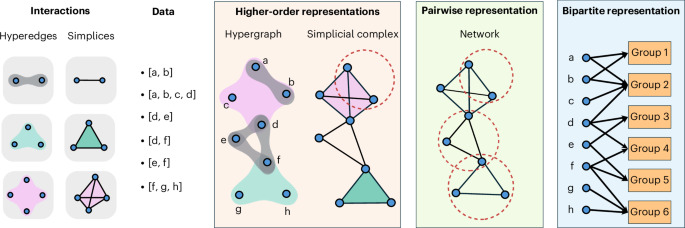
Traditional social network models focus on pairwise interactions, overlooking the complexity of group-level dynamics that shape collective human behaviour. Here we outline how the framework of higher-order social networks—using mathematical representations beyond simple graphs—can more accurately represent interactions involving multiple individuals. Drawing from empirical data including scientific collaborations and contact networks, we demonstrate how higher-order structures reveal mechanisms of group formation, social contagion, cooperation and moral behaviour that are invisible in dyadic models. By moving beyond dyads, this approach offers a transformative lens for understanding the relational architecture of human societies, opening new directions for behavioural experiments, cultural dynamics, team science and group behaviour as well as new cross-disciplinary research.

Read the full article at: www.nature.com