An Agent-Based Model of Leader Emergence and Leadership Perception within a Collective

Shun Cao, Neil G. MacLaren, Yiding Cao, Yingjun Dong, Hiroki Sayama, Francis J. Yammarino, Shelley D. Dionne, Michael D. Mumford, Shane Connelly, Robert Martin, Colleen J. Standish, Tanner R. Newbold et al.

Complexity Volume 2020 | Article ID 6857891


Effective teamwork in an initially leaderless group requires a high level of collective leadership emerging from dynamic interactions among group members. Leader emergence is a crucial topic in collective leadership, yet it is challenging to investigate as the problem context is typically highly complex and dynamic. Here, we explore leadership emergence and leadership perception by means of computational simulations whose assumptions and parameters were informed by empirical research and human-subject experiments. Our agent-based model describes the process of group planning. Each agent is assigned with three key attributes: talkativeness, intelligence, and credibility. An agent can propose a suggestion to modify the group plan as a speaker or respond and evaluate others’ suggestions and leadership as a listener. Simulation results suggested that agents with high values of talkativeness, intelligence, and credibility tended to be perceived as leaders by their peers. Results also showed that talkativeness may be the most significant and instantaneous predictor for leader emergence of the three investigated attributes: talkativeness, intelligence, and credibility. In terms of group performance, smaller groups may outperform larger groups regarding their problem-solving ability in the beginning, but their performance tends to be of no significant difference in a long run. These results match the empirical literature and offer a mechanistic, operationalized description of the collective leadership processes.

Source: www.hindawi.com

“Collective Decision Making in Living and Artificial Systems” – Special issue of the Swarm Intelligence journal

Collective decision making refers to the process whereby a group of individuals process information collectively to reach a common agreement. Reaching agreement is one of the fundamental cognitive processes upon which a collective can realize more complex behaviours. The decisions dynamics and their final outcome are determined by the mechanisms used by individuals to collect, share, and process information. Collective decision making is a widespread phenomenon in natural systems that is studied across taxa and scales, including in humans, group-living animals, and cell populations, and that has inspired the design of algorithms for decentralised artificial systems such as robot swarms and wireless sensor networks.

Examples of collective decisions made by animal groups include choosing a location where to build the nest, a food patch to feed on, or a common direction of motion. Human populations are able to reach an agreement on social norms in the absence of a central coordinating authority or, similarly, to select one commercial product among equally valuable alternatives. Collective decisions are also made by populations of cells, for instance, by collections of neurons interacting with each other to trigger a coordinated response in the brain. While studies of living collectives have inspired and continue to inspire the design of artificial systems, recent technological and theoretical advancements in computer vision, deep learning, and causal inference are providing novel research approaches to researchers in the life sciences.

This special issue solicits high-quality scientific contributions on collective decision making both in natural and artificial systems. We encourage submissions of research contributions that advance our theoretical understanding of the field of collective decision making, report experimental investigations of decision-making mechanisms in living or artificial collectives, propose innovative solutions to the design of decentralised decision-making systems, or provide novel perspectives on natural systems or technological advancements of interest across scientific boundaries.

Contributions to this special issue on collective decision making may fall in any of these research areas:
• Swarm robotics
• Collective animal behaviour
• Voting models
• Cultural evolution
• Network science
• Population dynamics
• Social neuroscience
• Socio- and Econo-physics
• Evolutionary game theory
• Information theory
• Bounded rationality
• Wireless sensor networks

Source: www.springer.com

Mobile phone data for informing public health actions across the COVID-19 pandemic life cycle

Nuria Oliver, Bruno Lepri, Harald Sterly, Renaud Lambiotte, Sébastien Delataille, Marco De Nadai, Emmanuel Letouzé, Albert Ali Salah, Richard Benjamins, Ciro Cattuto, Vittoria Colizza, Nicolas de Cordes, Samuel P. Fraiberger, Till Koebe, Sune Lehmann, Juan Murillo, Alex Pentland, Phuong N Pham, Frédéric Pivetta, Jari Saramäki, Samuel V. Scarpino, Michele Tizzoni, Stefaan Verhulst and Patrick Vinck

Science Advances 27 Apr 2020:
eabc0764


The coronavirus 2019-2020 pandemic (COVID-19) poses unprecedented challenges for governments and societies around the world (1). Non-pharmaceutical interventions (NPIs) have proven to be critical for delaying and containing the COVID-19 pandemic (2–6). This includes testing and tracing, bans on large gatherings, non-essential business and school and university closures, international and domestic mobility restrictions and physical isolation, and total lockdowns of regions and countries. Decision-making and evaluation or such interventions during all stages of the pandemic lifecycle require specific, reliable and timely data not only about infections, but also about human behavior, especially mobility and physical co-presence. We argue that mobile phone data, when used properly and carefully, represents a critical arsenal of tools for supporting public health actions across early, middle, and late-stage phases of the COVID-19 pandemic.

Source: advances.sciencemag.org

Topological portraits of multiscale coordination dynamics

Zhang, M., Kalies, W., Kelso, J., Tognoli, E. (2020). Topological portraits of multiscale coordination dynamics. Journal of Neuroscience Methods https://dx.doi.org/10.1016/j.jneumeth.2020.108672


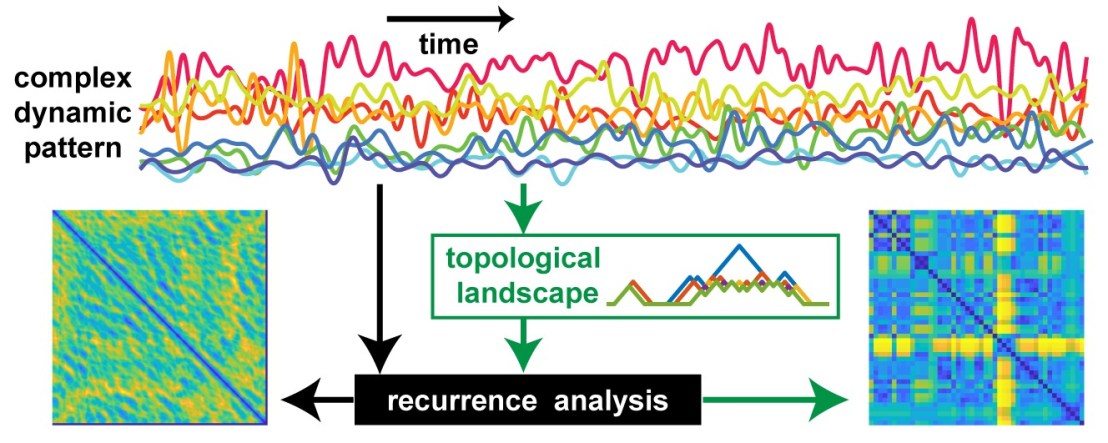
Living systems exhibit complex yet organized behavior on multiple spatiotemporal scales. To investigate the nature of multiscale coordination in living systems, one needs a meaningful and systematic way to quantify the complex dynamics, a challenge in both theoretical and empirical realms. The present work shows how integrating approaches from computational algebraic topology and dynamical systems may help us meet this challenge. In particular, we focus on the application of multiscale topological analysis to coordinated rhythmic processes. First, theoretical arguments are introduced as to why certain topological features and their scale-dependency are highly relevant to understanding complex collective dynamics. Second, we propose a method to capture such dynamically relevant topological information using persistent homology, which allows us to effectively construct a multiscale topological portrait of rhythmic coordination. Finally, the method is put to test in detecting transitions in real data from an experiment of rhythmic coordination in ensembles of interacting humans. The recurrence plots of topological portraits highlight collective transitions in coordination patterns that were elusive to more traditional methods. This sensitivity to collective transitions would be lost if the behavioral dynamics of individuals were treated as separate degrees of freedom instead of constituents of the topology that they collectively forge. Such multiscale topological portraits highlight collective aspects of coordination patterns that are irreducible to properties of individual parts. The present work demonstrates how the analysis of multiscale coordination dynamics can benefit from topological methods, thereby paving the way for further systematic quantification of complex, high-dimensional dynamics in living systems.

Source: linkinghub.elsevier.com

Global Behaviors and Perceptions in the COVID-19 Pandemic

Fetzer, Thiemo, Marc Witte, Lukas Hensel, Jon Jachimowicz, Johannes Haushofer, Andriy Ivchenko, Stefano Caria, et al. 2020. “Global Behaviors and Perceptions in the COVID-19 Pandemic.” PsyArXiv. April 16. doi:10.31234/osf.io/3kfmh


We conducted a large-scale survey covering 58 countries and over 100,000 respondents between late March and early April 2020 to study beliefs and attitudes towards citizens’ and governments’ responses to the COVID-19 pandemic. Most respondents reacted strongly to the crisis: they report engaging in social distancing and hygiene behaviors, and believe that strong policy measures, such as shop closures and curfews, are necessary. They also believe that their government and their country’s citizens are not doing enough and underestimate the degree to which others in their country support strong behavioral and policy responses to the pandemic. The perception of a weak government and public response is associated with higher levels of worries and depression. Using both cross-country panel data and an event-study, we additionally show that strong government reactions correct misperceptions, and reduce worries and depression. Our findings highlight that policy-makers not only need to consider how their decisions affect the spread of COVID-19, but also how such choices influence the mental health of their population.

Source: psyarxiv.com

Dataset available