
Mapping the coevolution, leadership and financing of research on viral vectors, RNAi, CRISPR/Cas9 and other genomic editing technologies

Fajardo-Ortiz D, Shattuck A, Hornbostel S 

PLoS ONE 15(4): e0227593.


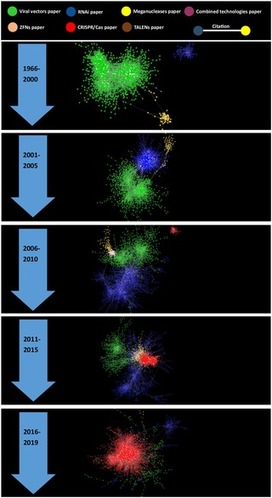
Genomic editing technologies are developing rapidly, promising significant developments for biomedicine, agriculture and other fields. In the present investigation, we analyzed and compared the process of innovation for six genomic technologies: viral vectors, RNAi, TALENs, meganucleases, ZFNs and CRISPR/Cas including the profile of the main research institutions and their funders, to understand how innovation evolved and what institutions influenced research trajectories. A Web of Science search of papers on viral vectors RNAi, CRISPR/Cas, TALENs, ZFNs and meganucleases was used to build a citation network of 16,746 papers. An analysis of network clustering combined with text mining was performed. For viral vectors, a long-term process of incremental innovation was identified, which was largely publicly funded in the United States and the European Union. The trajectory of RNAi research included clusters related to the study of RNAi as a biological phenomenon and its use in functional genomics, biomedicine and pest control. A British philanthropic organization and a US pharmaceutical company played a key role in the development of basic RNAi research and clinical application respectively, in addition to government and academic institutions. In the case of CRISPR/Cas research, basic science discoveries led to the technical improvements, and these two in turn provided the information required for the development of biomedical, agricultural, livestock and industrial applications. The trajectory of CRISPR/Cas research exhibits a geopolitical division of the investigation efforts between the US, as the main producer and funder of basic research and technical improvements, and Chinese research institutions increasingly leading applied research. Our results reflect a change in the model for financing science, with reduced public financing for basic science and applied research on publicly funded technological developments in the US, and the emergence of China as a scientific superpower, with implications for the development of applications of genomic technologies.

Source: journals.plos.org
An Agent-Based Model of Opinion Polarization Driven by Emotions

Frank Schweitzer, Tamas Krivachy, and David Garcia

Complexity Volume 2020 |Article ID 5282035


We provide an agent-based model to explain the emergence of collective opinions not based on feedback between different opinions, but based on emotional interactions between agents. The driving variable is the emotional state of agents, characterized by their valence, quantifying the emotion from unpleasant to pleasant, and their arousal, quantifying the degree of activity associated with the emotion. Both determine their emotional expression, from which collective emotional information is generated. This information feeds back on the dynamics of emotional states and individual opinions in a nonlinear manner. We derive the critical conditions for emotional interactions to obtain either consensus or polarization of opinions. Stochastic agent-based simulations and formal analyses of the model explain our results. Possible ways to validate the model are discussed.

Source: www.hindawi.com

Computational Models That Matter During a Global Pandemic Outbreak: A Call to Action

Flaminio Squazzoni, J. Gareth Polhill, Bruce Edmonds, Petra Ahrweiler, Patrycja Antosz, Geeske Scholz, Émile Chappin, Melania Borit, Harko Verhagen, Francesca Giardini and Nigel Gilbert

JASSS 23(2),10


The COVID-19 pandemic is causing a dramatic loss of lives worldwide, challenging the sustainability of our health care systems, threatening economic meltdown, and putting pressure on the mental health of individuals (due to social distancing and lock-down measures). The pandemic is also posing severe challenges to the scientific community, with scholars under pressure to respond to policymakers’ demands for advice despite the absence of adequate, trusted data. Understanding the pandemic requires fine-grained data representing specific local conditions and the social reactions of individuals. While experts have built simulation models to estimate disease trajectories that may be enough to guide decision-makers to formulate policy measures to limit the epidemic, they do not cover the full behavioural and social complexity of societies under pandemic crisis. Modelling that has such a large potential impact upon people’s lives is a great responsibility. This paper calls on the scientific community to improve the transparency, access, and rigour of their models. It also calls on stakeholders to improve the rapidity with which data from trusted sources are released to the community (in a fully responsible manner). Responding to the pandemic is a stress test of our collaborative capacity and the social/economic value of research.

Source: jasss.soc.surrey.ac.uk

See Also JASSS-Covid19-Thread

Assessing changes in commuting and individual mobility in major metropolitan areas in the United States during the COVID-19 outbreak

Brennan Klein, Timothy LaRock, Stefan McCabe, Leo Torres, Filippo Privitera, Brennan Lake, Moritz U. G. Kraemer, John S. Brownstein, David Lazer, Tina Eliassi-Rad, Samuel V. Scarpino, Matteo Chinazzi, and Alessandro Vespignani


On March 16, 2020, the United States government issued new guidelines promoting public health social social distancing interventions to reduce the spread of the COVID-19 epidemic in the country [1]. In addition, many state and local governments in the United States have enacted stay-at-home policies banning mass gatherings, enforcing school closures, and promoting smart working. So far, however, the extent to which these policies have resulted in reduced people’s mobility has not been quantified. By analyzing data from millions of (anonymized, aggregated, privacy-enhanced) devices, we estimate that by March 23 the policies have generally reduced by half the overall mobility in several major U.S. cities. In order to gauge the observed results we know events, we note that the commuting volume on Monday, March 16, approached those of a typical snow day or analogous day when public schools are partially closed (i.e. January 2). By Friday, March 20, we observe commuting numbers that resemble those measured on federal holidays (i.e. Martin Luther King Jr. Day in January or Presidents’ Day in February). Currently, we are unable to quantify the extent to which this reduced commuting volume is driven by people working from home or simply an increase in unemployment, though it is surely a mixture of both. Whether this reduction in mobility is enough to change the course of this pandemic is not yet known, but it does provide guidance for further measures that can be implemented at a national scale in the United States.


Source: www.networkscienceinstitute.org

Centralized and decentralized isolation strategies and their impact on the COVID-19 pandemic dynamics

Alexandru Topirceanu, Mihai Udrescu, Radu Marculescu


The infectious diseases are spreading due to human interactions enabled by various social networks. Therefore, when a new pathogen such as SARS-CoV-2 causes an outbreak, the non-pharmaceutical isolation strategies (e.g., social distancing) are the only possible response to disrupt its spreading. To this end, we introduce the new epidemic model (SICARS) and compare the centralized (C), decentralized (D), and combined (C+D) social distancing strategies, and analyze their efficiency to control the dynamics of COVID-19 on heterogeneous complex networks. Our analysis shows that the centralized social distancing is necessary to minimize the pandemic spreading. The decentralized strategy is insufficient when used alone, but offers the best results when combined with the centralized one. Indeed, the (C+D) is the most efficient isolation strategy at mitigating the network superspreaders and reducing the highest node degrees to less than 10% of their initial values. Our results also indicate that stronger social distancing, e.g., cutting 75% of social ties, can reduce the outbreak by 75% for the C isolation, by 33% for the D isolation, and by 87% for the (C+D) isolation strategy. Finally, we study the impact of proactive versus reactive isolation strategies, as well as their delayed enforcement. We find that the reactive response to the pandemic is less efficient, and delaying the adoption of isolation measures by over one month (since the outbreak onset in a region) can have alarming effects; thus, our study contributes to an understanding of the COVID-19 pandemic both in space and time. We believe our investigations have a high social relevance as they provide insights into understanding how different degrees of social distancing can reduce the peak infection ratio substantially; this can make the COVID-19 pandemic easier to understand and control over an extended period of time.

Source: arxiv.org