
Distinguishing cell phenotype using cell epigenotype

Thomas P. Wytock and Adilson E. Motter
Science Advances 6 (12), eaax7798 (2020)

Abstract. The relationship between microscopic observations and macroscopic behavior is a fundamental open question in biophysical systems. Here, we develop a unified approach that—in contrast with existing methods—predicts cell type from macromolecular data even when accounting for the scale of human tissue diversity and limitations in the available data. We achieve these benefits by applying a k-nearest-neighbors algorithm after projecting our data onto the eigenvectors of the correlation matrix inferred from many observations of gene expression or chromatin conformation. Our approach identifies variations in epigenotype that affect cell type, thereby supporting the cell-type attractor hypothesis and representing the first step toward model-independent control strategies in biological systems.

Source: advances.sciencemag.org
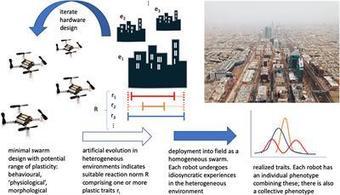
Phenotypic Plasticity Provides a Bioinspiration Framework for Minimal Field Swarm Robotics

Edmund R. Hunt


The real world is highly variable and unpredictable, and so fine-tuned robot controllers that successfully result in group-level “emergence” of swarm capabilities indoors may quickly become inadequate outside. One response to unpredictability could be greater robot complexity and cost, but this seems counter to the “swarm philosophy” of deploying (very) large numbers of simple agents. Instead, here I argue that bioinspiration in swarm robotics has considerable untapped potential in relation to the phenomenon of phenotypic plasticity: when a genotype can produce a range of distinctive changes in organismal behavior, physiology and morphology in response to different environments. This commonly arises following a natural history of variable conditions; implying the need for more diverse and hazardous simulated environments in offline, pre-deployment optimization of swarms. This will generate—indicate the need for—plasticity. Biological plasticity is sometimes irreversible; yet this characteristic remains relevant in the context of minimal swarms, where robots may become mass-producible. Plasticity can be introduced through the greater use of adaptive threshold-based behaviors; more fundamentally, it can link to emerging technologies such as smart materials, which can adapt form and function to environmental conditions. Moreover, in social animals, individual heterogeneity is increasingly recognized as functional for the group. Phenotypic plasticity can provide meaningful diversity “for free” based on early, local sensory experience, contributing toward better collective decision-making and resistance against adversarial agents, for example. Nature has already solved the challenge of resilient self-organisation in the physical realm through phenotypic plasticity: swarm engineers can follow this lead.

Source: www.frontiersin.org

Timing uncertainty in collective risk dilemmas encourages group reciprocation and polarization

Elias Fernández Domingos, Jelena Grujić, Juan C. Burguillo, Georg Kirchsteiger, Francisco C. Santos, Tom Lenaerts


Human social dilemmas are often shaped by actions involving uncertain goals and returns that may only be achieved in the future. Climate action, voluntary vaccination and other prospective choices stand as paramount examples of this setting. In this context, as well as in many other social dilemmas, uncertainty may produce non-trivial effects. Whereas uncertainty about collective targets and their impact were shown to negatively affect group coordination and success, no information is available about timing uncertainty, i.e. how uncertainty about when the target needs to be reached affects the outcome as well as the decision-making. Here we show experimentally, through a collective dilemma wherein groups of participants need to avoid a tipping point under the risk of collective loss, that timing uncertainty prompts not only early generosity but also polarized contributions, in which participants’ total contributions are distributed more unfairly than when there is no uncertainty. Analyzing participant behavior reveals, under uncertainty, an increase in reciprocal strategies wherein contributions are conditional on the previous donations of the other participants, a group analogue of the well-known Tit-for-Tat strategy. Although large timing uncertainty appears to reduce collective success, groups that successfully collect the required amount show strong reciprocal coordination. This conclusion is supported by a game theoretic model examining the dominance of behaviors in case of timing uncertainty. In general, timing uncertainty casts a shadow on the future that leads participants to respond early, encouraging reciprocal behaviors, and unequal contributions.

Source: arxiv.org

Beauty in artistic expressions through the eyes of networks and physics

Matjaž Perc

Journal of The Royal Society Interface Volume 17 Issue 164


Beauty is subjective, and as such it, of course, cannot be defined in absolute terms. But we all know or feel when something is beautiful to us personally. And in such instances, methods of statistical physics and network science can be used to quantify and to better understand what it is that evokes that pleasant feeling, be it when reading a book or looking at a painting. Indeed, recent large-scale explorations of digital data have lifted the veil on many aspects of our artistic expressions that would remain forever hidden in smaller samples. From the determination of complexity and entropy of art paintings to the creation of the flavour network and the principles of food pairing, fascinating research at the interface of art, physics and network science abounds. We here review the existing literature, focusing in particular on culinary, visual, musical and literary arts. We also touch upon cultural history and culturomics, as well as on the connections between physics and the social sciences in general. The review shows that the synergies between these fields yield highly entertaining results that can often be enjoyed by layman and experts alike. In addition to its wider appeal, the reviewed research also has many applications, ranging from improved recommendation to the detection of plagiarism.

Source: royalsocietypublishing.org

Flattening the COVID-19 Curves

What is the best public policy to counter the health risk from the Coronavirus, COVID-19? This is the question on everyone’s mind.
It is wise to try and learn from the current situation in China, where the rate of COVID-19 infections was extinguished as a result of a lockdown, and Italy, where hospitals are full and doctors have to make life-death decisions about patients because there are not enough beds to treat everyone in need. The mortality fraction of infected people appears to be higher by an order of magnitude when hospitals are overcrowded, so suppressing the rate of new infections serves the important purpose of allowing those in need to be treated.

Source: blogs.scientificamerican.com