Functional and Social Team Dynamics in Industrial Settings

Dominic E. Saadi, Mark Sutcliffe, Yaneer Bar-Yam, and Alfredo J. Morales

Complexity Volume 2020 |Article ID 8301575


Like other social systems, corporations comprise networks of individuals that share information and create interdependencies among their actions. The properties of these networks are crucial to a corporation’s success. Understanding how individuals self-organize into teams and how this relates to performance is a challenge for managers and management software developers looking for ways to enhance corporate tasks. In this paper, we analyze functional and social communication networks from industrial production plants and relate their properties to performance. We use internal management software data that reveal aspects of functional and social communications among workers. We found that distinct features of functional and social communication networks emerge. The former are asymmetrical, and the latter are segregated by job title, i.e., executives, managers, supervisors, and operators. We show that performance is negatively correlated with the volume of functional communications but positively correlated with the density of the emerging communication networks. Exposing social dynamics in the workplace matters given the increasing digitization and automation of corporate tasks and managerial processes.

Source: www.hindawi.com
Age profile of susceptibility, mixing, and social distancing shape the dynamics of the novel coronavirus disease 2019 outbreak in China

Juanjuan Zhang, Maria Litvinova, Yuxia Liang, Yan Wang, Wei Wang, Shanlu Zhao, Qianhui Wu, Stefano Merler, Cecile Viboud, Alessandro Vespignani, Marco Ajelli, Hongjie Yu


Strict interventions were successful to control the novel coronavirus (COVID-19) outbreak in China. As transmission intensifies in other countries, the interplay between age, contact patterns, social distancing, susceptibility to infection and disease, and COVID-19 dynamics remains unclear. To answer these questions, we analyze contact surveys data for Wuhan and Shanghai before and during the outbreak and contact tracing information from Hunan Province. Daily contacts were reduced 7-9 fold during the COVID-19 social distancing period, with most interactions restricted to the household. Children 0-14 years were 59% (95% CI 7-82%) less susceptible than individuals 65 years and over. A transmission model calibrated against these data indicates that social distancing alone, as implemented in China during the outbreak, is sufficient to control COVID-19. While proactive school closures cannot interrupt transmission on their own, they reduce peak incidence by half and delay the epidemic. These findings can help guide global intervention policies.

Source: www.medrxiv.org

To Adapt or Not to Adapt: A Quantification Technique for Measuring an Expected Degree of Self-Adaptation

Sven Tomforde and Martin Goller

Computers 2020, 9(1), 21


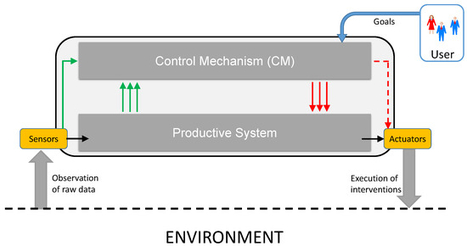
Self-adaptation and self-organization (SASO) have been introduced to the management of technical systems as an attempt to improve robustness and administrability. In particular, both mechanisms adapt the system’s structure and behavior in response to dynamics of the environment and internal or external disturbances. By now, adaptivity has been considered to be fully desirable. This position paper argues that too much adaptation conflicts with goals such as stability and user acceptance. Consequently, a kind of situation-dependent degree of adaptation is desired, which defines the amount and severity of tolerated adaptations in certain situations. As a first step into this direction, this position paper presents a quantification approach for measuring the current adaptation behavior based on generative, probabilistic models. The behavior of this method is analyzed in terms of three application scenarios: urban traffic control, the swidden farming model, and data communication protocols. Furthermore, we define a research roadmap in terms of six challenges for an overall measurement framework for SASO systems.

Source: www.mdpi.com

Effectiveness of social distancing strategies for protecting a community from a pandemic with a data- driven contact network based on census and real-world mobility data

David Martín-Calvo, Alberto Aleta, Alex Pentland, Yamir Moreno, Esteban Moro


The current situation of emergency is global. As of today, March 22nd 2020, there are more than 23 countries with more than 1.000 infected cases by COVID-19, in the exponential growth phase of the disease. Furthermore, there are different mitigation and suppression strategies in place worldwide, but many of them are based on enforcing, to a more or less extent, the so-called social distancing. The impact and outcomes of the adopted measures are yet to be contrasted and quantified. Therefore, realistic modeling approaches could provide important clues about what to expect and what could be the best course of actions. Such modeling efforts could potentially save thousands, if not millions of lives. Our report contains preliminary results that aim at answering the following questions in relation to the spread and control of the COVID-19 pandemic:
– What is the expected impact of current social distancing strategies?
– How long should such measures need to be in place?
– How many people will be infected and at which social level?
– How do R(t) and the epidemic dynamic change based on the adopted strategies?
– What is the probability of having a second outbreak, i.e., a reemergence?
– If there is a reemergence, how much time do we have to get ready?
– What is the best strategy to minimize the current epidemic and get ready for a second wave?
In this report, we provide details of the data analyzed, the methodology (and its limitations) employed as well as a quantitative and qualitative assessment of strategies based on social distancing and corresponding what-if-scenarios for control and mitigation. We use real world mobility and census data of the Boston area to build a co-location network at three different layers (community, households and schools), and a data-driven SEIR model that allows testing six different social distancing strategies, namely, (i) school closures, (ii) self-distancing and teleworking, (iii) self-distancing and teleworking plus School closure (iv) Restaurants, nightlife and cultural closures, (v) non-essential workplace closures and (vi) total confinement. We test the impact of establishing these strategies at different stages of the epidemic evolution and for different periods of time.

Source: covid-19-sds.github.io

ccnr covid-19 research

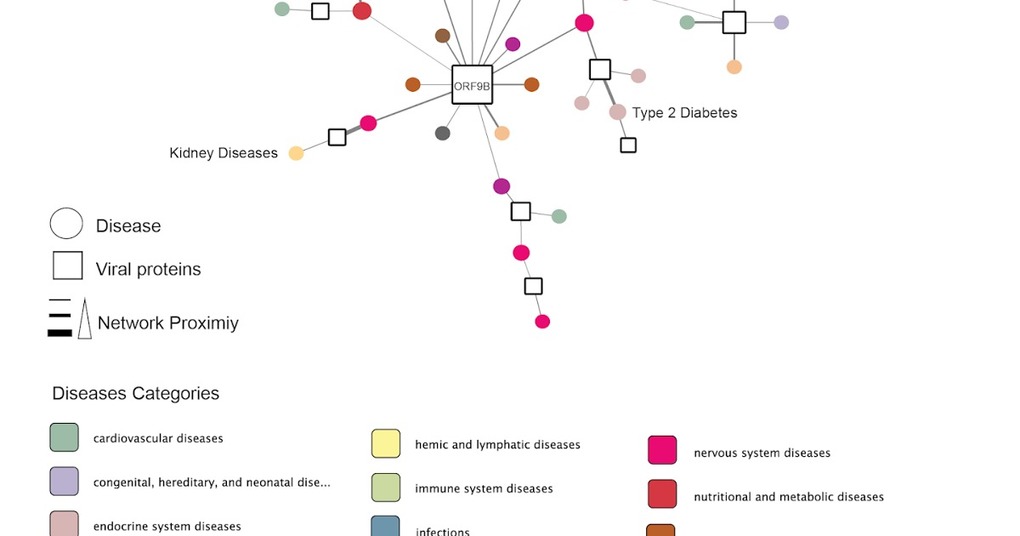
Network Medicine offers a series of powerful tools to identify new drugs and diagnostics. In this exceptional moment of need, we decided to turn the BarabasiLab’s intellectual resources and network medicine toolset to aid the hunt for a treatment for the COVID-19.

Source: covid.barabasilab.com