What China’s coronavirus response can teach the rest of the world

As the new coronavirus marches around the globe, countries with escalating outbreaks are eager to learn whether China’s extreme lockdowns were responsible for bringing the crisis there under control. Other nations are now following China’s lead and limiting movement within their borders, while dozens of countries have restricted international visitors.

Source: www.nature.com

End the Coronavirus

Spread the knowledge, not the virus.
Take part in eradicating this epidemic
Since the first confirmed case of a new, virulent strain of the coronavirus in December in Wuhan, China, the disease has spread to more than 100 countries and territories. As of March 12, 2020, there are 125,048 confirmed cases and 4,613 deaths. These numbers are still increasing.
Everyone can help.

Source: www.endcoronavirus.org

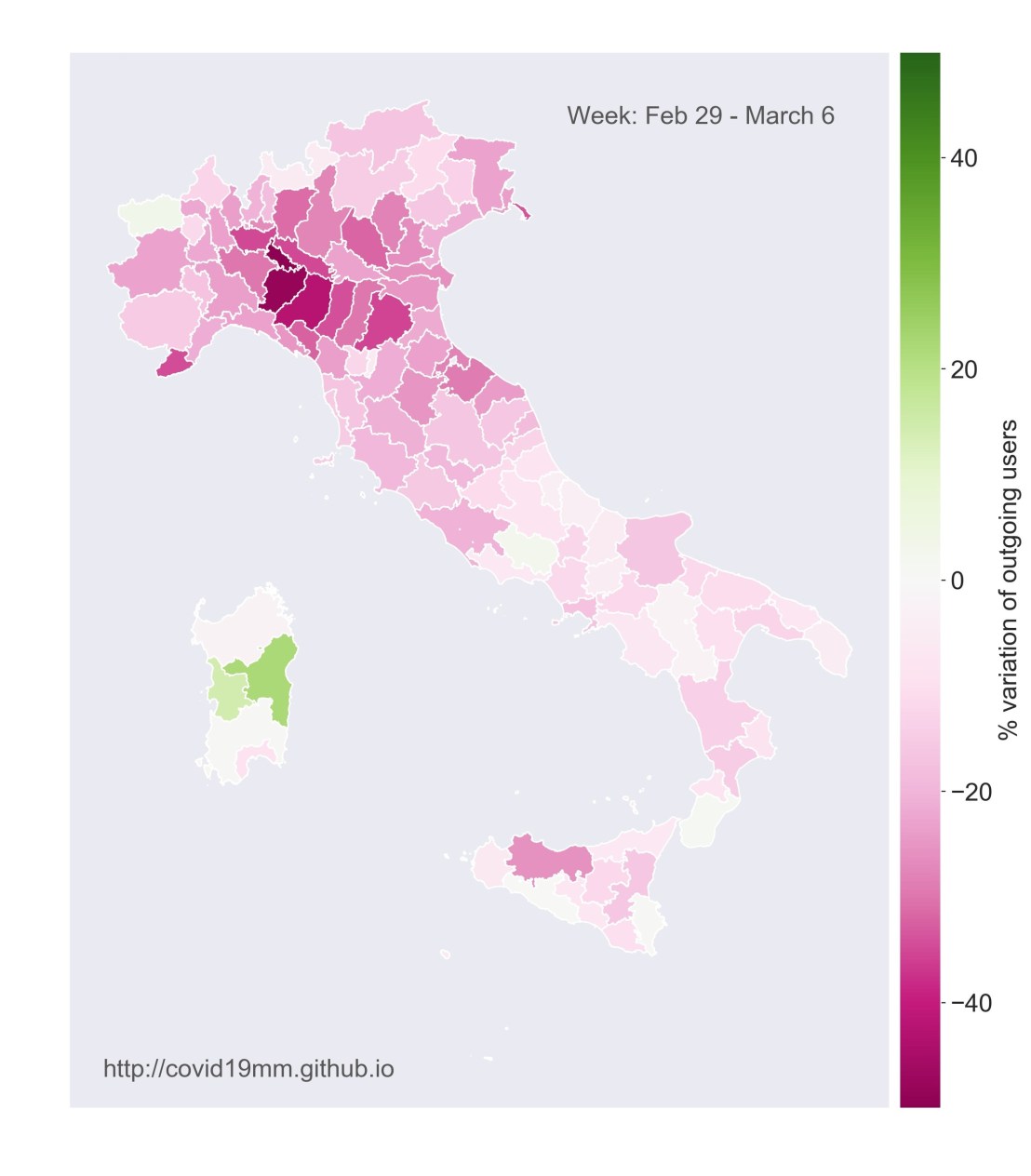
COVID-19 outbreak response: first assessment of mobility changes in Italy following lockdown

Emanuele Pepe, Paolo Bajardi, Laetitia Gauvin, Filippo Privitera, Ciro Cattuto, Michele Tizzoni


The mitigation measures enacted as part of the response to the unfolding SARS-CoV-2 pandemic are unprecedented in their breadth and societal burden. A major challenge in this situation is to quantitatively assess the impact of non-pharmaceutical interventions like mobility restrictions and social distancing, to better understand the ensuing reduction of mobility flows, individual mobility changes, and impact on contact patterns. Here we report preliminary results on tackling the above challenges by using de-identified, large-scale data from a location intelligence company, Cuebiq, that has instrumented smartphone apps with high-accuracy location-data collection software. We focus this initial analysis on Italy, where the COVID-19 epidemic has already triggered an unprecedented and escalating series of restrictions on travel and individual mobility of citizens.

Source: covid19mm.github.io

School closures, event cancellations, and the mesoscopic localization of epidemics in networks with higher-order structure

The COVID-19 epidemic is challenging in many ways, perhaps most obvious are failures of the surveillance system. Consequently, the official intervention has focused on conventional wisdom — social distancing, hand washing, etc. — while critical decisions such as the cancellation of large events like festivals, workshops and academic conferences are done on a case-by-case basis with limited information about local risks. Adding to this uncertainty is the fact that our mathematical models tend to assume some level of random mixing patterns instead of the higher-order structures necessary to describe these large events. Here, we discuss a higher-order description of epidemic dynamics on networks that provides a natural way of extending common models to interaction beyond simple pairwise contacts. We show that unlike the classic diffusion of standard epidemic models, higher-order interactions can give rise to mesoscopic localization, i.e., a phenomenon in which there is a concentration of the epidemic around certain substructures in the network. We discuss the implications of these results and show the potential impact of a blanket cancellation of events larger than a certain critical size. Unlike standard models of delocalized dynamics, epidemics in a localized phase can suddenly collapse when facing an intervention operating over structures rather than individuals.


Guillaume St-Onge, Vincent Thibeault, Antoine Allard, Louis J. Dubé, Laurent Hébert-Dufresne

Source: arxiv.org

Evolving Always-Critical Networks

Marco Villani , Salvatore Magrì, Andrea Roli and Roberto Serra


Living beings share several common features at the molecular level, but there are very few large-scale “operating principles” which hold for all (or almost all) organisms. However, biology is subject to a deluge of data, and as such, general concepts such as this would be extremely valuable. One interesting candidate is the “criticality” principle, which claims that biological evolution favors those dynamical regimes that are intermediaries between ordered and disordered states (i.e., “at the edge of chaos”). The reasons why this should be the case and experimental evidence are briefly discussed, observing that gene regulatory networks are indeed often found on, or close to, the critical boundaries. Therefore, assuming that criticality provides an edge, it is important to ascertain whether systems that are critical can further evolve while remaining critical. In order to explore the possibility of achieving such “always-critical” evolution, we resort to simulated evolution, by suitably modifying a genetic algorithm in such a way that the newly-generated individuals are constrained to be critical. It is then shown that these modified genetic algorithms can actually develop critical gene regulatory networks with two interesting (and quite different) features of biological significance, involving, in one case, the average gene activation values and, in the other case, the response to perturbations. These two cases suggest that it is often possible to evolve networks with interesting properties without losing the advantages of criticality. The evolved networks also show some interesting features which are discussed.

Source: www.mdpi.com