
Elites, communities and the limited benefits of mentorship in electronic music

Milán Janosov, Federico Musciotto, Federico Battiston & Gerardo Iñiguez 
Scientific Reports volume 10, Article number: 3136 (2020)


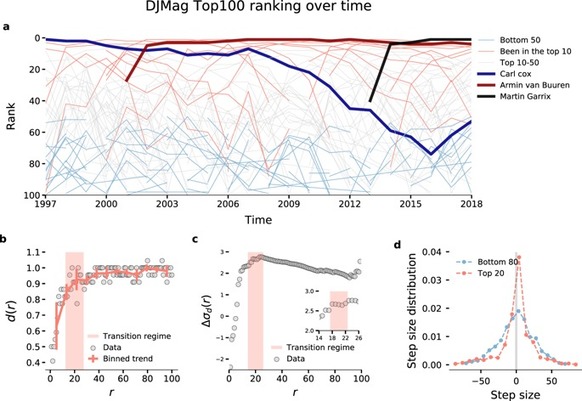
While the emergence of success in creative professions, such as music, has been studied extensively, the link between individual success and collaboration is not yet fully uncovered. Here we aim to fill this gap by analyzing longitudinal data on the co-releasing and mentoring patterns of popular electronic music artists appearing in the annual Top 100 ranking of DJ Magazine. We find that while this ranking list of popularity publishes 100 names, only the top 20 is stable over time, showcasing a lock-in effect on the electronic music elite. Based on the temporal co-release network of top musicians, we extract a diverse community structure characterizing the electronic music industry. These groups of artists are temporally segregated, sequentially formed around leading musicians, and represent changes in musical genres. We show that a major driving force behind the formation of music communities is mentorship: around half of musicians entering the top 100 have been mentored by current leading figures before they entered the list. We also find that mentees are unlikely to break into the top 20, yet have much higher expected best ranks than those who were not mentored. This implies that mentorship helps rising talents, but becoming an all-time star requires more. Our results provide insights into the intertwined roles of success and collaboration in electronic music, highlighting the mechanisms shaping the formation and landscape of artistic elites in electronic music.

Source: www.nature.com

The Collective Computation of Reality in Nature and Society

The first computers were not invented by humans but by nature. The mantra of complexity science — that complexity arises from interactions among simple components — is wrong. The parts—whether cells, neurons, bees, or humans—are often wonderfully complex themselves but operate under many constraints and are prone to failure and myopia and, consequently, errors in information processing that can lead to a profound misunderstanding of the nature of reality. In this public lecture, Jessica Flack will discuss how nature computes. She will build on the above points to argue collective computation—computation by the parts together—evolved as a solution to imperfect information processing, sometimes resulting in recovery of the “ground truth out there in the world” and sometimes resulting in a collectively constructed reality that takes on a life and meaning of its own. Flack will also discuss how an understanding of computation in nature challenges us to broaden our understanding of computation’s theoretical foundations.

All things are words belonging to that language
In which Someone or Something, night and day,
Writes down the infinite babble that is, per se,
The history of the world. And in that hodgepodge
Both Rome and Carthage, he and you and I,
My life that I don’t grasp, this painful load
Of being riddle, randomness, or code,
And all of Babel’s gibberish stream by.
—Jorge Luis Borges, two stanzas from his poem, The Compass

Jessica Flack is a professor at the Santa Fe Institute and director of its Collective Computation Group. Flack’s interests include the role of collective computation in the origins of biological space and time, coarse-graining in nature, causality, and robustness.

Source: www.youtube.com

The hidden universality of movement in cities

Markus Schläpfer, Michael Szell, Hadrien Salat, Carlo Ratti, Geoffrey B. West


The interaction of all mobile species with their environment hinges on their movement patterns: the places they visit and how frequently they go there. In human society, where the prevalent form of cohabitation is in cities, the highly dynamic and diverse movement of people is fundamental to almost every aspect of socio-economic life, including social interactions or disease spreading, and ultimately is key to the evolution of urban infrastructure, productivity, innovation and technology. However, despite the crucial role of the spatio-temporal structure of movement in cities, the laws that govern the variation of population flows to specific locations have remained elusive. Here we show that behind the apparent complexity of movement a surprisingly simple universal scaling relation drives the flow of individuals to any specific location based on both frequency of visitation and distance travelled. We derive a first principles argument stating that the number of visiting individuals should decrease as an inverse square of the product of visitation frequency and travel distance; or, equivalently, as a power law with exponent ≈−2. Using large-scale data analyses, we demonstrate that population flows obey this theoretical prediction in virtually all tested areas across the globe, ranging from Europe and America to Asia and Africa, regardless of the detailed geographies, cultures or levels of development. The revealed regularity offers unprecedented possibilities for the modelling of mobility fluxes at high spatial and temporal resolution, and it places an important constraint on any theory of movement, spatial organisation and social interaction in cities.

Source: arxiv.org

A curious formulation robot enables the discovery of a novel protocell behavior

We describe a chemical robotic assistant equipped with a curiosity algorithm (CA) that can efficiently explore the states a complex chemical system can exhibit. The CA-robot is designed to explore formulations in an open-ended way with no explicit optimization target. By applying the CA-robot to the study of self-propelling multicomponent oil-in-water protocell droplets, we are able to observe an order of magnitude more variety in droplet behaviors than possible with a random parameter search and given the same budget. We demonstrate that the CA-robot enabled the observation of a sudden and highly specific response of droplets to slight temperature changes. Six modes of self-propelled droplet motion were identified and classified using a time-temperature phase diagram and probed using a variety of techniques including NMR. This work illustrates how CAs can make better use of a limited experimental budget and significantly increase the rate of unpredictable observations, leading to new discoveries with potential applications in formulation chemistry.


Jonathan Grizou, Laurie J. Points, Abhishek Sharma and Leroy Cronin
Science Advances  31 Jan 2020:
Vol. 6, no. 5, eaay4237
DOI: 10.1126/sciadv.aay4237

Source: advances.sciencemag.org

Chaos | The Great Courses

It has been called the third great revolution of 20th-century physics, after relativity and quantum theory. But how can something called chaos theory help you understand an orderly world? What practical things might it be good for? What, in fact, is chaos theory? "Chaos theory," according to Dr. Steven Strogatz, Director of the Center for Applied Mathematics at Cornell University, "is the science of how things change." It describes the behavior of any system whose state evolves over time and whose behavior is sensitive to small changes in its initial conditions.

Source: www.thegreatcourses.com