How Computation Is Helping Unravel the Dynamics of Morphogenesis

David Pastor-Escuredo and Juan C. del Álamo

Front. Phys.


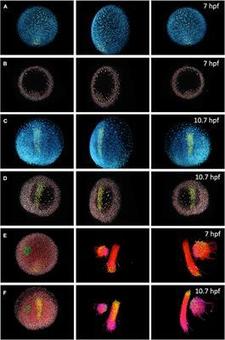
The growing availability of imaging data, calculation power, and algorithm sophistication are transforming the study of morphogenesis into a computation-driven discipline. In parallel, it is accepted that mechanics plays a role in many of the processes determining the cell fate map, providing further opportunities for modeling and simulation. We provide a perspective of this integrative field, discussing recent advances and outstanding challenges to understand the determination of the fate map. At the basis, high-resolution microscopy and image processing provide digital representations of embryos that facilitate quantifying their mechanics with computational methods. Moreover, innovations in in-vivo sensing and tissue manipulation can now characterize cell-scale processes to feed larger-scale representations. A variety of mechanical formalisms have been proposed to model cellular biophysics and its links with biochemical and genetic factors. However, there are still limitations derived from the dynamic nature of embryonic tissue and its spatio-temporal heterogeneity. Also, the increasing complexity and variety of implementations make it difficult to harmonize and cross-validate models. The solution to these challenges will likely require integrating novel in vivo measurements of embryonic biomechanics into the models. Machine Learning has great potential to classify spatio-temporally connected groups of cells with similar dynamics. Emerging Deep Learning architectures facilitate the discovery of causal links and are becoming transparent and interpretable. We anticipate these new tools will lead to multi-scale models with the necessary accuracy and flexibility to formulate hypotheses for in-vivo and in-silico testing. These methods have promising applications for tissue engineering, identification of therapeutic targets, and synthetic life.

Source: www.frontiersin.org
Disturbance in human gut microbiota networks by parasites and its implications in the incidence of depression

Elvia Ramírez-Carrillo, Osiris Gaona, Javier Nieto, Andrés Sánchez-Quinto, Daniel Cerqueda-García, Luisa I. Falcón, Olga A. Rojas-Ramos & Isaac González-Santoyo
Scientific Reports volume 10, Article number: 3680 (2020)


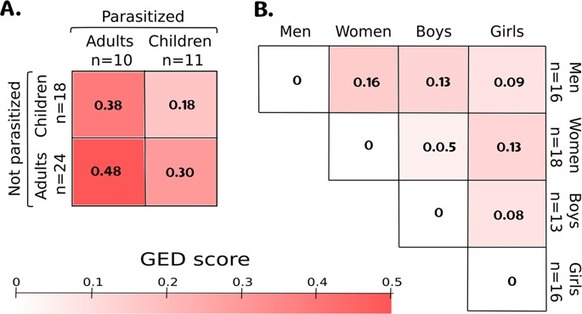
If you think you are in control of your behavior, think again. Evidence suggests that behavioral modifications, as development and persistence of depression, maybe the consequence of a complex network of communication between macro and micro-organisms capable of modifying the physiological axis of the host. Some parasites cause significant nutritional deficiencies for the host and impair the effectiveness of cognitive processes such as memory, teaching or non-verbal intelligence. Bacterial communities mediate the establishment of parasites and vice versa but this complexity approach remains little explored. We study the gut microbiota-parasite interactions using novel techniques of network analysis using data of individuals from two indigenous communities in Guerrero, Mexico. Our results suggest that Ascaris lumbricoides induce a gut microbiota perturbation affecting its network properties and also subnetworks of key species related to depression, translating in a loss of emergence. Studying these network properties changes is particularly important because recent research has shown that human health is characterized by a dynamic trade-off between emergence and self-organization, called criticality. Emergence allows the systems to generate novel information meanwhile self-organization is related to the system’s order and structure. In this way, the loss of emergence means a depart from criticality and ultimately loss of health.

Source: www.nature.com

Living robots

Philip Ball 
Nature Materials volume 19, page 265(2020)


The original ‘robots’, described in the 1921 play R.U.R. by the Czech writer Karel Čapek (the word is Czech for ‘labourer’) were not made from steel and controlled by electronics, but were fleshy and autonomous. Čapek’s manufacturing process, in which organs and other parts were made from vats of flesh-like dough and assembled into bodies, took inspiration from the emerging technology of in vivo tissue culture. It blurred the boundaries between engineering and biotechnology in a way that seemed far beyond the technologies of the time.


The results now reported by Kriegman et al. make this vision seem almost unnervingly prescient1. They describe ‘reconfigurable organisms’ made from living cells assembled into conglomerates about a millimetre across with arbitrary shapes, which are designed in silico for particular functions such as locomotion. These structures have been dubbed xenobots — which might be given the literal and apt interpretation of ‘strange robots’, although here ‘xeno’ comes from the use of embryonic stem cells of the African clawed frog Xenopus laevis as the construction material.

Source: www.nature.com

Synthetic ablations in the C. elegans nervous system

Emma K. Towlson and Albert-László Barabási

Network Neuroscience


"Synthetic lethality" in cell biology is an extreme example of the effects of higher order genetic interactions: The simultaneous knockout of two or more individually nonessential genes leads to cell death. We define a neural analog to this concept in relation to the locomotor response to gentle touch in C. elegans. Two or more neurons are synthetic essential if individually they are not required for this behavior, yet their combination is. We employ a network control approach to systematically assess all pairs and triplets of neurons by their effect on body wall muscle controllability, and find that only surprisingly small sets of neurons are synthetic essential. They are highly localized in the nervous system and predicted to affect control over specific sets of muscles.

Source: www.mitpressjournals.org

Networks and long-range mobility in cities: A study of more than one billion taxi trips in New York City

A. P. Riascos & José L. Mateos 
Scientific Reports volume 10, Article number: 4022 (2020)


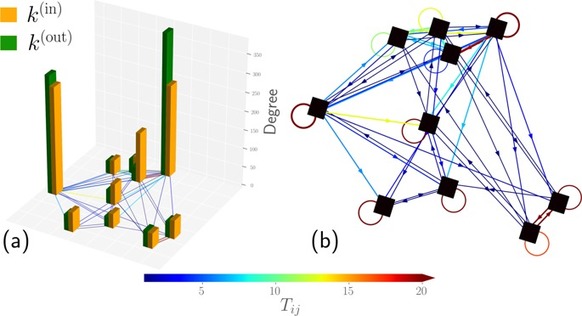
We analyze the massive data set of more than one billion taxi trips in New York City, from January 2009 to December 2015. With these records of seven years, we generate an origin-destination matrix that has information of a vast number of trips. The mobility and flow of taxis can be described as a directed weighted network that connects different zones of high demand for taxis. This network has in and out degrees that follow a stretched exponential and a power law with an exponential cutoff distributions, respectively. Using the origin-destination matrix, we obtain a rank, called "OD rank”, analogous to the page rank of Google, that gives the more relevant places in New York City in terms of taxi trips. We introduced a model that captures the local and global dynamics that agrees with the data. Considering the taxi trips as a proxy of human mobility in cities, it might be possible that the long-range mobility found for New York City would be a general feature in other large cities around the world.

Source: www.nature.com