
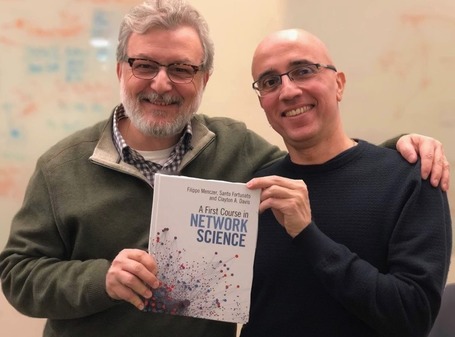
A First Course in Network Science

The book A First Course in Network Science by CNetS faculty members Filippo Menczer and Santo Fortunato and CNetS PhD graduate Clayton A. Davis was recently published by Cambridge University Press. This textbook introduces the basics of network science for a wide range of job sectors from management to marketing, from biology to engineering, and from neuroscience to the social sciences. Extensive tutorials, datasets, and homework problems provide plenty of hands-on practice. The book has been endorsed as “Rigorous” (Alessandro Vespignani), “comprehensive… indispensable” (Olaf Sporns), “with remarkable clarity and insight” (Brian Uzzi), “accessible” (Albert-László Barabási), “amazing… extraordinary” (Alex Arenas), and “sophisticated yet introductory… an excellent introduction that is also eminently practical” (Stephen Borgatti). It was ranked by Amazon #1 among new releases in mathematical physics.

Source: cnets.indiana.edu
Mining social media data for biomedical signals and health-related behavior

Rion Brattig Correia, Ian B. Wood, Johan Bollen, Luis M. Rocha


Social media data has been increasingly used to study biomedical and health-related phenomena. From cohort level discussions of a condition to planetary level analyses of sentiment, social media has provided scientists with unprecedented amounts of data to study human behavior and response associated with a variety of health conditions and medical treatments. Here we review recent work in mining social media for biomedical, epidemiological, and social phenomena information relevant to the multilevel complexity of human health. We pay particular attention to topics where social media data analysis has shown the most progress, including pharmacovigilance, sentiment analysis especially for mental health, and other areas. We also discuss a variety of innovative uses of social media data for health-related applications and important limitations in social media data access and use.

Source: arxiv.org

Computational Social Science and Complex Systems, edited by J. Kertész, R.N. Mantegna, S. Miccichè

For many years, the development of large-scale quantitative social science was hindered by a lack of data. Traditional methods of data collection like surveys were very useful, but were limited. The situation has of course changed with the development of computing and information communication technology, and we now live in a world of data deluge, where the question has become how to extract important information from the plethora of data that can be accessed. Big Data has made it possible to study societal questions which were once impossible to deal with, but new tools and new multidisciplinary approaches are required. Physicists, together with economists, sociologists, computer scientists, etc. have played an important role in their development.


This book presents the 9 lectures delivered at the CCIII Summer Course Computational Social Science and Complex Systems, held as part of the International School of Physics Enrico Fermi in Varenna, Italy, from 16-21 July 2018. The course had the aim of presenting some of the recent developments in the interdisciplinary fields of computational social science and econophysics to PhD students and young researchers, with lectures focused on recent problems investigated in computational social science.


Addressing some of the basic questions and many of the subtleties of the emerging field of computational social science, the book will be of interest to students, researchers and advanced research professionals alike.

Source: www.iospress.nl

Early epidemiological analysis of the 2019-nCoV outbreak based on a crowdsourced data

Kaiyuan Sun, Jenny Chen, Cécile Viboud.


Starting in December 2019, Chinese health authorities have been closely monitoring a cluster of pneumonia cases in the city of Wuhan, in Hubei Province. It has been determined that the causing agent of the viral pneumonia among affected individuals is a new coronavirus (2019-nCoV). As of January 29, 2020, a total of 6,088 cases have been detected and confirmed in Mainland China, with more than 70 additional cases detected and confirmed internationally in Japan, Thailand, South Korea, Taiwan, Singapore, Vietnam, United States, France, Australia, Nepal, Canada, Cambodia, Sri Lanka, United Arab Emirates, Finland, and Germany. By using the cases detected outside China we are providing estimates of size of the Wuhan outbreak as of January 29th, 2020.​ By using an estimate of 10 days from exposure to detection and an effective population of 20 million people in Wuhan catchment area the estimated median size of the Wuhan outbreak is 31,200 infections [95% CI: 23,400-40,400]. Technical details are in the full report available below. 

Source: www.mobs-lab.org

Phase transitions in information spreading on structured populations

Davis, Jessica, Perra, Nicola, Zhang, Qian, Moreno, Yamir and Vespignani, Alessandro (2020) Phase transitions in information spreading on structured populations. Nature Physics. ISSN 1745-2473 (Print), 1745-2481 (Online) (In Press)


Mathematical models of social contagion that incorporate networks of human interactions have become increasingly popular, however, very few approaches have tackled the challenges of including complex and realistic properties of socio-technical systems. In this work we define a framework to characterize the dynamics of the Maki-Thompson rumor spreading model in structured populations, and analytically find a previously uncharacterized dynamical phase transition that separates the local and global contagion regimes. We validate our threshold prediction through extensive Monte Carlo simulations. Furthermore, we apply this framework in two real-world systems, the European commuting and transportation network and the Digital Bibliography and Library Project (DBLP) collaboration network. Our findings highlight the importance of the underlying population structure in understanding social contagion phenomena and have the potential to define new intervention strategies aimed at hindering or facilitating the diffusion of information in socio-technical systems.

Source: gala.gre.ac.uk