
Dualities and non-Abelian mechanics

Michel Fruchart, Yujie Zhou & Vincenzo Vitelli 
Nature volume 577, pages 636–640 (2020)


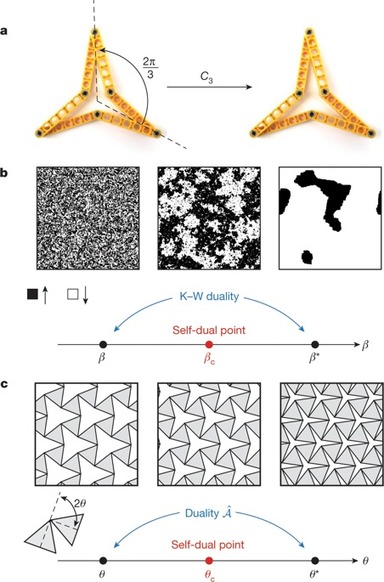
Dualities are mathematical mappings that reveal links between apparently unrelated systems in virtually every branch of physics1,2,3,4,5,6,7,8. Systems mapped onto themselves by a duality transformation are called self-dual and exhibit remarkable properties, as exemplified by the scale invariance of an Ising magnet at the critical point. Here we show how dualities can enhance the symmetries of a dynamical matrix (or Hamiltonian), enabling the design of metamaterials with emergent properties that escape a standard group theory analysis. As an illustration, we consider twisted kagome lattices9,10,11,12,13,14,15, reconfigurable mechanical structures that change shape by means of a collapse mechanism9. We observe that pairs of distinct configurations along the mechanism exhibit the same vibrational spectrum and related elastic moduli. We show that these puzzling properties arise from a duality between pairs of configurations on either side of a mechanical critical point. The critical point corresponds to a self-dual structure with isotropic elasticity even in the absence of spatial symmetries and a twofold-degenerate spectrum over the entire Brillouin zone. The spectral degeneracy originates from a version of Kramers’ theorem16,17 in which fermionic time-reversal invariance is replaced by a hidden symmetry emerging at the self-dual point. The normal modes of the self-dual systems exhibit non-Abelian geometric phases18,19 that affect the semiclassical propagation of wavepackets20, leading to non-commuting mechanical responses. Our results hold promise for holonomic computation21 and mechanical spintronics by allowing on-the-fly manipulation of synthetic spins carried by phonons.

Source: www.nature.com

Prosociality in the economic Dictator Game is associated with less parochialism and greater willingness to vote for intergroup compromise

Mohsen Mosleh. Alexander J. Stewart, Joshua B. Plotkin, David G. Rand


http://journal.sjdm.org/19/190814/jdm190814.pdf


Is prosociality parochial or universalist? To shed light on this issue, we examine the relationship between the amount of money given to a stranger (giving in an incentivized Dictator Game) and intergroup attitudes and behavior in the context of randomly assigned teams (a minimal group paradigm) among N = 4,846 Amazon Mechanical Turk workers. Using a set of Dynamic Identity Diffusion Index measures, we find that participants who give more in the Dictator Game show less preferential identification with their team relative to the other team, and more identification with all participants regardless of team. Furthermore, in an incentivized Voter Game, participants who give more in the Dictator Game are more likely to support compromise by voting for the opposing team in order to avoid deadlock. Together, these results suggest that – at least in this subject pool and using these measures – prosociality is better characterized by universalism than parochialism.


Keywords: Prosociality, Dictator Game, Ingroup Bias, Intergroup Attitude

Source: journal.sjdm.org

Counterfactual thinking in cooperation dynamics

Moniz Pereira, Luis; Santos, Francisco C.


Counterfactual Thinking is a human cognitive ability studied in a wide variety of domains. It captures the process of reasoning about a past event that did not occur, namely what would have happened had this event occurred, or, otherwise, to reason about an event that did occur but what would ensue had it not. Given the wide cognitive empowerment of counterfactual reasoning in the human individual, the question arises of how the presence of individuals with this capability may improve cooperation in populations of self-regarding individuals. Here we propose a mathematical model, grounded on Evolutionary Game Theory, to examine the population dynamics emerging from the interplay between counterfactual thinking and social learning (i.e., individuals that learn from the actions and success of others) whenever the individuals in the population face a collective dilemma. Our results suggest that counterfactual reasoning fosters coordination in collective action problems occurring in large populations, and has a limited impact on cooperation dilemmas in which coordination is not required. Moreover, we show that a small prevalence of individuals resorting to counterfactual thinking is enough to nudge an entire population towards highly cooperative standards.

Source: ui.adsabs.harvard.edu

Phase Transitions in Spatial Connectivity during Influenza Pandemics

Nathan Harding, Richard E Spinney, and Mikhail Prokopenko

Entropy 202022(2), 133


We investigated phase transitions in spatial connectivity during influenza pandemics, relating epidemic thresholds to the formation of clusters defined in terms of average infection. We employed a large-scale agent-based model of influenza spread at a national level: the Australian Census-based Epidemic Model (ACEmathsizesmallMod). In using the ACEmathsizesmallMod simulation framework, which leverages the 2016 Australian census data and generates a surrogate population of ≈23.4 million agents, we analysed the spread of simulated epidemics across geographical regions defined according to the Australian Statistical Geography Standard. We considered adjacent geographic regions with above average prevalence to be connected, and the resultant spatial connectivity was then analysed at specific time points of the epidemic. Specifically, we focused on the times when the epidemic prevalence peaks, either nationally (first wave) or at a community level (second wave). Using the percolation theory, we quantified the connectivity and identified critical regimes corresponding to abrupt changes in patterns of the spatial distribution of infection. The analysis of criticality is confirmed by computing Fisher Information in a model-independent way. The results suggest that the post-critical phase is characterised by different spatial patterns of infection developed during the first or second waves (distinguishing urban and rural epidemic peaks).

Source: www.mdpi.com

The exposome and health: Where chemistry meets biology

Roel Vermeulen, Emma L. Schymanski, Albert-László Barabási, Gary W. Miller
Science 24 Jan 2020:
Vol. 367, Issue 6476, pp. 392-396
DOI: 10.1126/science.aay3164


Despite extensive evidence showing that exposure to specific chemicals can lead to disease, current research approaches and regulatory policies fail to address the chemical complexity of our world. To safeguard current and future generations from the increasing number of chemicals polluting our environment, a systematic and agnostic approach is needed. The “exposome” concept strives to capture the diversity and range of exposures to synthetic chemicals, dietary constituents, psychosocial stressors, and physical factors, as well as their corresponding biological responses. Technological advances such as high-resolution mass spectrometry and network science have allowed us to take the first steps toward a comprehensive assessment of the exposome. Given the increased recognition of the dominant role that nongenetic factors play in disease, an effort to characterize the exposome at a scale comparable to that of the human genome is warranted.

Source: science.sciencemag.org