
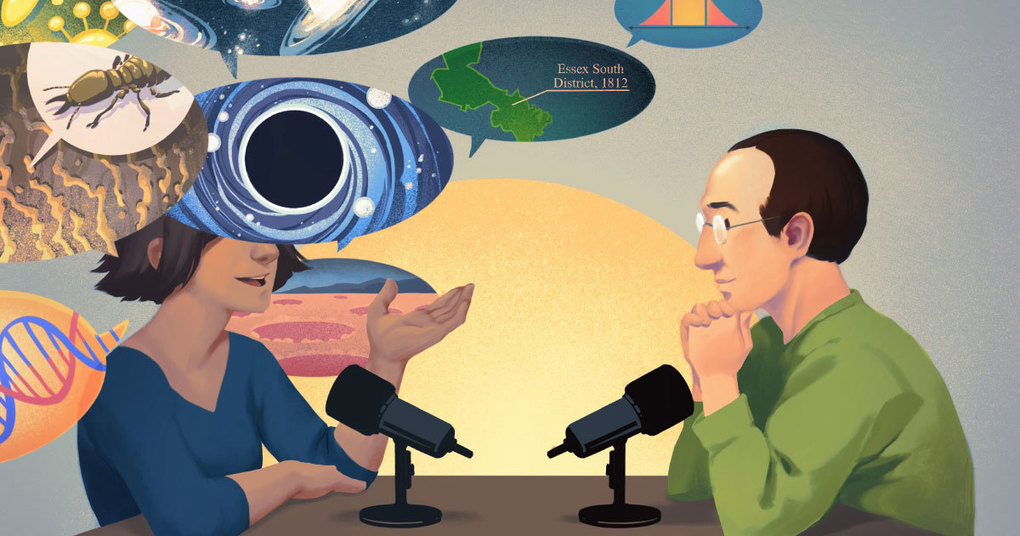
The noted mathematician and author Steven Strogatz explains why he wanted to share intimate conversations with leading researchers from diverse fields in his new Quanta Magazine podcast.
Source: www.quantamagazine.org
Networking the complexity community since 1999
The noted mathematician and author Steven Strogatz explains why he wanted to share intimate conversations with leading researchers from diverse fields in his new Quanta Magazine podcast.
Source: www.quantamagazine.org

In our study published today in Nature, we demonstrate how artificial intelligence research can drive and accelerate new scientific discoveries. We’ve built a dedicated, interdisciplinary team in hopes of using AI to push basic research forward: bringing together experts from the fields of structural biology, physics, and machine learning to apply cutting-edge techniques to predict the 3D structure of a protein based solely on its genetic sequence.
Source: deepmind.com
Edmond Awad, Sohan Dsouza, Azim Shariff, Iyad Rahwan, and Jean-François Bonnefon
PNAS
We report the largest cross-cultural study of moral preferences in sacrificial dilemmas, that is, the circumstances under which people find it acceptable to sacrifice one life to save several. On the basis of 70,000 responses to three dilemmas, collected in 10 languages and 42 countries, we document a universal qualitative pattern of preferences together with substantial country-level variations in the strength of these preferences. In particular, we document a strong association between low relational mobility (where people are more cautious about not alienating their current social partners) and the tendency to reject sacrifices for the greater good—which may be explained by the positive social signal sent by such a rejection. We make our dataset publicly available for researchers.
Source: www.pnas.org
Pierre-Alexandre Balland, Cristian Jara-Figueroa, Sergio G. Petralia, Mathieu P. A. Steijn, David L. Rigby & César A. Hidalgo
Nature Human Behaviour (2020)
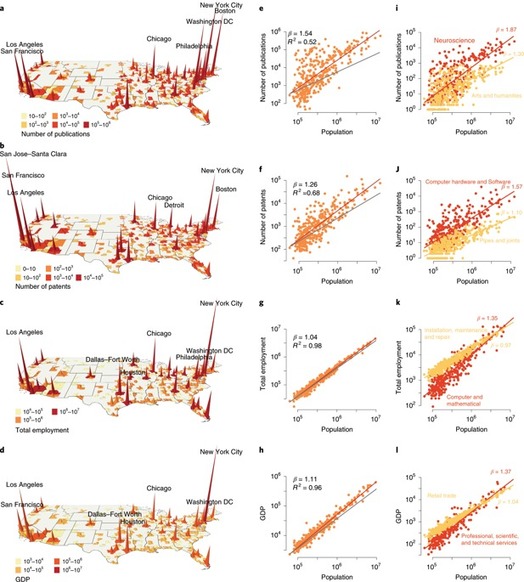
Human activities, such as research, innovation and industry, concentrate disproportionately in large cities. The ten most innovative cities in the United States account for 23% of the national population, but for 48% of its patents and 33% of its gross domestic product. But why has human activity become increasingly concentrated? Here we use data on scientific papers, patents, employment and gross domestic product, for 353 metropolitan areas in the United States, to show that the spatial concentration of productive activities increases with their complexity. Complex economic activities, such as biotechnology, neurobiology and semiconductors, concentrate disproportionately in a few large cities compared to less–complex activities, such as apparel or paper manufacturing. We use multiple proxies to measure the complexity of activities, finding that complexity explains from 40% to 80% of the variance in urban concentration of occupations, industries, scientific fields and technologies. Using historical patent data, we show that the spatial concentration of cutting-edge technologies has increased since 1850, suggesting a reinforcing cycle between the increase in the complexity of activities and urbanization. These findings suggest that the growth of spatial inequality may be connected to the increasing complexity of the economy.
Source: www.nature.com
Lana Sinapayen, Atsushi Masumori, and Takashi Ikegami
Front. Comput. Neurosci., 22 January 2020
Complex environments provide structured yet variable sensory inputs. To best exploit information from these environments, organisms must evolve the ability to anticipate consequences of new stimuli, and act on these predictions. We propose an evolutionary path for neural networks, leading an organism from reactive behavior to simple proactive behavior and from simple proactive behavior to induction-based behavior. Based on earlier in-vitro and in-silico experiments, we define the conditions necessary in a network with spike-timing dependent plasticity for the organism to go from reactive to proactive behavior. Our results support the existence of specific evolutionary steps and four conditions necessary for embodied neural networks to evolve predictive and inductive abilities from an initial reactive strategy.
Source: www.frontiersin.org
 Complexity Digest