
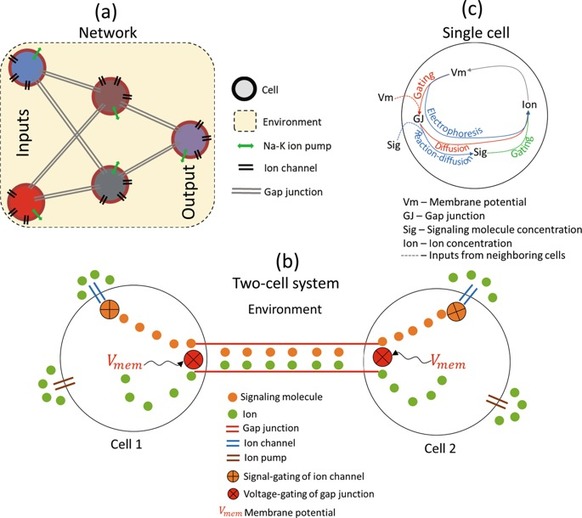
Modeling somatic computation with non-neural bioelectric networks

The field of basal cognition seeks to understand how adaptive, context-specific behavior occurs in non-neural biological systems. Embryogenesis and regeneration require plasticity in many tissue types to achieve structural and functional goals in diverse circumstances. Thus, advances in both evolutionary cell biology and regenerative medicine require an understanding of how non-neural tissues could process information. Neurons evolved from ancient cell types that used bioelectric signaling to perform computation. However, it has not been shown whether or how non-neural bioelectric cell networks can support computation. We generalize connectionist methods to non-neural tissue architectures, showing that a minimal non-neural Bio-Electric Network (BEN) model that utilizes the general principles of bioelectricity (electrodiffusion and gating) can compute. We characterize BEN behaviors ranging from elementary logic gates to pattern detectors, using both fixed and transient inputs to recapitulate various biological scenarios. We characterize the mechanisms of such networks using dynamical-systems and information-theory tools, demonstrating that logic can manifest in bidirectional, continuous, and relatively slow bioelectrical systems, complementing conventional neural-centric architectures. Our results reveal a variety of non-neural decision-making processes as manifestations of general cellular biophysical mechanisms and suggest novel bioengineering approaches to construct functional tissues for regenerative medicine and synthetic biology as well as new machine learning architectures.

Source: www.nature.com

Dynamical Inference of Simple Heteroclinic Networks

Maximilian Voit and Hildegard Meyer-Ortmanns

Front. Appl. Math. Stat., 10 December 2019


Heteroclinic networks are structures in phase space that consist of multiple saddle fixed points as nodes, connected by heteroclinic orbits as edges. They provide a promising candidate attractor to generate reproducible sequential series of metastable states. While from an engineering point of view it is known how to construct heteroclinic networks to achieve certain dynamics, a data based approach for the inference of heteroclinic dynamics is still missing. Here, we present a method by which a template system dynamically learns to mimic an input sequence of metastable states. To this end, the template is unidirectionally, linearly coupled to the input in a master-slave fashion, so that it is forced to follow the same sequence. Simultaneously, its eigenvalues are adapted to minimize the difference of template dynamics and input sequence. Hence, after the learning procedure, the trained template constitutes a model with dynamics that are most similar to the training data. We demonstrate the performance of this method at various examples, including dynamics that differ from the template, as well as a regular and a random heteroclinic network. In all cases the topology of the heteroclinic network is recovered precisely, as are most eigenvalues. Our approach may thus be applied to infer the topology and the connection strength of a heteroclinic network from data in a dynamical fashion. Moreover, it may serve as a model for learning in systems of winnerless competition.

Source: www.frontiersin.org

Transitivity and degree assortativity explained: The bipartite structure of social networks

Demival Vasques Filho, Dion R. J. O’Neale


Dynamical processes, such as the diffusion of knowledge, opinions, pathogens, "fake news", innovation, and others, are highly dependent on the structure of the social network on which they occur. However, questions on why most social networks present some particular structural features, namely high levels of
transitivity and degree assortativity, when compared to other types of networks remain open. First, we argue that every one-mode network can be regarded as a projection of a bipartite network, and show that this is the case using two simple examples solved with the generating functions formalism. Second, using synthetic and empirical data, we reveal how the combination of the degree distribution of both sets of nodes of the bipartite network — together with the presence of cycles of length four and six — explains the observed levels of transitivity and degree assortativity in the one-mode projected network. Bipartite networks with top node degrees that display a more right-skewed distribution than the bottom nodes result in highly transitive and degree assortative projections, especially if a large number of small cycles are present in the bipartite structure.

Source: arxiv.org

Digital Fingerprints of Cognitive Reflection

Mohsen Mosleh, Gordon Pennycook, Antonio Arechar, David Rand

Social media is playing an increasingly large role in everyday life. Thus, it is of both scientific and practical interest to understand behavior on social media platforms. Furthermore, social media provides a unique window for social scientists to deepen our understanding of the human mind. Here we investigate the relationship between individual differences in cognitive reflection and behavior on Twitter in a sample of large N = 1,953 users recruited via Prolific Academic. In doing so, we differentiate between two competing accounts of human information processing: an “intuitionist” account whereby reflection plays little role in daily life, and a “reflectionist” account whereby reflection (and, in particular, overriding intuitive responses) does play an important role. We found that people who score higher on the Cognitive Reflection Test (CRT) – a widely used measure of reflective thinking – were more discerning in their social media use: They followed more selectively, shared news content from more reliable sources, and tweeted about weightier subjects. Furthermore, a network analysis indicated that the phenomenon of echo chambers, in which discourse is more likely with like-minded others, is not limited to politics: we observe “cognitive echo chambers” in which people low on cognitive reflection tend to follow the same set of accounts. Our results help to illuminate the drivers of behavior on social media platforms, and challenge intuitionist notions that reflective thinking is unimportant for everyday judgment and decision-making.

Source: psyarxiv.com

A Genetic Model of the Connectome

The connectomes of organisms of the same species show remarkable architectural and often local wiring similarity, raising the question: where and how is neuronal connectivity encoded? Here, we start from the hypothesis that the genetic identity of neurons guides synapse and gap-junction formation and show that such genetically driven wiring predicts the existence of specific biclique motifs in the connectome. We identify a family of large, statistically significant biclique subgraphs in the connectomes of three species and show that within many of the observed bicliques the neurons share statistically significant expression patterns and morphological characteristics, supporting our expectation of common genetic factors that drive the synapse formation within these subgraphs. The proposed connectome model offers a self-consistent framework to link the genetics of an organism to the reproducible architecture of its connectome, offering experimentally falsifiable predictions on the genetic factors that drive the formation of individual neuronal circuits.


A Genetic Model of the Connectome
Dániel L. Barabási, Albert-László Barabási

Neuron

Source: www.sciencedirect.com