Global Optimization Through Heterogeneous Oscillator Ising Machines

Ahmed Allibhoy, Arthur N. Montanari, Fabio Pasqualetti, Adilson E. Motter

Oscillator Ising machines (OIMs) are networks of coupled oscillators that seek the minimum energy state of an Ising model. Since many NP-hard problems are equivalent to the minimization of an Ising Hamiltonian, OIMs have emerged as a promising computing paradigm for solving complex optimization problems that are intractable on existing digital computers. However, their performance is sensitive to the choice of tunable parameters, and convergence guarantees are mostly lacking. Here, we show that lower energy states are more likely to be stable, and that convergence to the global minimizer is often improved by introducing random heterogeneities in the regularization parameters. Our analysis relates the stability properties of Ising configurations to the spectral properties of a signed graph Laplacian. By examining the spectra of random ensembles of these graphs, we show that the probability of an equilibrium being asymptotically stable depends inversely on the value of the Ising Hamiltonian, biasing the system toward low-energy states. Our numerical results confirm our findings and demonstrate that heterogeneously designed OIMs efficiently converge to globally optimal solutions with high probability.

Read the full article at: arxiv.org
Collective learning for resilience in Global South cities: a community-based systems mapping approach to integrated climate and health action

Lidia Maria de Oliveira Morais, et al.

Front. Public Health, 18 May 2025
Volume 13 – 2025

Introduction: Cities in the Global South face escalating climate change challenges, including extreme weather events that disproportionately affect marginalized populations and exacerbate health risks, such as non-communicable diseases (NCDs). Climate resilience, defined as the capacity to adapt and recover from climate-related events, requires intersectoral collaboration between governments and civil society.

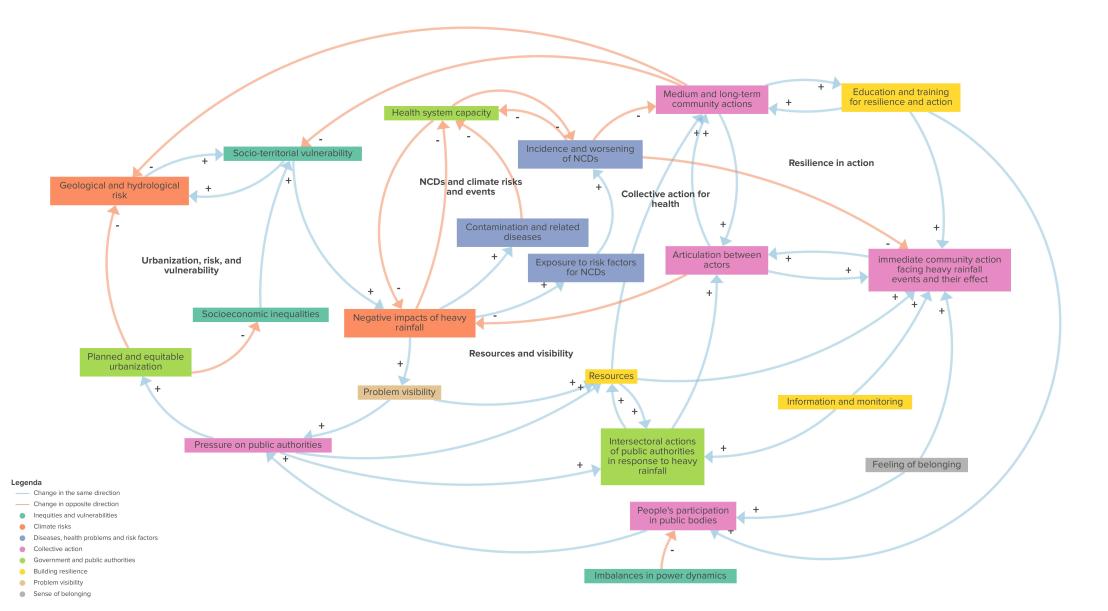
Methods: This study employs a Community-based System Dynamics approach, leveraging shared learning across four cities—Belo Horizonte (BH, Brazil), Yaoundé (Cameroon), Kingston (Jamaica), and Kisumu (Kenya)—through the Global Diet and Activity Research Network (GDAR). An implementation of the method in BH is detailed, examining drivers and interdependencies shaping community-based climate resilience strategies against heavy rainfalls.

Results: In BH, findings highlight the interplay between urbanization risks, vulnerabilities, heavy rainfall, and NCDs, with visibility, resources, education, and training identified as critical intervention points.

Conclusion: This study underscores the importance of aligning community action with public policy and highlights opportunities for collective learning and resilience-building for climate change in Global South cities.

Read the full article at: www.frontiersin.org

Measuring social mobility in temporal networks

Matthew Russell Barnes, Vincenzo Nicosia & Richard G. Clegg 

Scientific Reports volume 15, Article number: 5941 (2025)

In complex networks, the “rich-get-richer” effect (nodes with high degree at one point in time gain more degree in their future) is commonly observed. In practice this is often studied on a static network snapshot, for example, a preferential attachment model assumed to explain the more highly connected nodes or a rich-club effect that analyses the most highly connected nodes. In this paper, we consider temporal measures of how success (measured here as node degree) propagates across time. By analogy with social mobility (a measure of people moving within a social hierarchy through their life) we define hierarchical mobility to measure how a node’s propensity to gain degree changes over time. We introduce an associated taxonomy of temporal correlation statistics including mobility, philanthropy and community. Mobility measures the extent to which a node’s degree gain in one time period predicts its degree gain in the next. Philanthropy and community measure similar properties related to node neighbourhood. We apply these statistics both to artificial models and to 26 real temporal networks. We find that most of our networks show a tendency for individual nodes and their neighbourhoods to remain in similar hierarchical positions over time, while most networks show low correlative effects between individuals and their neighbourhoods. Moreover, we show that the mobility taxonomy can discriminate between networks from different fields. We also generate artificial network models to gain intuition about the behaviour and expected range of the statistics. The artificial models show that the opposite of the “rich-get-richer” effect requires the existence of inequality of degree in a network. Overall, we show that measuring the hierarchical mobility of a temporal network is an invaluable resource for discovering its underlying structural dynamics.

Read the full article at: www.nature.com

Extending Minds with Generative AI

Andy Clark 
Nature Communications volume 16, Article number: 4627 (2025)

As human-AI collaborations become the norm, we should remind ourselves that it is our basic nature to build hybrid thinking systems – ones that fluidly incorporate non-biological resources. Recognizing this invites us to change the way we think about both the threats and promises of the coming age.

Read the full article at: www.nature.com

Breaking the Code: Multi-level Learning in the Eurovision Song Contest

Luís A. Nunes Amaral, Arthur Capozzi, Dirk Helbing

Organizations learn from the market, political, and societal responses to their actions. While in some cases both the actions and responses take place in an open manner, in many others, some aspects may be hidden from external observers. The Eurovision Song Contest offers an interesting example to study organizational level learning at two levels: organizers and participants. We find evidence for changes in the rules of the Contest in response to undesired outcomes such as runaway winners. We also find strong evidence of participant learning in the characteristics of competing songs over the 70-years of the Contest. English has been adopted as the lingua franca of the competing songs and pop has become the standard genre. Number of words of lyrics has also grown in response to this collective learning. Remarkably, we find evidence that four participating countries have chosen to ignore the “lesson” that English lyrics increase winning probability. This choice is consistent with utility functions that award greater value to featuring national language than to winning the Contest. Indeed, we find evidence that some countries — but not Germany — appear to be less susceptible to “peer” pressure. These observations appear to be valid beyond Eurovision.

Read the full article at: arxiv.org