APCNCS 2026 – Asia-Pacific Summer School and Conference on Networks and Complex Systems

9-12 June, 2026
Nanyang Technological University, Singapore

The number of scientists working on networks and complex systems in the Asia-Pacific region is increasing, but high-level conferences in these areas remain limited to NetSci, NetSciX, the International Conference on Computational Science (ICCS), and Conference on Complex Systems (CCS). Asia-Pacific scientists, especially postdocs and PhD students in these areas therefore have limited opportunities to attend these conferences. This leads to a lack of exposure of Asia-Pacific scientists to good work done elsewhere in the world, and of scientists from other parts of the world to good work done in Asia-Pacific, and seriously hampers the academic growths of Asia-Pacific scientists. Recently, we have been encouraged by the strong turnout of Indian scientists at all levels at the NetSciX 2025 conference in Indore, India. We can sense that the younger scientists treasured this opportunity to share their work. Unfortunately, it is impossible to bring these flagship conferences to Asia-Pacific every year. At best, we can host one such conference in Asia once every three to four years.

This prompted us to start an Asia-Pacific Conference on Networks and Complex Systems beginning next year (2-5 Jun 2026 in Singapore) to cater to these unmet demands. With this conference, we would always have a platform to present our recent work and meet up with colleagues. While we will always invite the most exciting speakers from all around the world, our goal is to include more invited speakers from Asia-Pacific. We also aim to give as many participants as possible (including PhD students) a chance to give oral presentations. We will rotate this conference series around Asia-Pacific, where most venues are more affordable compared to Europe or North America. Hopefully, more Asian scientists would be able to attend, even if they have limited funding. This is especially true of PhD students and postdoctoral researchers, many of whom can only attend the local editions of the conference.

Finally, to ensure that the conference is relevant and high-level, we will be advised by an International Advisory Committee of eminent scientists in the fields of networks and complex systems. Additionally, to ensure that good organizational practices are shared after they are developed, besides local organizers the organizing team for a given year will also comprise core members from the organizing team for the next year.

More at: apcncs2026.github.io
Copy or collaborate? How networks impact collective problem solving

Gülşah Akçakır, John C. Lang & P. J. Lamberson
npj Complexity volume 2, Article number: 35 (2025)

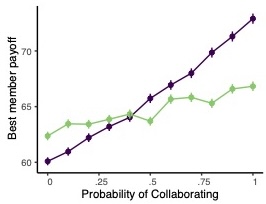
Collaboration enables groups to solve problems beyond the reach of their individual members in contexts ranging from research and development to high-energy physics. While communication networks play a pivotal role in group success, there is a longstanding debate on the optimal network topology for solving complex problems. Prior research reaches contradictory conclusions–some studies suggest networks that slow information transmission help maintain diversity, leading groups to explore more of the problem space and find better solutions in the long run, while others argue that networks that maximize communication efficiency allow groups to exploit known solutions, boosting overall performance. Many existing models assume that individuals use their network connections only to copy better-performing group members, but we show that such groups often perform worse than if individuals worked independently. Instead, our model introduces a crucial distinction: in addition to copying, individuals can actively collaborate, leveraging diverse perspectives to uncover solutions that would otherwise remain inaccessible. Our findings reveal that the optimal network structure depends on the balance between copying and collaboration. When copying dominates, inefficient, exploration-focused networks lead to better outcomes. However, when individuals primarily collaborate, highly connected, efficient networks win out. We also show how groups can reap the benefits of both strategies by employing a collaborate first-copy later heuristic in highly connected networks. The results offer new insights into how organizations should be structured to maximize problem-solving performance across different contexts.

Read the full article at: www.nature.com

The Physics of News, Rumors, and Opinions

Guido Caldarelli, Oriol Artime, Giulia Fischetti, Stefano Guarino, Andrzej Nowak, Fabio Saracco, Petter Holme, Manlio de Domenico
The boundaries between physical and social networks have narrowed with the advent of the Internet and its pervasive platforms. This has given rise to a complex adaptive information ecosystem where individuals and machines compete for attention, leading to emergent collective phenomena. The flow of information in this ecosystem is often non-trivial and involves complex user strategies from the forging or strategic amplification of manipulative content to large-scale coordinated behavior that trigger misinformation cascades, echo-chamber reinforcement, and opinion polarization. We argue that statistical physics provides a suitable and necessary framework for analyzing the unfolding of these complex dynamics on socio-technological systems. This review systematically covers the foundational and applied aspects of this framework. The review is structured to first establish the theoretical foundation for analyzing these complex systems, examining both structural models of complex networks and physical models of social dynamics (e.g., epidemic and spin models). We then ground these concepts by describing the modern media ecosystem where these dynamics currently unfold, including a comparative analysis of platforms and the challenge of information disorders. The central sections proceed to apply this framework to two central phenomena: first, by analyzing the collective dynamics of information spreading, with a dedicated focus on the models, the main empirical insights, and the unique traits characterizing misinformation; and second, by reviewing current models of opinion dynamics, spanning discrete, continuous, and coevolutionary approaches. In summary, we review both empirical findings based on massive data analytics and theoretical advances, highlighting the valuable insights obtained from physics-based efforts to investigate these phenomena of high societal impact.

Read the full article at: arxiv.org

The hidden physics of life | Nikta Fakhri

Life thrives far from equilibrium, driven by dynamic energy flows that build complexity and break symmetry. These flows create patterns, from the mesmerizing murmur of starlings to the rippling protein waves in cells, revealing a self-organizing dance in the physics of living systems. By understanding these patterns, we can understand the arrow of time, energy, and the processes that sustain life, challenging us to perceive existence as a vibrant, evolving ballet.

Nikta is an associate professor in the department of physics at MIT and the physics of living systems group. She studies how to adapt and extend physics concepts to describe how tiny biological components give rise to living organisms. Her research group combines concepts from physics, biology, and engineering to decode non-equilibrium mechanisms in active living matter and exploit these mechanisms to engineer functional, active materials.

Watch at: www.youtube.com

The Power of Complex Systems: Unlocking Intelligence in Mobile Communication Networks by Marialisa Scatà

* Explores the potential of complex systems in shaping the future of communication networks
* Integrates network science, bio-inspired models, artificial intelligence, and higher-order graph theory
* Provides a guide for researchers to use the full potential of complex systems in revolutionizing communication networks

More at: link.springer.com