
Month: July 2026

Infodynamics of Corruption and Parasitism, a Review

Klaus Jaffe

Infodynamics studies how energy and information interact and change over time. In social behaviour this interaction is especially visible: relationships involving asymmetric energy exchange, often take the form of parasitism or corruption. Corruption denotes behaviour that is unlawful, whereas social parasitism describes exploitative relationships that are socially damaging but legal. In contemporary societies a primary form of energy is money, and many instances of parasitic or corrupt behaviour revolve around its distribution and use. Social parasitic behaviour predate human society: primate studies document bribery-like exchanges for favours, status, food, shelter, transport, or priority in scarce resources, showing that moneyless systems are not immune to corruption. Corruption can cause incalculable harm to society as victims of earthquakes in Haiti, Tukey and Venezuela can attest. This essay reviews essential aspects of corruption and social parasitism among humans. Both phenomena are sustained when information is distorted and transparency is suppressed, preventing antagonistic or corrective forces from acting.

Read the full article at: papers.ssrn.com
A Chemically Defined Synthetic Cell Capable of Growth and Replication

Nathaniel J. Gaut, Christopher Deich, Brock Cash, Tanner Hoog, Aaron E. Engelhart, Katarzyna P. Adamala

Prof. Kate Adamala and her team at the University of Minnesota have built SpudCell, a cell-like system constructed entirely from known chemical components that can perform a complete cell cycle.

The system contains 36 purified enzymes, a 90,000 base pair genome spread across nine separate DNA molecules, and a lipid membrane. SpudCell is able to grow, replicate its genome, divide, and undergo selection and competition across multiple generations.

Unlike earlier work on minimal cells that carved down living cells, SpudCell is built entirely bottom-up from individually purified, non-living components. It is the first time such a system has demonstrated a complete cell cycle.

Read the full article at: biotic.org

GOettingen EMergent Minds: Winter School on Learning and Computation in Brains and Machines

Winter School Feb 15 – Mar 6, 2027
Registration open until Sep 1, 2026

This winter school brings together researchers from neuroscience, machine learning, information theory, and applied mathematics to study learning, computation, and representation in complex systems. Topics range from neural dynamics and synaptic plasticity to data-driven discovery of dynamical models, biologically inspired machine learning, information-theoretic approaches to causality, and experimental and data-analytic perspectives. The goal is to foster a shared understanding of how brains and machines learn, represent structure in the world, and give rise to coherent computation across scales.

The program will contain lectures from invited speakers and researchers from Göttingen, hands-on tutorials, a hackathon, lab tours, a poster session, and networking activities.
A Special session with a dedicated lecture on the Philosophy and Ethics of Artificial Intelligence.
No registration fees and applications are open until Sep 1 2026.
The Venue is the Max Planck Institute for Dynamics and Self-Organization Am Faßberg 17, 37077 Göttingen

More at: goemmi-goettingen.de

72 Hours, 7 Teams, Infinite Complexity

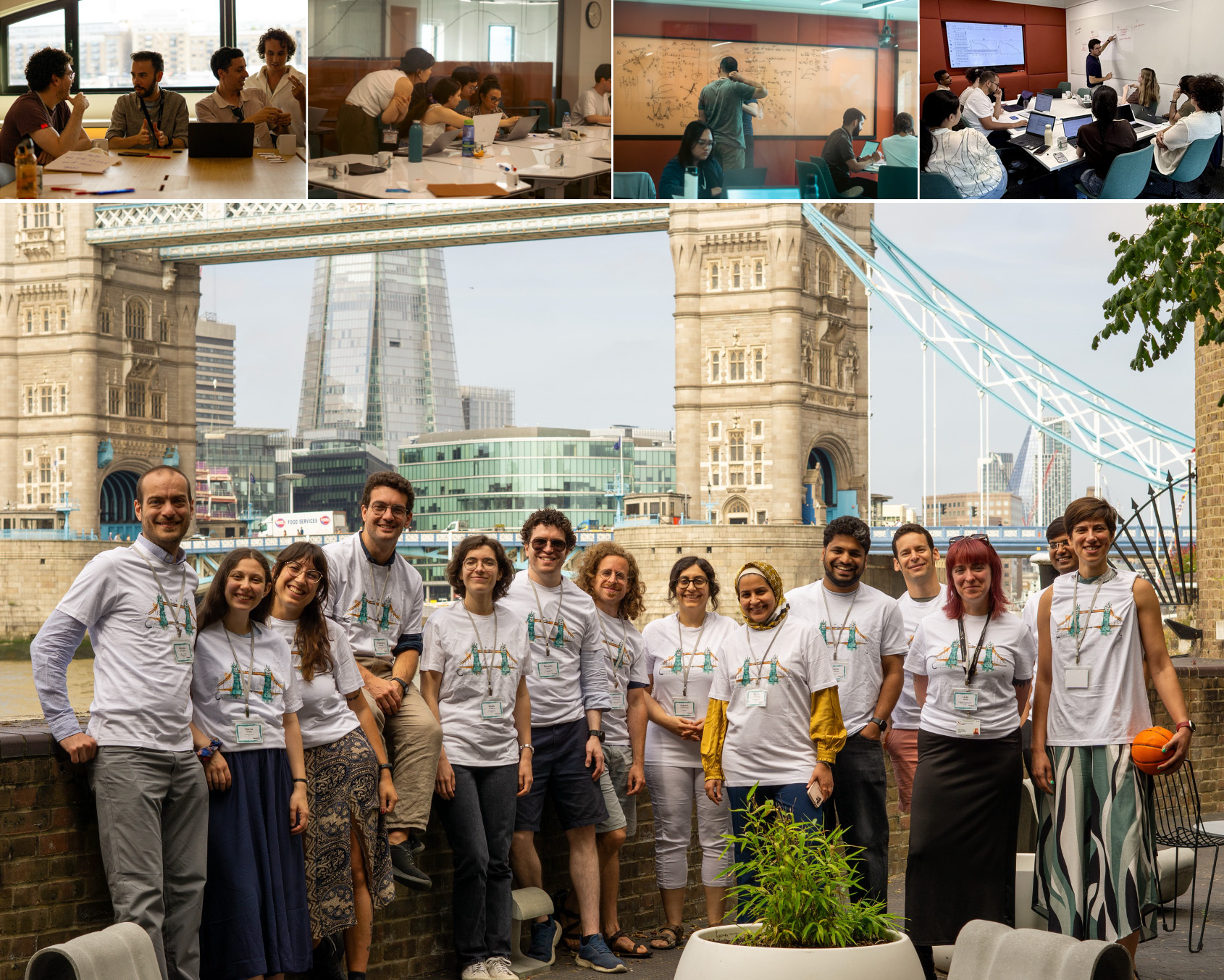
The 2026 edition of the Complexity 72h Workshop has wrapped up in London, bringing together roughly 60 participants and 14 tutor teams for five days of intensive, collaborative science. Hosted by Northeastern University London and the Network Science Institute (NetSI) at their Devon House campus—a striking location overlooking London’s historic St Katharine Docks, the event carried on a tradition launched in 2018 where researchers form small teams around a specific project and work flat-out for 72 hours, with the goal of having a paper ready for an online repository by the time the clock runs out. The track record so far is perfect — all 33 projects from past editions have resulted in preprints, and 9 have gone on to become peer-reviewed publications, leading to long-term collaborations.

This year’s cohort tackled a notably wide range of questions. Projects spanned political polarization and belief networks, brain connectivity and the social self, regional greenhouse-gas trends, emergent deception in LLM-based agent models, statistical signatures of success in NBA basketball, patterns in egocentric communication networks, and the long-term impact of AI on education. The diversity of topics is part of what makes the format so productive: participants arrive from different disciplines and leave having genuinely done science together. 

True to the workshop’s mission of producing a research preprint within 72 hours, the results of the seven projects can already be viewed on arXiv

Read the full article at: www.networkscienceinstitute.org

Investigation of regional variations in CO$_2$ growth rates : Integrating Emission Inventories and Atmospheric Observations

Investigation of regional variations in CO2 growth rates : Integrating Emission Inventories and Atmospheric Observations
Yogesh Bali, Darja Cvetković, Juan Gancio, Adrián Gutiérrez-Arroyo, Sofia Vazquez Alferez, Xuan Tung Vu, Jin Yan, Pietro Zgaga, Fakhteh Ghanbarnejad, Nasrin Mostafavi Pak
Atmospheric carbon dioxide (CO2) growth rates reflects the combined influence of anthropogenic emissions, biospheric carbon exchange, and climate variability. While climate mitigation is primarily evaluated using bottom-up emission inventories within political boundaries, there is a need to validate these emission reductions using atmospheric measurements. Here, we present a global top-down analysis of atmospheric CO2 growth rates using CAMS atmospheric CO2 reanalysis, EDGAR anthropogenic emissions, GOSIF dataset and the Southern Oscillation Index (SOI) as a measures of biospheric activity, to quantify the relative influence of human and natural drivers. We find that atmospheric CO2 growth rate varies substantially across space and time but is dominated by natural carbon-cycle processes and global background trends. Anthropogenic emission signals are frequently masked by natural variability, making regional top-down detection of human emission changes difficult. The COVID-19 emission reductions in 2020, despite occurring during a neutral ENSO year, were not consistently reflected in regional atmospheric CO2 growth rates, highlighting the dominant roles of biospheric dynamics and atmospheric transport. Using unsupervised clustering and persistence analysis, we identify five characteristic carbon-cycle regimes. Spatial averaging removes much of the regional variability, leaving large-scale climate as the dominant control in most regimes. The active biosphere is the main exception, where strong biogenic signals persist, underscoring the critical role of tropical forests in shaping atmospheric CO2 variability.

Read the full article at: arxiv.org