
Santa Elena Tellez-Flores and Alberto Robledo
Complexities 2026, 2(3), 19
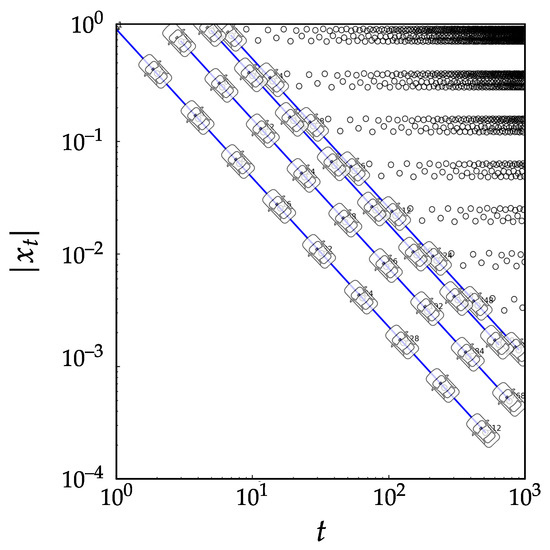
We present a nonlinear dynamical model for vehicular traffic jams and their dissolution based on the noise-perturbed onset of chaos. The model makes use of the bifurcation gap generated by addition of noise to quadratic iterated maps. The gap results from the elimination by noise of periodic and chaotic attractors with large periods and large numbers of chaotic bands, respectively. The bifurcation gap is recapitulated at the transition to chaos (vanishing Lyapunov exponent) as a crossover from noiseless to irregular, chaotic-like regimes at an iteration time tcross with value dependent on the noise amplitude. This behavior is employed in a model (with variants) that we design for multilane road congested traffic. We highlight four main model properties that are also present in the dynamics of glass formation: (i) plateau interrupted relaxation; (ii) Adam–Gibbs empirical law; (iii) aging; and (iv) diffusion arrest. The model bridges previous studies that have indicated analogies between glassy dynamics and vehicular traffic as well as nonlinear dynamics and same-name traffic. We also discuss the connection of the model with urban multilane road networks.
Read the full article at: www.mdpi.com

