
Sean P. Maley, Carlos Gershenson, Stuart A. Kauffman
Journal of Theoretical Biology
How new levels of organization arise is a long-standing question. The emergence of higher-level organization can appear unlikely, since cooperation must prevail over competition. One well-studied example is the autocatalytic set, a collection of molecules in which the formation of each member is catalyzed by another member of the set, and which is often considered a prerequisite for the evolution of life.
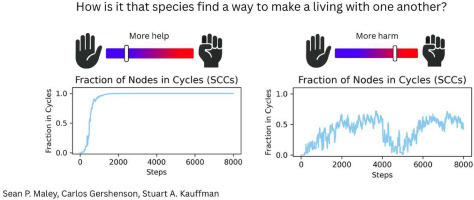
We present a random threshold-directed network model that integrates node-specific traits with dynamic edge formation and node removal, simulating arbitrary levels of cooperation and competition. Intrinsic node values determine directed links through threshold rules, generating a multi-digraph with signed edges (reflecting support and antagonism, labeled “help” and “harm”) that yields two parallel yet interdependent threshold graphs. Incorporating temporal growth and node turnover allows exploration of the evolution, adaptation, and potential collapse of communities.
We find that a strongly connected core assembles and persists even when antagonistic interactions predominate. Members are culled once incoming harm outweighs incoming help, so those that remain are helped more than they are harmed, and a quantitative increase in the number of elements produces a qualitative transition. As the harm-to-help ratio ρ rises, late-time population growth and mean connectivity both decline steadily, growth reaching zero and connectivity its floor near ρc ≈ 0.6, marking a shift from sustained growth to a bounded regime. Raising the binding chance moves the onset of a system-spanning strongly connected component to progressively smaller populations without changing its eventual extent, indicating that interaction opportunity governs when collective organization appears rather than whether it appears.
These results extend classical random threshold and Erdős-Rényi random graph models, and bear on how microbial communities and other adaptive systems assemble Collective Affordance Sets under persistent antagonism.
Read the full article at: www.sciencedirect.com

