
Author: cxdig

EPJ B Topical Issue: Advances in Complex Systems

Guest Editors: Thiago B. Murari, Marcelo A. Moret, Hernane B. de B. Pereira, Tarcísio M. Rocha Filho, José F. F. Mendes and Tiziana Di Matteo

Submissions are invited for a Topical Issue of EPJ B on Advances in Complex Systems.

In general, a complex system is a system composed of many components that may interact with each other in nonlinear ways. Examples of complex systems include fractals, chaos, nonlinear dynamics, self-organized criticality, and complex networks. This issue aims to promote research in complex systems, both in pure and applied contexts.

The goal of this topical issue is to summarize the most recent research, covering aspects such as:

Foundations of Complex Systems, Basic Sciences, and Quantum Complexity
Complex Networks
Data Science, Machine Learning, and Artificial Intelligence in the context of Complex Systems
Computation and Information Processing in Complex Systems
Economics and Finance
Social Systems
Ecological Systems
Cognition, Psychology, and Neurosciences
Complexity in Biology and Health Sciences
City Science, Mobility, and Transport
Energy, Environment, Sustainability, Climate, and Global Change

Read the full call at: epjb.epj.org
Self-Organisation of Prediction Models

Rainer Feistel

Entropy 2023, 25(12), 1596

Living organisms are active open systems far from thermodynamic equilibrium. The ability to behave actively corresponds to dynamical metastability: minor but supercritical internal or external effects may trigger major substantial actions such as gross mechanical motion, dissipating internally accumulated energy reserves. Gaining a selective advantage from the beneficial use of activity requires a consistent combination of sensual perception, memorised experience, statistical or causal prediction models, and the resulting favourable decisions on actions. This information processing chain originated from mere physical interaction processes prior to life, here denoted as structural information exchange. From there, the self-organised transition to symbolic information processing marks the beginning of life, evolving through the novel purposivity of trial-and-error feedback and the accumulation of symbolic information. The emergence of symbols and prediction models can be described as a ritualisation transition, a symmetry-breaking kinetic phase transition of the second kind previously known from behavioural biology. The related new symmetry is the neutrally stable arbitrariness, conventionality, or code invariance of symbols with respect to their meaning. The meaning of such symbols is given by the structural effect they ultimately unleash, directly or indirectly, by deciding on which actions to take. The early genetic code represents the first symbols. The genetically inherited symbolic information is the first prediction model for activities sufficient for survival under the condition of environmental continuity, sometimes understood as the “final causality” property of the model.

Read the full article at: www.mdpi.com

9 Faculty Openings | Systems Science and Industrial Engineering | Binghamton University

The Department of Systems Science and Industrial Engineering (SSIE) at Binghamton University’s Thomas J. Watson College of Engineering and Applied Science is expanding further and seeks eight (8) tenure-track faculty:

Assistant Professor in Energy Systems (1 position)
Assistant Professor in Health Systems (1 position)
Assistant Professor in Systems Science (1 position)
Associate Professor of Nanofabrication (1 position)
Associate or Full Professor in Energy Storage (1 position)
Associate or Full Professor in Energy Systems and Policy (1 position)
Associate or Full Professor in Flexible, Additive and Hybrid Electronic Systems (1 position)
Associate or Full Professor in Systems Engineering in Electronics and Semiconductor Manufacturing (1 position)
In addition, the greater Watson College of Engineering and Applied Science also has openings for the following roles, which could also have close association with SSIE depending on candidate background:

AI/ML SUNY Empire Innovation Professor (1 position)

Read the full article at: www.binghamton.edu

Impact of physicality on network structure

Márton Pósfai, Balázs Szegedy, Iva Bačić, Luka Blagojević, Miklós Abért, János Kertész, László Lovász & Albert-László Barabási 

Nature Physics (2023)

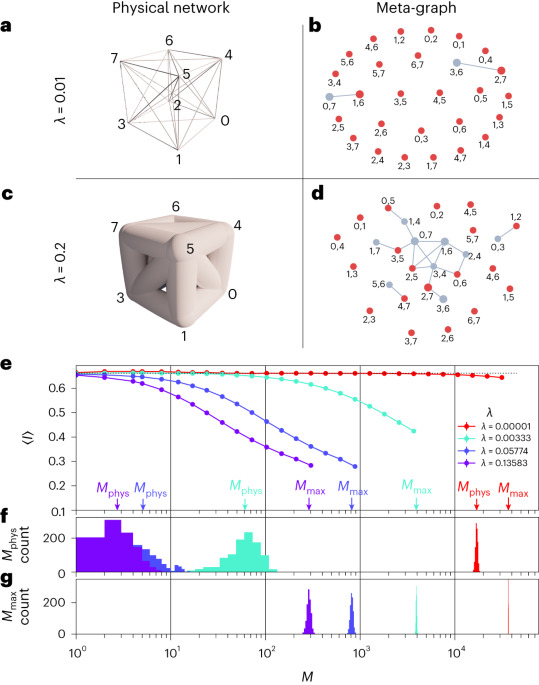
The emergence of detailed maps of physical networks, such as the brain connectome, vascular networks or composite networks in metamaterials, whose nodes and links are physical entities, has demonstrated the limits of the current network science toolset. Link physicality imposes a non-crossing condition that affects both the evolution and the structure of a network, in a way that the adjacency matrix alone—the starting point of all graph-based approaches—cannot capture. Here, we introduce a meta-graph that helps us to discover an exact mapping between linear physical networks and independent sets, which is a central concept in graph theory. The mapping allows us to analytically derive both the onset of physical effects and the emergence of a jamming transition, and to show that physicality affects the network structure even when the total volume of the links is negligible. Finally, we construct the meta-graphs of several real physical networks, which allows us to predict functional features, such as synapse formation in the brain connectome, that agree with empirical data. Overall, our results show that, to understand the evolution and behaviour of real complex networks, the role of physicality must be fully quantified.

Read the full article at: www.nature.com

Comparing Humans, GPT-4, and GPT-4V On Abstraction and Reasoning Tasks

Melanie Mitchell, Alessandro B. Palmarini, Arseny Moskvichev

We explore the abstract reasoning abilities of text-only and multimodal versions of GPT-4, using the ConceptARC benchmark [10], which is designed to evaluate robust understanding and reasoning with core-knowledge concepts. We extend the work of Moskvichev et al. [10] by evaluating GPT-4 on more detailed, one-shot prompting (rather than simple, zero-shot prompts) with text versions of ConceptARC tasks, and by evaluating GPT-4V, the multimodal version of GPT-4, on zero- and one-shot prompts using image versions of the simplest tasks. Our experimental results support the conclusion that neither version of GPT-4 has developed robust abstraction abilities at humanlike levels.

Read the full article at: arxiv.org