

A Focus issue celebrating the 50th anniversary of Kenneth Wilson’s work on the renormalization group.
More at: www.nature.com
Networking the complexity community since 1999
Author: cxdig
A Focus issue celebrating the 50th anniversary of Kenneth Wilson’s work on the renormalization group.
More at: www.nature.com
Zhang Zhang, Arsham Ghavasieh, Jiang Zhang, Manlio De Domenico
Information dynamics is vital for many complex systems with networked backbones, from cells to societies. Recent advances in statistical physics have enabled capturing the macroscopic network properties, like how diverse the flow pathways are and how fast the signals can transport, based on the network counterparts of entropy and free energy. However, given the computational challenge posed by the large number of components in real-world systems, there is a need for advanced network renormalization— i.e., compression— methods providing simpler-to-read representations while preserving the flow of information between functional units across scales. We use graph neural networks to identify suitable groups of components for coarse-graining a network and achieve a low computational complexity suitable for practical application. Even for large compressions, our approach is highly effective in preserving the flow in synthetic and empirical networks, as demonstrated by theoretical analysis and numerical experiments. Remarkably, we find that the model works by merging nodes of similar ecological niches— i.e., structural properties—, suggesting that they play redundant roles as senders or receivers of information. Our work offers a low-complexity renormalization method breaking the size barrier for meaningful compressions of extremely large networks, working as a multiscale topological lens in preserving the flow of information in biological, social, and technological systems better than existing alternatives mostly focused on structural properties of a network.
Read the full article at: www.researchsquare.com
Serguei Saavedra, José Ignacio Arroyo, Pablo A. Marquet, Chris P. Kempes
Metabolic scaling and coexistence theories have been pivotal in mathematizing both the energy expenditures and transformations across individuals and populations. Yet, it is unclear how the sustainability of biodiversity depends on metabolic scaling relationships. Here, we provide a tractable and scalable perspective to study how the possibilities for multispecies coexistence (i.e., feasibility) change as a function of the dependence of a population’s metabolism on body size. This integration predicts that, regardless of body size distribution among populations, there is a reciprocal relationship between the scaling exponents defining the dependence of competitive effects and expected carrying capacities on body size. In line with empirical observations, our integration predicts that expected carrying capacities lead to equilibrium biomasses that are independent from body size, and consequently, to equilibrium abundances that are inversely related to body size. We show that this even distribution of equilibrium biomasses increases the possibilities for multispecies coexistence under random environmental perturbations. Additionally, this integration establishes that the possibilities for multispecies coexistence is maximized when no species has an energetic competitive advantage. This integration opens new opportunities to increase our understanding of how metabolic scaling relationships at the individual and population levels shape processes at the community level.
Read the full article at: www.biorxiv.org
Jesse S. Bettinger, Karl J. Friston
Neuroscience & Biobehavioral Reviews
Since the late nineteen-nineties, the concept of homeostasis has been contextualized within a broader class of “allostatic” dynamics characterized by a wider-berth of causal factors including social, psychological and environmental entailments; the fundamental nature of integrated brain-body dynamics; plus the role of anticipatory, top-down constraints supplied by intrinsic regulatory models. Many of these evidentiary factors are integral in original descriptions of homeostasis; subsequently integrated; and/or cite more-general operating principles of self-organization. As a result, the concept of allostasis may be generalized to a larger category of variational systems in biology, engineering and physics in terms of advances in complex systems, statistical mechanics and dynamics involving heterogenous (hierarchical/heterarchical, modular) systems like brain-networks and the internal milieu. This paper offers a three-part treatment. 1) interpret “allostasis” to emphasize a variational and relational foundation of physiological stability; 2) adapt the role of allostasis as “stability through change” to include a “return to stability” and 3) reframe the model of homeostasis with a conceptual model of criticality that licenses the upgrade to variational dynamics.
Read the full article at: www.sciencedirect.com
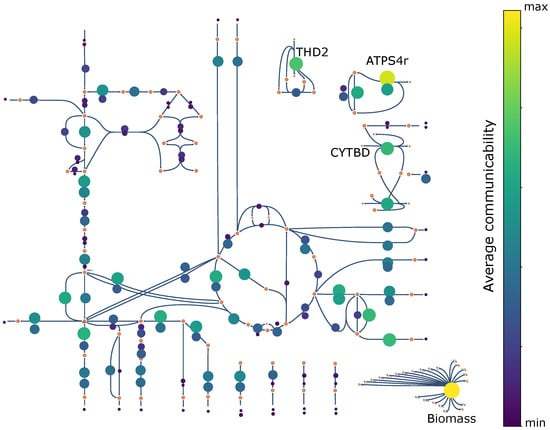 Pietro Traversa, Guilherme Ferraz de Arruda, Alexei Vazquez, Yamir Moreno
Entropy 2023, 25(11), 1537
Metabolic networks are probably among the most challenging and important biological networks. Their study provides insight into how biological pathways work and how robust a specific organism is against an environment or therapy. Here, we propose a directed hypergraph with edge-dependent vertex weight as a novel framework to represent metabolic networks. This hypergraph-based representation captures higher-order interactions among metabolites and reactions, as well as the directionalities of reactions and stoichiometric weights, preserving all essential information. Within this framework, we propose the communicability and the search information as metrics to quantify the robustness and complexity of directed hypergraphs. We explore the implications of network directionality on these measures and illustrate a practical example by applying them to a small-scale E. coli core model. Additionally, we compare the robustness and the complexity of 30 different models of metabolism, connecting structural and biological properties. Our findings show that antibiotic resistance is associated with high structural robustness, while the complexity can distinguish between eukaryotic and prokaryotic organisms.
Read the full article at: www.mdpi.com

