Author: cxdig

PhD Position at Binghamton University

Dr. Sadamori Kojaku invites applicants for graduate research assistant starting in Spring 2024 in System Sciences and Industrial Engineering at Binghamton University. We are seeking highly motivated students to explore the following topics:
● Representation learning for text and graphs
● Complex Systems and Network Science
● Biases in AIs
● Computational social sciences and the science of science.

More at: skojaku.github.io

How Output Outweighs Input and Interlocutors Matter for Study-Abroad SLA: Computational Social Network Analysis of Learner Interactions (winner, Best of MLJ for 2022 paper award)

MICHAŁ B. PARADOWSKI, AGNIESZKA CIERPICH–KOZIEŁ, CHIH–CHUN CHEN, JEREMI K. OCHAB

MLJ Volume106, Issue4 Winter 2022 Pages 694-725

This data-driven study framed in the interactionist approach investigates the influence of social graph topology and peer interaction dynamics among foreign exchange students enrolled in an intensive German language course on second language acquisition (SLA) outcomes. Applying the algorithms and metrics of computational social network analysis (SNA), we find that (a) the best predictor of target language (TL) performance is reciprocal interactions in the language being acquired, (b) the proportion of output in the TL is a stronger predictor than input (Principle of Proportional Output), (c) there is a negative relationship between performance and interactions with same-first-language speakers, (d) a significantly underperforming English native-speaker dominated cluster is present, and (e) there are more intense interactions taking place between students of different proficiency levels. Unlike previous study abroad social network research concentrating on the microlevel of individual learners’ egocentric networks and presenting an emic view only, this study constitutes the first application of computational SNA to a complete learner network (sociogram). It provides new insights into the link between social relations and SLA with an etic perspective, showing how social network configuration and peer learner interaction are stronger predictors of TL performance than individual factors such as attitude or motivation, and offering a rigorous methodology for investigating the phenomenon.

Read the full article at: onlinelibrary.wiley.com

The role of intra-guild indirect interactions in assembling plant-pollinator networks

Sabine Dritz, Rebecca A. Nelson & Fernanda S. Valdovinos 

Nature Communications volume 14, Article number: 5797 (2023)

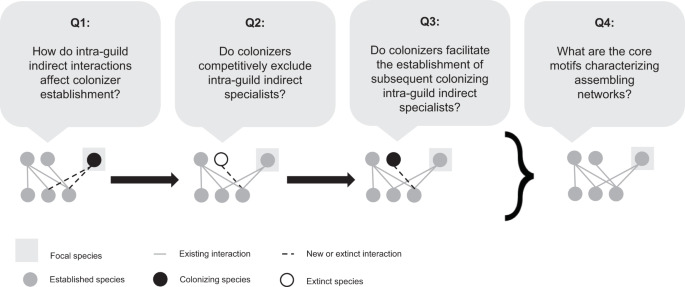
Understanding the assembly of plant-pollinator communities has become critical to their conservation given the rise of species invasions, extirpations, and species’ range shifts. Over the course of assembly, colonizer establishment produces core interaction patterns, called motifs, which shape the trajectory of assembling network structure. Dynamic assembly models can advance our understanding of this process by linking the transient dynamics of colonizer establishment to long-term network development. In this study, we investigate the role of intra-guild indirect interactions and adaptive foraging in shaping the structure of assembling plant-pollinator networks by developing: 1) an assembly model that includes population dynamics and adaptive foraging, and 2) a motif analysis tracking the intra-guild indirect interactions of colonizing species throughout their establishment. We find that while colonizers leverage indirect competition for shared mutualistic resources to establish, adaptive foraging maintains the persistence of inferior competitors. This produces core motifs in which specialist and generalist species coexist on shared mutualistic resources which leads to the emergence of nested networks. Further, the persistence of specialists develops richer and less connected networks which is consistent with empirical data. Our work contributes new understanding and methods to study the effects of species’ intra-guild indirect interactions on community assembly.

Read the full article at: www.nature.com

Meaning from movement and stillness: Signatures of coordination dynamics reveal infant agency

Aliza T. Sloan, Nancy Aaron Jones, and J. A. Scott Kelso

PNAS 120 (39) e2306732120

How do human beings make sense of their relation to the world and realize their ability to effect change? Applying modern concepts and methods of coordination dynamics, we demonstrate that patterns of movement and coordination in 3 to 4-mo-olds may be used to identify states and behavioral phenotypes of emergent agency. By means of a complete coordinative analysis of baby and mobile motion and their interaction, we show that the emergence of agency can take the form of a punctuated self-organizing process, with meaning found both in movement and stillness.

Read the full article at: www.pnas.org

Cross-inhibition leads to group consensus despite the presence of strongly opinionated minorities and asocial behaviour

A. Reina, R. Zakir, G. De Masi, E. Ferrante.

Communications Physics 6: 236, 2023.

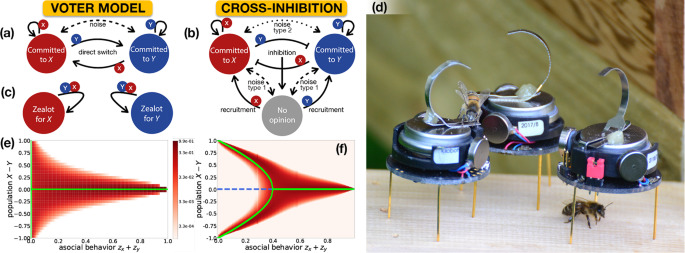
Strongly opinionated minorities can have a dramatic impact on the opinion dynamics of a large population. Two factions of inflexible minorities, polarised into two competing opinions, could lead the entire population to persistent indecision. Equivalently, populations can remain undecided when individuals sporadically change their opinion based on individual information rather than social information. Our analysis compares the cross-inhibition model with the voter model for decisions between equally good alternatives, and with the weighted voter model for decisions among alternatives characterised by different qualities. Here we show that cross-inhibition, contrary to the other two models, is a simple mechanism that allows the population to reach a stable majority for one alternative even in the presence of a relatively high amount of asocial behaviour. The results predicted by the mean-field models are confirmed by experiments with swarms of 100 locally interacting robots. This work suggests an answer to the longstanding question of why inhibitory signals are widespread in natural systems of collective decision making, and, at the same time, it proposes an efficient mechanism for designing resilient swarms of minimalistic robots. Reaching group consensus without a leader can be jeopardized by even a minimal number of self-willed individuals. This study shows that, when individuals use inhibitory signals, a stable consensus is guaranteed, thus suggesting an answer to the longstanding question of why inhibition is widespread in natural systems of collective decision making.

Read the full article at: www.nature.com