Author: cxdig

Impacts of climate change and extreme weather on food supply chains cascade across sectors and regions in Australia

Arunima Malik, Mengyu Li, Manfred Lenzen, Jacob Fry, Navoda Liyanapathirana, Kathleen Beyer, Sinead Boylan, Amanda Lee, David Raubenheimer, Arne Geschke & Mikhail Prokopenko
Nature Food volume 3, pages 631–643 (2022)

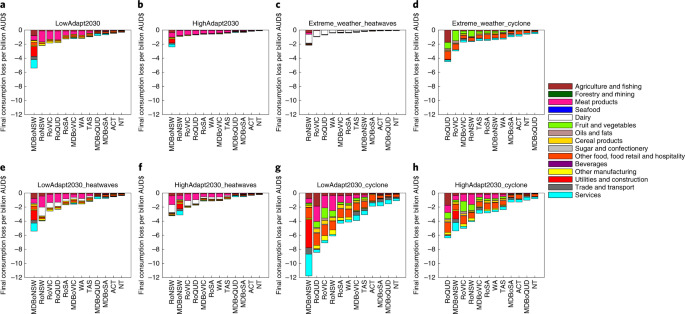
Disasters resulting from climate change and extreme weather events adversely impact crop and livestock production. While the direct impacts of these events on productivity are generally well known, the indirect supply-chain repercussions (spillovers) are still unclear. Here, applying an integrated modelling framework that considers economic and physical factors, we estimate spillovers in terms of social impacts (for example, loss of job and income) and health impacts (for example, nutrient availability and diet quality) resulting from disruptions in food supply chains, which cascade across regions and sectors. Our results demonstrate that post-disaster impacts are wide-ranging and diverse owing to the interconnected nature of supply chains. We find that fruit, vegetable and livestock sectors are the most affected, with effects flowing on to other non-food production sectors such as transport services. The ability to cope with disasters is determined by socio-demographic characteristics, with communities in rural areas being most affected.

Read the full article at: www.nature.com
Cattle transport network predicts endemic and epidemic foot-and-mouth disease risk on farms in Turkey

Herrera-Diestra JL, Tildesley M, Shea K, Ferrari MJ (2022) Cattle transport network predicts endemic and epidemic foot-and-mouth disease risk on farms in Turkey. PLoS Comput Biol 18(8): e1010354.

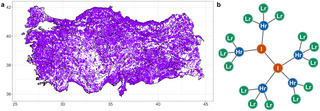
Contact network epidemiology has been extensively used in the context of infectious diseases, primarily focusing on epidemic diseases. In this paper we use detailed recorded data about cattle exchange between farms in Turkey from 2007 to 2012, to build, analyze and characterize the directed-weighted complex network of shipments of cattle. Additionally, using outbreaks data about recorded cases of foot-and-mouth disease (FMD) in Turkey, we assess the correlation between the “farm’s” position in the network (importance) and the risk of being infected with FMD, which has been endemic in Turkey for a long time. We find some network measures that are more likely to identify high-risk and low-risk farms (in-degree and in-coreness, respectively) when proposing strategies for surveillance or containment of an infectious disease.

Read the full article at: journals.plos.org

Quantifying the unexpected: A scientific approach to Black Swans

Giordano De Marzo, Andrea Gabrielli, Andrea Zaccaria, and Luciano Pietronero
Phys. Rev. Research 4, 033079 – Published 27 July 2022

Many natural and socioeconomic systems are characterized by power-law distributions that make the occurrence of extreme events not negligible. Such events are sometimes referred to as Black Swans, but a quantitative definition of a Black Swan is still lacking. Here, by leveraging on the properties of Zipf-Mandelbrot law, we investigate the relations between such extreme events and the dynamics of the upper cutoff of the inherent distribution. This approach permits a quantification of extreme events and allows to classify them as White, Gray, or Black Swans. Our criterion is in accordance with some previous findings but also allows us to spot new examples of Black Swans, such as Lionel Messi and the Turkish Airlines Flight 981 disaster. The systematic and quantitative methodology we developed allows a scientific and immediate categorization of rare events, also providing insight into the generative mechanism behind Black Swans.

Read the full article at: link.aps.org

Prevalence and scalable control of localized networks

Chao Duan, Takashi Nishikawa, and Adilson E. Motter

PNAS 119 (32) e2122566119

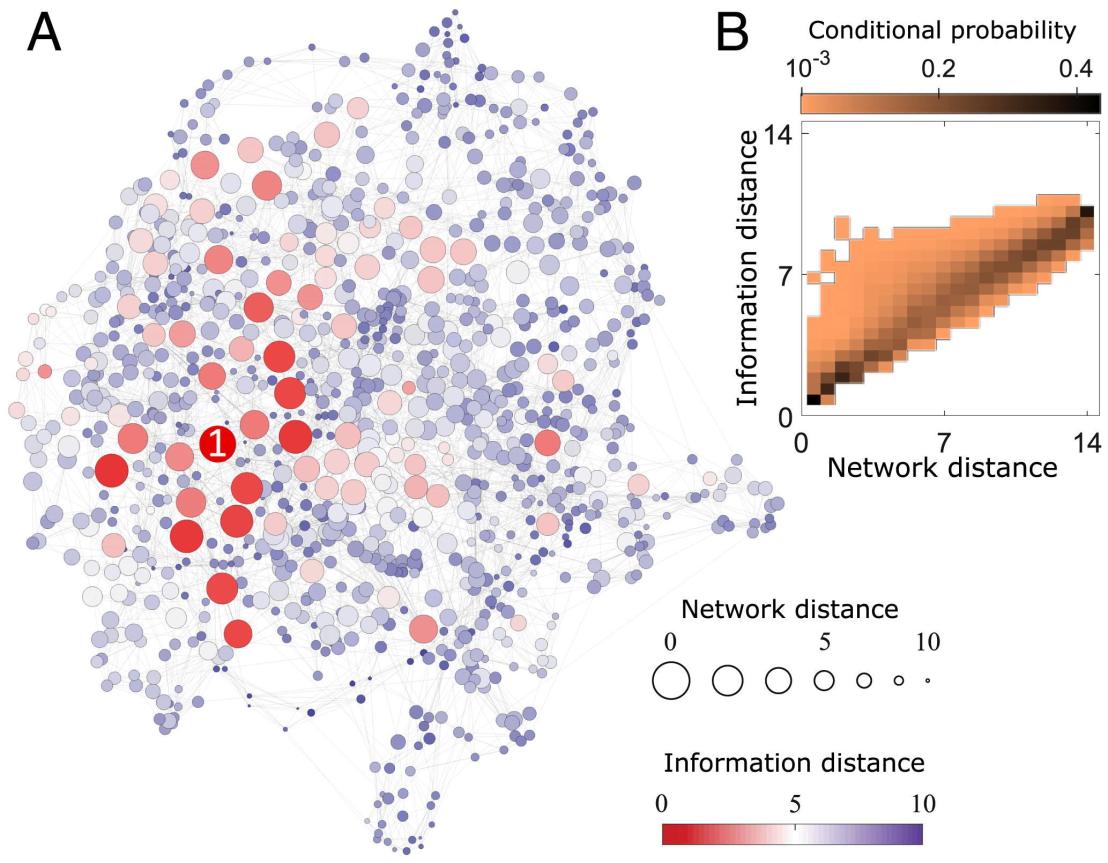
The control of large-scale networks is a pressing problem of relevance to numerous natural and engineered systems. Despite recent advances in network and control science, there has been a lack of fundamental understanding about the network properties that can enable effective and efficient control of such systems. Here, we demonstrate that network locality, which we show to be a rather common property, can dramatically improve our ability to control large-scale networks. In particular, we demonstrate that locality can be exploited to substantially simplify the task of controlling nonlinear networks for desirable dynamical performance while minimizing the control effort. Our theory and algorithms provide a unified framework and show that local computation and communication suffice to achieve near-optimal control outcomes.

Read the full article at: www.pnas.org