
Author: cxdig

GATTACA AS A LENS ON CONTEMPORARY GENETICS Marking 25 years into the film’s “not-too-distant” future

C. Brandon Ogbunu, Michael D. Edge

The 1997 film Gattaca has emerged as a canonical pop culture reference used to discuss modern controversies in genetics and bioethics. It appeared in theaters a few years prior to the announcement of the “completion” of the human genome (2000), as the science of human genetics was developing a renewed sense of its social implications. The story is set in a near-future world in which parents can, with technological assistance, influence the genetic composition of their offspring on the basis of predicted life outcomes. This moment—25 years after the film’s release—offers an opportunity to reflect on where so- ciety currently stands with respect to the ideas explored in Gattaca. Here, we review and discuss several active areas of genetic research—genetic prediction, embryo selection, forensic genetics, and others–that interface directly with scenes and concepts in the film. On its silver anniversary, we argue that Gattaca remains an important reflection of society’s expectations and fears with respect to the ways that genetic science has manifested in the real world. In an accompanying appendix, we offer some thought questions to guide group discussions inside and outside of the classroom.

Read the full article at: osf.io
Causal Machine Learning: A Survey and Open Problems

Jean Kaddour, Aengus Lynch, Qi Liu, Matt J. Kusner, Ricardo Silva
Causal Machine Learning (CausalML) is an umbrella term for machine learning methods that formalize the data-generation process as a structural causal model (SCM). This perspective enables us to reason about the effects of changes to this process (interventions) and what would have happened in hindsight (counterfactuals). We categorize work in CausalML into five groups according to the problems they address: (1) causal supervised learning, (2) causal generative modeling, (3) causal explanations, (4) causal fairness, and (5) causal reinforcement learning. We systematically compare the methods in each category and point out open problems. Further, we review data-modality-specific applications in computer vision, natural language processing, and graph representation learning. Finally, we provide an overview of causal benchmarks and a critical discussion of the state of this nascent field, including recommendations for future work.

Read the full article at: arxiv.org

Worldwide scaling of waste generation in urban systems

Mingzhen Lu, Chuanbin Zhou, Chenghao Wang, Robert B. Jackson, Christopher P. Kempes
The production of waste as a consequence of human activities is one of the most fundamental challenges facing our society and global ecological systems. Waste generation is rapidly increasing, with corresponding shifts in the structure of our societies where almost all nations are moving from rural agrarian societies to urban and technological ones. However, the connections between these radical societal shifts and waste generation have not yet been described. Here we apply scaling theory to establish a new understanding of waste in urban systems. We identify universal scaling laws of waste generation across diverse urban systems worldwide for three forms of waste: wastewater, municipal solid waste, and greenhouse gasses. We show that wastewater generation scales superlinearly, municipal solid waste scales linearly, and greenhouse gasses scales sublinearly with city size. In specific cases production can be understood in terms of city size coupled with financial and natural resources. For example, wastewater generation can be understood in terms of the increased economic activity of larger cities, and the deviations around the scaling relationship – indicating relative efficiency – depend on GDP per person and local rainfall. We also show how the temporal evolution of these scaling relationships reveals a loss of economies of scale and the general increase in waste production, where sublinear scaling relationships become linear. Our findings suggest general mechanisms controlling waste generation across diverse cities and global urban systems. Our approach offers a systematic approach to uncover these underlying mechanisms that might be key to reducing waste and pursing a more sustainable future.

Read the full article at: arxiv.org

Social capital I: measurement and associations with economic mobility

Raj Chetty, Matthew O. Jackson, Theresa Kuchler, Johannes Stroebel, Nathaniel Hendren, Robert B. Fluegge, Sara Gong, Federico Gonzalez, Armelle Grondin, Matthew Jacob, Drew Johnston, Martin Koenen, Eduardo Laguna-Muggenburg, Florian Mudekereza, Tom Rutter, Nicolaj Thor, Wilbur Townsend, Ruby Zhang, Mike Bailey, Pablo Barberá, Monica Bhole & Nils Wernerfelt 

Nature (2022)

Social capital—the strength of an individual’s social network and community—has been identified as a potential determinant of outcomes ranging from education to health1,2,3,4,5,6,7,8. However, efforts to understand what types of social capital matter for these outcomes have been hindered by a lack of social network data. Here, in the first of a pair of papers9, we use data on 21 billion friendships from Facebook to study social capital. We measure and analyse three types of social capital by ZIP (postal) code in the United States: (1) connectedness between different types of people, such as those with low versus high socioeconomic status (SES); (2) social cohesion, such as the extent of cliques in friendship networks; and (3) civic engagement, such as rates of volunteering. These measures vary substantially across areas, but are not highly correlated with each other. We demonstrate the importance of distinguishing these forms of social capital by analysing their associations with economic mobility across areas. The share of high-SES friends among individuals with low SES—which we term economic connectedness—is among the strongest predictors of upward income mobility identified to date10,11. Other social capital measures are not strongly associated with economic mobility. If children with low-SES parents were to grow up in counties with economic connectedness comparable to that of the average child with high-SES parents, their incomes in adulthood would increase by 20% on average. Differences in economic connectedness can explain well-known relationships between upward income mobility and racial segregation, poverty rates, and inequality12,13,14. To support further research and policy interventions, we publicly release privacy-protected statistics on social capital by ZIP code at https://www.socialcapital.org. 

Read the full article at: www.nature.com

Social capital II: determinants of economic connectedness

Raj Chetty, Matthew O. Jackson, Theresa Kuchler, Johannes Stroebel, Nathaniel Hendren, Robert B. Fluegge, Sara Gong, Federico Gonzalez, Armelle Grondin, Matthew Jacob, Drew Johnston, Martin Koenen, Eduardo Laguna-Muggenburg, Florian Mudekereza, Tom Rutter, Nicolaj Thor, Wilbur Townsend, Ruby Zhang, Mike Bailey, Pablo Barberá, Monica Bhole & Nils Wernerfelt
Nature (2022)

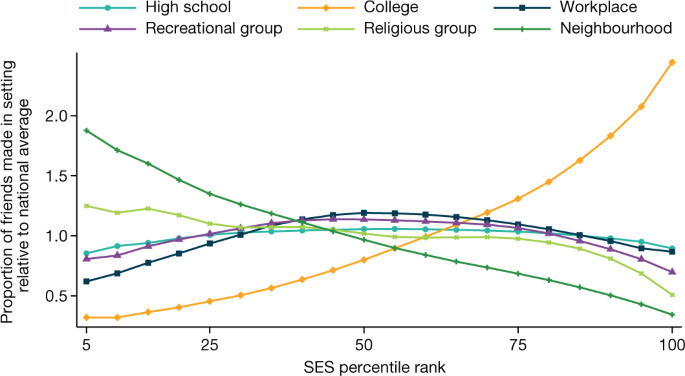
Low levels of social interaction across class lines have generated widespread concern1,2,3,4 and are associated with worse outcomes, such as lower rates of upward income mobility4,5,6,7. Here we analyse the determinants of cross-class interaction using data from Facebook, building on the analysis in our companion paper7. We show that about half of the social disconnection across socioeconomic lines—measured as the difference in the share of high-socioeconomic status (SES) friends between people with low and high SES—is explained by differences in exposure to people with high SES in groups such as schools and religious organizations. The other half is explained by friending bias—the tendency for people with low SES to befriend people with high SES at lower rates even conditional on exposure. Friending bias is shaped by the structure of the groups in which people interact. For example, friending bias is higher in larger and more diverse groups and lower in religious organizations than in schools and workplaces. Distinguishing exposure from friending bias is helpful for identifying interventions to increase cross-SES friendships (economic connectedness). Using fluctuations in the share of students with high SES across high school cohorts, we show that increases in high-SES exposure lead low-SES people to form more friendships with high-SES people in schools that exhibit low levels of friending bias. Thus, socioeconomic integration can increase economic connectedness in communities in which friending bias is low. By contrast, when friending bias is high, increasing cross-SES interactions among existing members may be necessary to increase economic connectedness. To support such efforts, we release privacy-protected statistics on economic connectedness, exposure and friending bias for each ZIP (postal) code, high school and college in the United States at https://www.socialcapital.org.

Read the full article at: www.nature.com