
Author: cxdig

Information theory: A foundation for complexity science

Amos Golan and John Harte

PNAS 119 (33) e2119089119

Modeling and inference are central to most areas of science and especially to evolving and complex systems. Critically, the information we have is often uncertain and insufficient, resulting in an underdetermined inference problem; multiple inferences, models, and theories are consistent with available information. Information theory (in particular, the maximum information entropy formalism) provides a way to deal with such complexity. It has been applied to numerous problems, within and across many disciplines, over the last few decades. In this perspective, we review the historical development of this procedure, provide an overview of the many applications of maximum entropy and its extensions to complex systems, and discuss in more detail some recent advances in constructing comprehensive theory based on this inference procedure. We also discuss efforts at the frontier of information-theoretic inference: application to complex dynamic systems with time-varying constraints, such as highly disturbed ecosystems or rapidly changing economies.

Read the full article at: www.pnas.org
ALIFE 2022: The 2022 Conference on Artificial Life | MIT Press

This volume presents the proceedings of the 2022 Conference on Artificial Life (ALIFE 2022) which took place in Trento,
18-22 July 2022 (https://2022.alife.org/). The conference was held virtually due to the ongoing COVID-19 pandemic.
The ALIFE 2022 conference theme is ‘La DOLCE vita. Discoveries on Life Complexity and Evolution for the improvement
of real lives’. The conference theme explores how to improve the quality of real life using techniques and discoveries from
the ALife field. This covers various topics including (but not limited to): the creation of artificial cells and organisms for
health and technological applications, engineered ecosystems for improved environmental quality and sustainable agriculture,
virtual/augmented reality creations with positive social impact, the well-being of our digital infrastructure, AI and ALife algorithms for equitable access to resources and accurate information, AI, ALife or robot assistance for those in need, AI, ALife
or robot applications for food production and distribution, the regeneration, redistribution and reuse of everyday resources,
microbial fuel cell systems for renewable energy, and other innovative technologies for social good.

Read the full book at: direct.mit.edu

[Classics] On a class of skew distribution functions

HERBERT A. SIMON

Biometrika, Volume 42, Issue 3-4, December 1955, Pages 425–440,

It is the purpose of this paper to analyse a class of distribution functions that appears in a wide range of empirical data—particularly data describing sociological, biological and economic phenomena. Its appearance is so frequent, and the phenomena in which it appears so diverse, that one is led to the conjecture that if these phenomena have any property in common it can only be a similarity in the structure of the underlying probability mechanisms. The empirical distributions to which we shall refer specifically are: (A) distributions of words in prose samples by their frequency of occurrence, (B) distributions of scientists by number of papers published, (C) distributions of cities by population, (D) distributions of incomes by size, and (E) distributions of biological genera by number of species.
No one supposes that there is any connexion between horse-kicks suffered by soldiers in the German army and blood cells on a microscope slide other than that the same urn scheme provides a satisfactory abstract model of both phenomena. It is in the same direction that we shall look for an explanation of the observed close similarities among the five classes of distributions listed above.

Read the full article at: academic.oup.com

20 years of network community detection

Santo Fortunato & Mark E. J. Newman 
Nature Physics (2022)

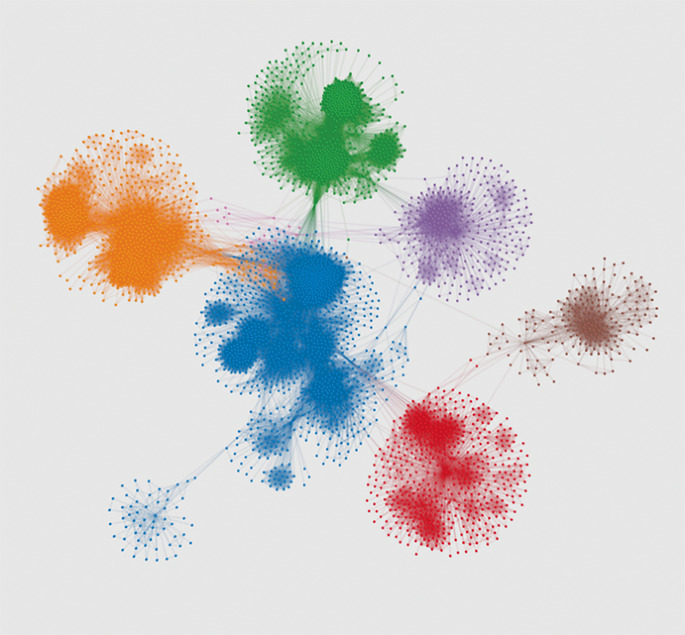
A fundamental technical challenge in the analysis of network data is the automated discovery of communities — groups of nodes that are strongly connected or that share similar features or roles. In this Comment we review progress in the field over the past 20 years.

Read the full article at: www.nature.com

Information access equality on generative models of complex networks

Xindi Wang, Onur Varol & Tina Eliassi-Rad 

Applied Network Science volume 7, Article number: 54 (2022)

It is well known that networks generated by common mechanisms such as preferential attachment and homophily can disadvantage the minority group by limiting their ability to establish links with the majority group. This has the effect of limiting minority nodes’ access to information. We present the results of an empirical study on the equality of information access in network models with different growth mechanisms and spreading processes. For growth mechanisms, we focus on the majority/minority dichotomy, homophily, preferential attachment, and diversity. For spreading processes, we investigate simple versus complex contagions, different transmission rates within and between groups, and various seeding conditions. We observe two phenomena. First, information access equality is a complex interplay between network structures and the spreading processes. Second, there is a trade-off between equality and efficiency of information access under certain circumstances (e.g., when inter-group edges are low and information transmits asymmetrically). Our findings can be used to make recommendations for mechanistic design of social networks with information access equality.

Read the full article at: appliednetsci.springeropen.com