
Author: cxdig

Influence maximization in Boolean networks

Thomas Parmer, Luis M. Rocha & Filippo Radicchi 
Nature Communications volume 13, Article number: 3457 (2022)

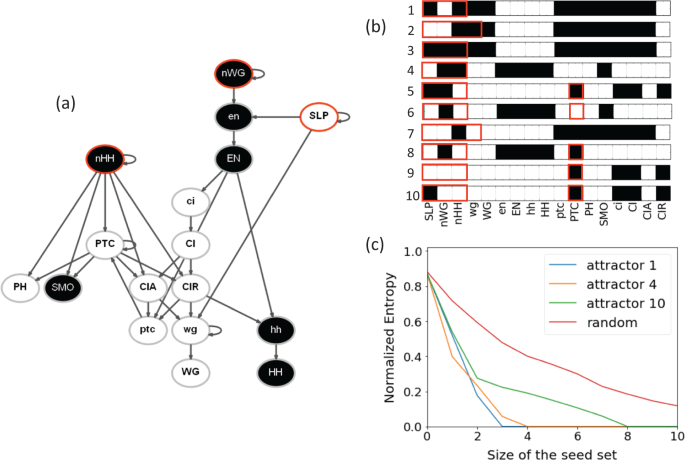
The optimization problem aiming at the identification of minimal sets of nodes able to drive the dynamics of Boolean networks toward desired long-term behaviors is central for some applications, as for example the detection of key therapeutic targets to control pathways in models of biological signaling and regulatory networks. Here, we develop a method to solve such an optimization problem taking inspiration from the well-studied problem of influence maximization for spreading processes in social networks. We validate the method on small gene regulatory networks whose dynamical landscapes are known by means of brute-force analysis. We then systematically study a large collection of gene regulatory networks. We find that for about 65% of the analyzed networks, the minimal driver sets contain less than 20% of their nodes.

Read the full article at: www.nature.com

A Formal Definition of Scale-dependent Complexity and the Multi-scale Law of Requisite Variety

Alexander F. Siegenfeld, Yaneer Bar-Yam
Ashby’s law of requisite variety allows a comparison of systems with their environments, providing a necessary (but not sufficient) condition for system efficacy: a system must possess at least as much complexity as any set of environmental behaviors that require distinct responses from the system. However, the complexity of a system depends on the level of detail, or scale, at which it is described. Thus, the complexity of a system can be better characterized by a complexity profile (complexity as a function of scale) than by a single number. It would therefore be useful to have a multi-scale generalization of Ashby’s law that requires that a system possess at least as much complexity as the relevant set of environmental behaviors *at each scale*. We construct a formalism for a class of complexity profiles that is the first, to our knowledge, to exhibit this multi-scale law of requisite variety. This formalism not only provides a characterization of multi-scale complexity but also generalizes the single constraint on system behaviors provided by Ashby’s law to an entire class of multi-scale constraints. We show that these complexity profiles satisfy a sum rule, which reflects the important tradeoff between smaller- and larger-scale degrees of freedom, and we extend our results to subdivided systems and systems with a continuum of components.

Read the full article at: arxiv.org

Lithbea, A New Domain outside the Tree of Life

Gomez-Marquez, J. Lithbea, A New Domain outside the Tree of Life . Preprints 2022, 2022060094 (doi: 10.20944/preprints202206.0094.v1)

As synthetic/artificial life forms become more abundant and sophisticated, an increasing number of bizarre creatures – xenobots, robots, soft A-life entities, genetically engineered organisms, etc. – are invading our society. Therefore, we need to bring order to all this, to establish what is living and what is not. Here, I intend to classify all these non-natural entities and clarify their status with reference to their consideration or not as living beings, leaving the door open to an uncertain future in which perhaps we can see how “the artificial” and “the natural” merge to originate something new. To order all this “new biodiversity” and to also give entry to viruses (which are excluded of the three-domains tree of life), I propose the creation of a new domain, Lithbea (from the name: life-in-the-border entities), in which all these new human-made entities as well as the viruses will be included. Within this domain there would be two kingdoms, Virus and Humade (contraction of human-made), based on their origin, natural or human-made. A brief description of each component of Lithbea is included and the implications for society and biology of this “new biodiversity” is briefly discussed.

Read the full article at: www.preprints.org

Complex systems for the most vulnerable

Elisa Omodei, Manuel Garcia-Herranz, Daniela Paolotti and Michele Tizzoni

Journal of Physics: Complexity, Volume 3, Number 2

In a rapidly changing world, facing an increasing number of socioeconomic, health and environmental crises, complexity science can help us to assess and quantify vulnerabilities, and to monitor and achieve the UN sustainable development goals. In this perspective, we provide three exemplary use cases where complexity science has shown its potential: poverty and socioeconomic inequalities, collective action for representative democracy, and computational epidemic modeling. We then review the challenges and limitations related to data, methods, capacity building, and, as a result, research operationalization. We finally conclude with some suggestions for future directions, urging the complex systems community to engage in applied and methodological research addressing the needs of the most vulnerable.

Read the full article at: iopscience.iop.org