Author: cxdig

Ninth International Conference on Complex Networks & Their Applications Madrid, Spain December 1- 3, 2020

The International Conference on Complex Networks and their Applications aims at bringing together researchers from different scientific communities working on areas related to complex networks. Two types of contributions are welcome: theoretical developments arising from practical problems, and case studies where methodologies are applied. Both contributions are aimed at stimulating the interaction between theoreticians and practitioners.

Source: complexnetworks.org
Modelling COVID-19

Alessandro Vespignani, Huaiyu Tian, Christopher Dye, James O. Lloyd-Smith, Rosalind M. Eggo, Munik Shrestha, Samuel V. Scarpino, Bernardo Gutierrez, Moritz U. G. Kraemer, Joseph Wu, Kathy Leung & Gabriel M. Leung 
Nature Reviews Physics (2020)


As the COVID-19 pandemic continues, mathematical epidemiologists share their views on what models reveal about how the disease has spread, the current state of play and what work still needs to be done.

Source: www.nature.com

A Class of Models with the Potential to Represent Fundamental Physics

Stephen Wolfram


A class of models intended to be as minimal and structureless as possible is introduced. Even in cases with simple rules, rich and complex behavior is found to emerge, and striking correspondences to some important core known features of fundamental physics are seen, suggesting the possibility that the models may provide a new approach to finding a fundamental theory of physics.

Source: arxiv.org

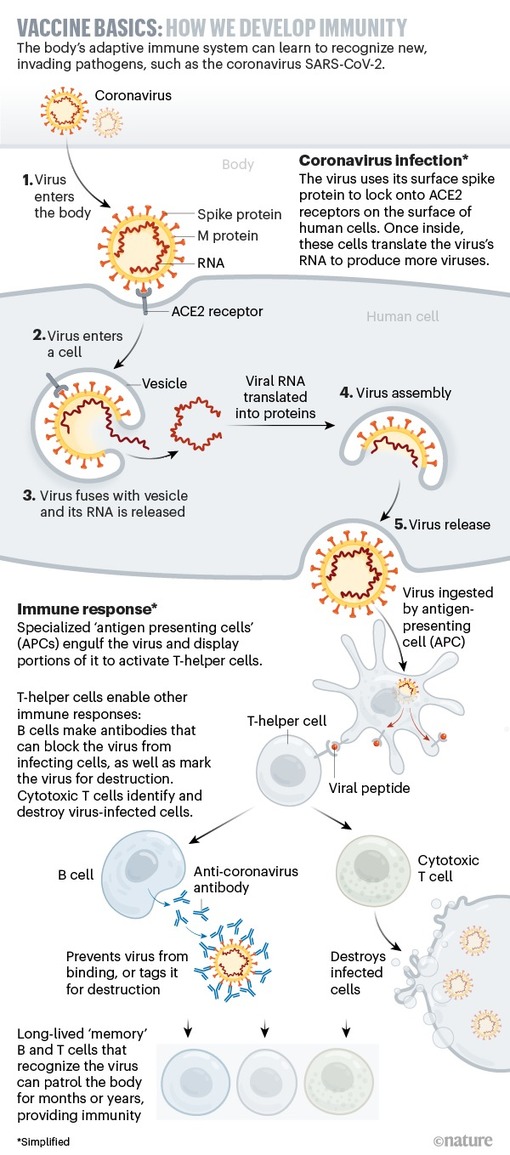
The race for coronavirus vaccines – a graphical guide

More than 90 vaccines are being developed against SARS-CoV-2 by research teams in companies and universities across the world. Researchers are trialling different technologies, some of which haven’t been used in a licensed vaccine before. At least six groups have already begun injecting formulations into volunteers in safety trials; others have started testing in animals. Nature’s graphical guide explains each vaccine design.

Source: www.nature.com

How Coronavirus Mutates and Spreads

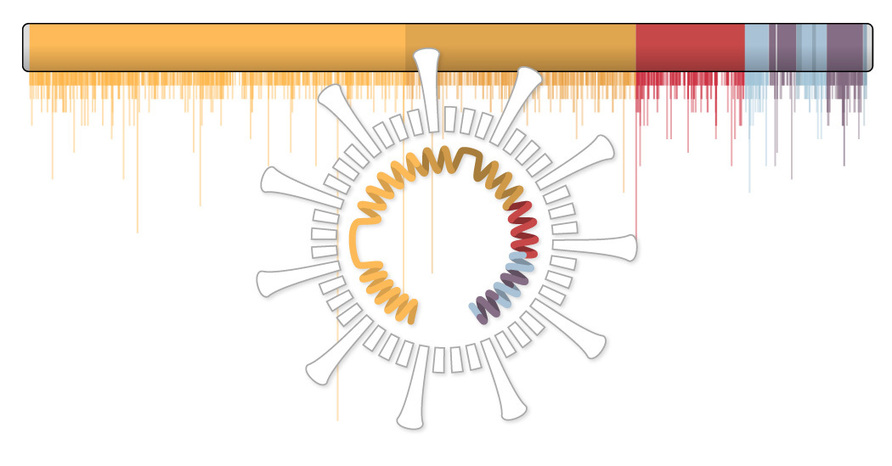
The virus has mutated. But that doesn’t mean it’s getting deadlier.


At this point in the pandemic, coronavirus genomes with 10 or fewer mutations are common, and only a small number have over 20 mutations — which is still less than a tenth of a percent of the genome.


Over time, viruses can evolve into new strains — in other words, viral lineages that are significantly different from each other. Since January, researchers have sequenced many thousands of SARS-CoV-2 genomes and tracked all the mutations that have arisen. So far, they haven’t found compelling evidence that the mutations have had a significant change in how the virus affects us.

Source: www.nytimes.com