
Author: cxdig

US Coronavirus Death Toll Is Far Higher Than Reported, CDC Data Suggests

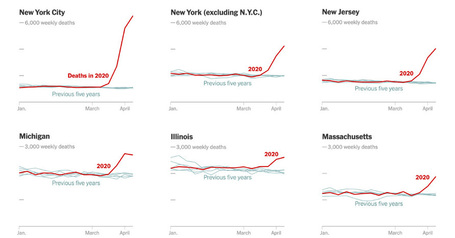
Total deaths in seven states that have been hard hit by the coronavirus pandemic are nearly 50 percent higher than normal for the five weeks from March 8 through April 11 2020, according to new death statistics from the Centers for Disease Control and Prevention. That is 9,000 more deaths than were reported as of April 11 in official counts of deaths from the coronavirus.


The new data is partial and most likely undercounts the recent death toll significantly. But it still illustrates how the coronavirus is causing a surge in deaths in the places it has struck, probably killing more people than the reported statistics capture. These increases belie arguments that the virus is only killing people who would have died anyway from other causes. Instead, the virus has brought a pattern of deaths unlike anything seen in recent years.


If you look at the provisional deaths from all causes, death counts in New York, New Jersey, Michigan, Massachusetts, Illinois, Maryland and Colorado have spiked far above their normal levels for the period. In New York City, the home of the biggest outbreak, the number of deaths over this period is more than three times the normal number. Recent data suggests it could have reached six times higher than normal.

Source: www.nytimes.com

Towards Social Capital in a Network Organization: A Conceptual Model and an Empirical Approach

 Saad Alqithami, Rahmat Budiarto, Musaad Alzahrani and Henry Hexmoor

Entropy 2020, 22(5), 519


Due to the complexity of an open multi-agent system, agents’ interactions are instantiated spontaneously, resulting in beneficent collaborations with one another for mutual actions that are beyond one’s current capabilities. Repeated patterns of interactions shape a feature of their organizational structure when those agents self-organize themselves for a long-term objective. This paper, therefore, aims to provide an understanding of social capital in organizations that are open membership multi-agent systems with an emphasis in our formulation on the dynamic network of social interactions that, in part, elucidate evolving structures and impromptu topologies of networks. We model an open source project as an organizational network and provide definitions and formulations to correlate the proposed mechanism of social capital with the achievement of an organizational charter, for example, optimized productivity. To empirically evaluate our model, we conducted a case study of an open source software project to demonstrate how social capital can be created and measured within this type of organization. The results indicate that the values of social capital are positively proportional towards optimizing agents’ productivity into successful completion of the project.

Source: www.mdpi.com

Complexity Weekend: Virtual COVID-19 Hackathon | May 22-24, 2020

Team Up Against COVID-19

Meet new collaborators and learn Complexity Science by doing.

Help to address the unprecedented, interconnected problems created and exposed by this pandemic. Complexity Science is an interdisciplinary and inclusive framework for studying, designing, and controlling Complex systems. Over the course of one weekend, you will learn about Complexity Science from a variety of perspectives while developing solutions in a team setting to address:

Unemployment
Shelter in Place Policy
Testing
PPE
Supply Chains
Vaccine Research
Ventilator Shortage
Mental Health
Many other ongoing problems

Here’s what to expect during this weekend experience:

This event will feature Complexity Science-inspired lectures, discussions, and workshops on Friday night and Saturday day. All attendees will then engage in a collective brainstorming and team formation process Saturday afternoon, followed by a facilitated hackathon experience with these teams on Sunday.

Source: www.complexityweekend.com

Changes in contact patterns shape the dynamics of the COVID-19 outbreak in China

Juanjuan Zhang, Maria Litvinova, Yuxia Liang, Yan Wang, Wei Wang, Shanlu Zhao, Qianhui Wu, Stefano Merler, Cécile Viboud, Alessandro Vespignani, Marco Ajelli, Hongjie Yu

Science  29 Apr 2020:
eabb8001


Intense non-pharmaceutical interventions were put in place in China to stop transmission of the novel coronavirus disease (COVID-19). As transmission intensifies in other countries, the interplay between age, contact patterns, social distancing, susceptibility to infection, and COVID-19 dynamics remains unclear. To answer these questions, we analyze contact surveys data for Wuhan and Shanghai before and during the outbreak and contact tracing information from Hunan Province. Daily contacts were reduced 7-8-fold during the COVID-19 social distancing period, with most interactions restricted to the household. We find that children 0-14 years are less susceptible to SARS-CoV-2 infection than adults 15-64 years of age (odd ratio 0.34, 95%CI 0.24-0.49), while in contrast, individuals over 65 years are more susceptible to infection (odd ratio 1.47, 95%CI: 1.12-1.92). Based on these data, we build a transmission model to study the impact of social distancing and school closure on transmission. We find that social distancing alone, as implemented in China during the outbreak, is sufficient to control COVID-19. While proactive school closures cannot interrupt transmission on their own, they can reduce peak incidence by 40-60% and delay the epidemic.

Source: science.sciencemag.org

How a Landmark Physics Paper from the 1970s Uncannily Describes the COVID-19 Pandemic

Phil Anderson’s article “More Is Different” describes how different levels of complexity require new ways of thinking. And as the virus multiplies and spreads, that’s just what the human race desperately needs

Source: blogs.scientificamerican.com