Author: cxdig

Language Evolution in Swarm Robotics: A Perspective

Nicolas Cambier, Roman Miletitch, Vincent Frémont, Marco Dorigo, Eliseo Ferrante and Vito Trianni


While direct local communication is very important for the organization of robot swarms, so far it has mostly been used for relatively simple tasks such as signaling robots preferences or states. Inspired by the emergence of meaning found in natural languages, more complex communication skills could allow robot swarms to tackle novel situations in ways that may not be a priori obvious to the experimenter. This would pave the way for the design of robot swarms with higher autonomy and adaptivity. The state of the art regarding the emergence of communication for robot swarms has mostly focused on offline evolutionary approaches, which showed that signaling and communication can emerge spontaneously even when not explicitly promoted. However, these approaches do not lead to complex, language-like communication skills, and signals are tightly linked to environmental and/or sensory-motor states that are specific to the task for which communication was evolved. To move beyond current practice, we advocate an approach to emergent communication in robot swarms based on language games. Thanks to language games, previous studies showed that cultural self-organization—rather than biological evolution—can be responsible for the complexity and expressive power of language. We suggest that swarm robotics can be an ideal test-bed to advance research on the emergence of language-like communication. The latter can be key to provide robot swarms with additional skills to support self-organization and adaptivity, enabling the design of more complex collective behaviors.

Source: www.frontiersin.org
CCS2020: Conference on Complex Systems. Palma de Mallorca, Oct 19-23

Complexity, understood as the emergence of new macro properties from the interactions of basic components, is a pervasive characteristic in natural, artificial and social systems. The Conference on Complex Systems (CCS) is the biggest and most important annual meeting of the international complex systems community. It comes under the auspices of the Complex Systems Society. This edition, after successful events in Singapore , Thessaloniki (Greece) , Cancun (Mexico) and Amsterdam (Netherlands), will take place in the Mediterranean island of Mallorca, Spain, organized by IFISC (CSIC-UIB).

Source: ccs2020.org

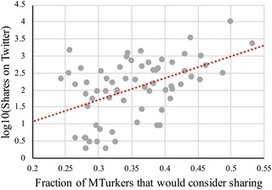
Self-reported willingness to share political news articles in online surveys correlates with actual sharing on Twitter

Mohsen Mosleh, Gordon Pennycook, David G. Rand 


There is an increasing imperative for psychologists and other behavioral scientists to understand how people behave on social media. However, it is often very difficult to execute experimental research on actual social media platforms, or to link survey responses to online behavior in order to perform correlational analyses. Thus, there is a natural desire to use self-reported behavioral intentions in standard survey studies to gain insight into online behavior. But are such hypothetical responses hopelessly disconnected from actual sharing decisions? Or are online survey samples via sources such as Amazon Mechanical Turk (MTurk) so different from the average social media user that the survey responses of one group give little insight into the on-platform behavior of the other? Here we investigate these issues by examining 67 pieces of political news content. We evaluate whether there is a meaningful relationship between (i) the level of sharing (tweets and retweets) of a given piece of content on Twitter, and (ii) the extent to which individuals (total N = 993) in online surveys on MTurk reported being willing to share that same piece of content. We found that the same news headlines that were more likely to be hypothetically shared on MTurk were also shared more frequently by Twitter users, r = .44. For example, across the observed range of MTurk sharing fractions, a 20 percentage point increase in the fraction of MTurk participants who reported being willing to share a news headline on social media was associated with 10x as many actual shares on Twitter. We also found that the correlation between sharing and various features of the headline was similar using both MTurk and Twitter data. These findings suggest that self-reported sharing intentions collected in online surveys are likely to provide some meaningful insight into what content would actually be shared on social media.

Source: journals.plos.org

Adoption Dynamics and Societal Impact of AI Systems in Complex Networks 

Pedro M. Fernandes, Francisco C. Santos, Manuel Lopes

AIES ’20: Proceedings of the AAAI/ACM Conference on AI, Ethics, and SocietyFebruary 2020 Pages 258–264


We propose a game-theoretical model to simulate the dynamics of AI adoption in adaptive networks. This formalism allows us to understand the impact of the adoption of AI systems for society as a whole, addressing some of the concerns on the need for regulation. Using this model we study the adoption of AI systems, the distribution of the different types of AI (from selfish to utilitarian), the appearance of clusters of specific AI types, and the impact on the fitness of each individual. We suggest that the entangled evolution of individual strategy and network structure constitutes a key mechanism for the sustainability of utilitarian and human-conscious AI. Differently, in the absence of rewiring, a minority of the population can easily foster the adoption of selfish AI and gains a benefit at the expense of the remaining majority.

Source: dl.acm.org

Artificial Life—Next Generation Perspectives: Echoes from the 2018 Conference in Tokyo

Olaf Witkowski, Takashi Ikegami, Nathaniel Virgo, Mizuki Oka and Hiroyuki Iizuka


Artificial life is a research field devoted to the theoretical study of features of living systems, such as evolution and the brain. The field has developed philosophical concepts such as autopoiesis and emergence, alongside a large range of computational and experimental setups, from evolutionary simulations to robotics and chemical experiments.

The complexity and diversity of the artificial life field is crucial to its community. Many researchers consider the community as a real source of creativity and free-minded exchange of ideas on important questions. For ideas that donʼt fit neatly into a single “mainstream” field of science, there is value in examining and discussing them in a context free from departmental or disciplinary constraints, with the purpose of reaching a better knowledge of the fundamental mechanisms that govern living systems.

Source: www.mitpressjournals.org