Author: cxdig

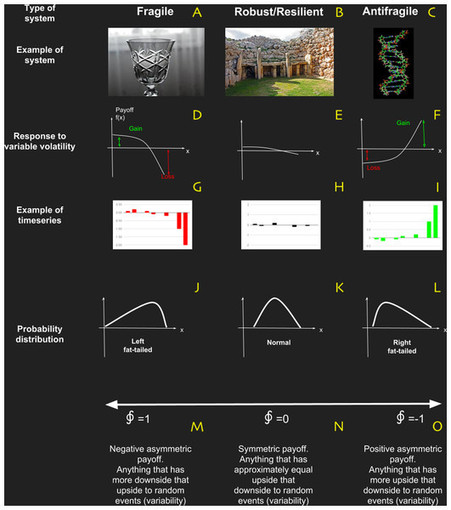
Ecosystem antifragility: beyond integrity and resilience

We review the concept of ecosystem resilience in its relation to ecosystem integrity from an information theory approach. We summarize the literature on the subject identifying three main narratives: ecosystem properties that enable them to be more resilient; ecosystem response to perturbations; and complexity. We also include original ideas with theoretical and quantitative developments with application examples. The main contribution is a new way to rethink resilience, that is mathematically formal and easy to evaluate heuristically in real-world applications: ecosystem antifragility. An ecosystem is antifragile if it benefits from environmental variability. Antifragility therefore goes beyond robustness or resilience because while resilient/robust systems are merely perturbation-resistant, antifragile structures


Equihua M, Espinosa Aldama M, Gershenson C, López-Corona O, Munguía M, Pérez-Maqueo O, Ramírez-Carrillo E. 2020. Ecosystem antifragility: beyond integrity and resilience. PeerJ 8:e8533 https://doi.org/10.7717/peerj.8533

Source: peerj.com

Dynamics of a birth–death process based on combinatorial innovation

Mike Steel, Wim Hordijk, Stuart A. Kauffman

Journal of Theoretical Biology


A feature of human creativity is the ability to take a subset of existing items (e.g. objects, ideas, or techniques) and combine them in various ways to give rise to new items, which, in turn, fuel further growth. Occasionally, some of these items may also disappear (extinction). We model this process by a simple stochastic birth–death model, with non-linear combinatorial terms in the growth coefficients to capture the propensity of subsets of items to give rise to new items. In its simplest form, this model involves just two parameters (P, α). This process exhibits a characteristic ‘hockey-stick’ behaviour: a long period of relatively little growth followed by a relatively sudden ‘explosive’ increase. We provide exact expressions for the mean and variance of this time to explosion and compare the results with simulations. We then generalise our results to allow for more general parameter assignments, and consider possible applications to data involving human productivity and creativity.


Source: www.sciencedirect.com

Science of Stories

Stories have the power to shape our identities and worldviews. They can be factual or fictional, text-based or visual and can take many forms—from novels and non-fiction to conspiracy theories, rumors and disinformation. This Collection includes primary research papers that propose innovative, data-driven approaches to understanding stories and their impact, on such topics as the nature of narrative and narrative thinking, methods to extract stories from datasets and datasets from stories, the role of narrative in science communication, and the transformative power of stories.

Source: collections.plos.org

Friendship paradox biases perceptions in directed networks

Nazanin Alipourfard, Buddhika Nettasinghe, Andrés Abeliuk, Vikram Krishnamurthy & Kristina Lerman 
Nature Communications volume 11, Article number: 707 (2020)


Social networks shape perceptions by exposing people to the actions and opinions of their peers. However, the perceived popularity of a trait or an opinion may be very different from its actual popularity. We attribute this perception bias to friendship paradox and identify conditions under which it appears. We validate the findings empirically using Twitter data. Within posts made by users in our sample, we identify topics that appear more often within users’ social feeds than they do globally among all posts. We also present a polling algorithm that leverages the friendship paradox to obtain a statistically efficient estimate of a topic’s global prevalence from biased individual perceptions. We characterize the polling estimate and validate it through synthetic polling experiments on Twitter data. Our paper elucidates the non-intuitive ways in which the structure of directed networks can distort perceptions and presents approaches to mitigate this bias.

Source: www.nature.com