

A programmable quantum computer has been reported to outperform the most powerful conventional computers in a specific task — a milestone in computing comparable in importance to the Wright brothers’ first flights.
Source: www.nature.com
Networking the complexity community since 1999
Author: cxdig
A programmable quantum computer has been reported to outperform the most powerful conventional computers in a specific task — a milestone in computing comparable in importance to the Wright brothers’ first flights.
Source: www.nature.com
Social behaviours emerge from the exchange of information among individuals—constrained by and reciprocally influencing the structure of information flows. The Internet radically transformed communication by democratizing broadcast capabilities and enabling easy and borderless formation of new acquaintances. However, actual information flows are heterogeneous and confined to self-organized echo-chambers. Of central importance to the future of society is understanding how existing physical segregation affects online social fragmentation. Here, we show that the virtual space is a reflection of the geographical space where physical interactions and proximity-based social learning are the main transmitters of ideas. We show that online interactions are segregated by income just as physical interactions are, and that physical separation reflects polarized behaviours beyond culture or politics. Our analysis is consistent with theoretical concepts suggesting polarization is associated with social exposure that reinforces within-group homogenization and between-group differentiation, and they together promote social fragmentation in mirrored physical and virtual spaces.
Segregation and polarization in urban areas
Alfredo J. Morales, Xiaowen Dong, Yaneer Bar-Yam and Alex ‘Sandy’ Pentland
Royal Society Open Science
Source: royalsocietypublishing.org
This paper proposes new avenues for origins research that apply modern concepts from stochastic thermodynamics, information thermodynamics and complexity science. Most approaches to the emergence of life prioritize certain compounds, reaction pathways, environments or phenomena. What they all have in common is the objective of reaching a state that is recognizably alive, usually positing the need for an evolutionary process. As with life itself, this correlates with a growth in the complexity of the system over time. Complexity often takes the form of an intuition or a proxy for a phenomenon that defies complete understanding. However, recent progress in several theoretical fields allows the rigorous computation of complexity. We thus propose that measurement and control of the complexity and information content of origins-relevant systems can provide novel insights that are absent in other approaches. Since we have no guarantee that the earliest forms of life (or alien life) used the same materials and processes as extant life, an appeal to complexity and information processing provides a more objective and agnostic approach to the search for life’s beginnings. This paper gives an accessible overview of the three relevant branches of modern thermodynamics. These frameworks are not commonly applied in origins studies, but are ideally suited to the analysis of such non-equilibrium systems. We present proposals for the application of these concepts in both theoretical and experimental origins settings.
Probing complexity: thermodynamics and computational mechanics approaches to origins studies
Stuart J. Bartlett and Patrick Beckett
Interface Focus
Source: royalsocietypublishing.org
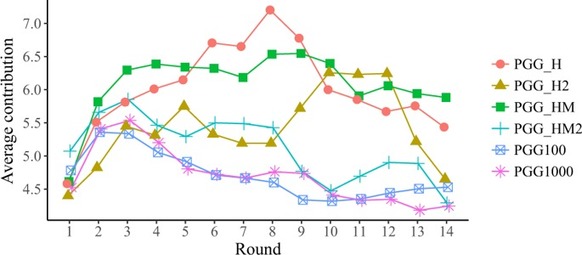
The problem of public good provision is central in economics and touches upon many challenging societal issues, ranging from climate change mitigation to vaccination schemes. However, results which are supposed to be applied to a societal scale have only been obtained with small groups of people, with a maximum group size of 100 being reported in the literature. This work takes this research to a new level by carrying out and analysing experiments on public good games with up to 1000 simultaneous players. The experiments are carried out via an online protocol involving daily decisions for extended periods. Our results show that within those limits, participants’ behaviour and collective outcomes in very large groups are qualitatively like those in smaller ones. On the other hand, large groups imply the difficulty of conveying information on others’ choices to the participants. We thus consider different information conditions and show that they have a drastic effect on subjects’ contributions. We also classify the individual decisions and find that they can be described by a moderate number of types. Our findings allow to extend the conclusions of smaller experiments to larger settings and are therefore a relevant step forward towards the understanding of human behaviour and the organisation of our society.
Large scale and information effects on cooperation in public good games
María Pereda, Ignacio Tamarit, Alberto Antonioni, Jose A. Cuesta, Penélope Hernández & Angel Sánchez
Scientific Reports volume 9, Article number: 15023 (2019)
Source: www.nature.com
Breakthrough discoveries and inventions involve unexpected combinations of contents including problems, methods, and natural entities, and also diverse contexts such as journals, subfields, and conferences. Drawing on data from tens of millions of research papers, patents, and researchers, we construct models that predict more than 95% of next year’s content and context combinations with embeddings constructed from high-dimensional stochastic block models, where the improbability of new combinations itself predicts up to half of the likelihood that they will gain outsized citations and major awards. Most of these breakthroughs occur when problems in one field are unexpectedly solved by researchers from a distant other. These findings demonstrate the critical role of surprise in advance, and enable evaluation of scientific institutions ranging from education and peer review to awards in supporting it.
Science and Technology Advance through Surprise
Feng Shi, James Evans
Source: arxiv.org

