
Author: cxdig

The Prize in Economic Sciences 2019

The research conducted by this year’s Laureates has considerably improved our ability to fight global poverty. In just two decades, their new experiment-based approach has transformed development economics, which is now a flourishing field of research.

Despite recent dramatic improvements, one of humanity’s most urgent issues is the reduction of global poverty, in all its forms. More than 700 million people still subsist on extremely low incomes. Every year, around five million children under the age of five still die of diseases that could often have been prevented or cured with inexpensive treatments. Half of the world’s children still leave school without basic literacy and numeracy skills.

This year’s Laureates have introduced a new approach to obtaining reliable answers about the best ways to fight global poverty. In brief, it involves dividing this issue into smaller, more manageable, questions – for example, the most effective interventions for improving educational outcomes or child health. They have shown that these smaller, more precise, questions are often best answered via carefully designed experiments among the people who are most affected.

Source: www.nobelprize.org
Irreversibility and emergent structure in active matter

Active matter is rapidly becoming a key paradigm of out-of-equilibrium soft matter exhibiting complex collective phenomena, yet the thermodynamics of such systems remain poorly understood. In this article we study the dynamical irreversibility of large scale active systems capable of motility-induced phase separation and polar alignment. We use a model with momenta in both translational and rotational degrees of freedom, revealing a hidden component not previously reported in the literature. Steady state irreversibility is quantified at each point in the phase diagram which exhibits sharp discontinuities at phase transitions. Identification of the irreversibility in individual particles lays the groundwork for discussion of the thermodynamics of micro-features, such as defects in the emergent structure. The interpretation of the time reversal symmetry in the dynamics of the particles is found to be crucial.


Irreversibility and emergent structure in active matter
Phys. Rev. E
Emanuele Crosato, Mikhail Prokopenko, and Richard E. Spinney

Source: journals.aps.org

Scalar model of flocking dynamics on complex social networks

We investigate the effects of long-range social interactions in flocking dynamics by studying the dynamics of a scalar model of collective motion embedded in a complex network representing a pattern of social interactions, as observed in several social species. In this scalar model we find a phenomenology analogous to that observed in the classic Vicsek model: In networks with low heterogeneity, a phase transition separates an ordered from a disordered phase. At high levels of heterogeneity, instead, the transition is suppressed and the system is always ordered. This observation is backed up analytically by the solution of a modified scalar model within an heterogeneous mean-field approximation. Our work extends the understanding of the effects of social interactions in flocking dynamics and opens the path to the analytical study of more complex topologies of social ties.


Scalar model of flocking dynamics on complex social networks
M. Carmen Miguel, Romualdo Pastor-Satorras

Source: arxiv.org

U.S. Social Fragmentation at Multiple Scales

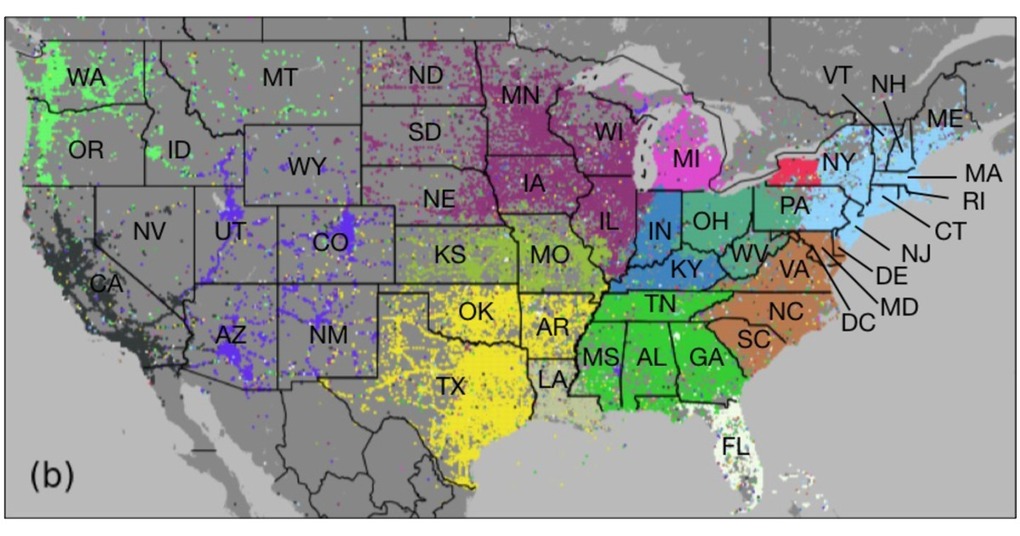
Despite global connectivity, societies seem to be increasingly polarized and fragmented. This phenomenon is rooted in the underlying complex structure and dynamics of social systems. Far from homogeneously mixing or adopting conforming views, individuals self-organize into groups at multiple scales, ranging from families up to cities and cultures. In this paper, we study the fragmented structure of the American society using mobility and communication networks obtained from geo-located social media data. We find self-organized patches with clear geographical borders that are consistent between physical and virtual spaces. The patches have multi-scale structure ranging from parts of a city up to the entire nation. Their significance is reflected in distinct patterns of collective interests and conversations. Finally, we explain the patch emergence by a model of network growth that combines mechanisms of geographical distance gravity, preferential attachment, and spatial growth. Our observations are consistent with the emergence of social groups whose separated association and communication reinforce distinct identities. Rather than eliminating borders, the virtual space reproduces them as people mirror their offline lives online. Understanding the mechanisms driving the emergence of fragmentation in hyper-connected social systems is imperative in the age of the Internet and globalization.


Leila Hedayatifar, Rachel A. Rigg, Yaneer Bar-Yam, and Alfredo J. Morales, U.S. social fragmentation at multiple scales, Journal of the Royal Society Interface (October 8, 2019).

Source: necsi.edu

The Nobel Prize in Chemistry 2019

The Nobel Prize in Chemistry 2019 rewards the development of the lithium-ion battery. This lightweight, rechargeable and powerful battery is now used in everything from mobile phones to laptops and electric vehicles. It can also store significant amounts of energy from solar and wind power, making possible a fossil fuel-free society.

Source: www.nobelprize.org