
Author: cxdig

The Neuroscience of Reality

  • The reality we perceive is not a direct reflection of the external objective world.
  • Instead it is the product of the brain’s predictions about the causes of incoming sensory signals.
  • The property of realness that accompanies our perceptions may serve to guide our behavior so that we respond appropriately to the sources of sensory signals.


The Neuroscience of Reality

Anil Seth

Scientific American

Source: www.scientificamerican.com
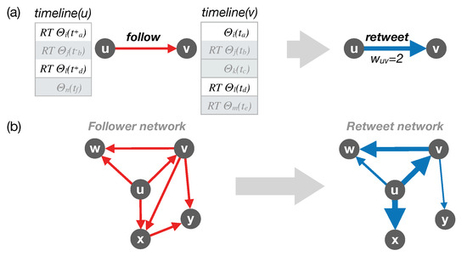
Interactional and Informational Attention on Twitter

Twitter may be considered to be a decentralized social information processing platform whose users constantly receive their followees’ information feeds, which they may in turn dispatch to their followers. This decentralization is not devoid of hierarchy and heterogeneity, both in terms of activity and attention. In particular, we appraise the distribution of attention at the collective and individual level, which exhibits the existence of attentional constraints and focus effects. We observe that most users usually concentrate their attention on a limited core of peers and topics, and discuss the relationship between interactional and informational attention processes—all of which, we suggest, may be useful to refine influence models by enabling the consideration of differential attention likelihood depending on users, their activity levels, and peers’ positions.


Interactional and Informational Attention on Twitter
Agathe Baltzer, Márton Karsai, and Camille Roth
Information 2019, 10(8), 250

Source: www.mdpi.com

We Need an International Center for Climate Modeling

Earth’s climate is changing, and we must decide what to do about it. Existing climate models all predict further warming, but for all we currently know, this trend could range from modest and manageable to an existential threat. In face of such large uncertainty it is difficult to agree on a course of action. For this reason, we propose the formation of an international initiative for high resolution climate models with the aim of providing more reliable long-term predictions.

Source: blogs.scientificamerican.com

The economic impact of universities: Evidence from across the globe

•Using international data on universities we study their impact on regional growth.

•Increases in universities are positively and robustly associated with higher growth.

•This effect spills over into neighbouring regions within the same country.

•Increasing regional human capital and innovation matter help mediate this effect.

•The economic benefits of university expansion are likely to exceed the costs.


The economic impact of universities: Evidence from across the globe

Anna Valero, John Van Reenen

Economics of Education Review
Volume 68, February 2019, Pages 53-67

Source: www.sciencedirect.com

How to Defraud Democracy

  • There are still major cybersecurity vulnerabilities facing the 2020 U.S. presidential election, in part because the election system is based on faith instead of evidence.
  • Foreign attackers could target voter-registration rolls and election machinery to either influence the outcome or sow chaos and doubt.
  • The worst-case scenarios could result in an unprecedented constitutional crisis.

Source: www.scientificamerican.com