Author: cxdig

Settlement percolation: A study of building connectivity and poles of inaccessibility

•Spatial clustering is applied to coordinates of the building stock in Germany.

•We determine the percolation distance at which a country spanning cluster emerges.

•The top five largest holes in that mesh are or were military training areas.

•The building density decreases with the clustering threshold following a power-law with an exponent close to 0.75.

•The overbuilding is a phenomenon that is beyond the dichotomy of sprawled and compact urban development.


Settlement percolation: A study of building connectivity and poles of inaccessibility

Martin Behnisch, Martin Schorcht, Steffen Kriewald, DiegoRybski

Landscape and Urban Planning
Volume 191, November 2019, 103631

Source: www.sciencedirect.com

How Much Would You Pay to Change a Game before Playing It?

Envelope theorems provide a differential framework for determining how much a rational decision maker (DM) is willing to pay to alter the parameters of a strategic scenario. We generalize this framework to the case of a boundedly rational DM and arbitrary solution concepts. We focus on comparing and contrasting the case where DM’s decision to pay to change the parameters is observed by all other players against the case where DM’s decision is private information. We decompose DM’s willingness to pay a given amount into a sum of three factors: (1) the direct effect a parameter change would have on DM’s payoffs in the future strategic scenario, holding strategies of all players constant; (2) the effect due to DM changing its strategy as they react to a change in the game parameters, with the strategies of the other players in that scenario held constant; and (3) the effect there would be due to other players reacting to a the change in the game parameters (could they observe them), with the strategy of DM held constant. We illustrate these results with the quantal response equilibrium and the matching pennies game and discuss how the willingness to pay captures DM’s anticipation of their future irrationality.


How Much Would You Pay to Change a Game before Playing It?
David Wolpert and Justin Grana

Entropy 2019, 21(7), 686

Source: www.mdpi.com

Connecting empirical phenomena and theoretical models of biological coordination across scales

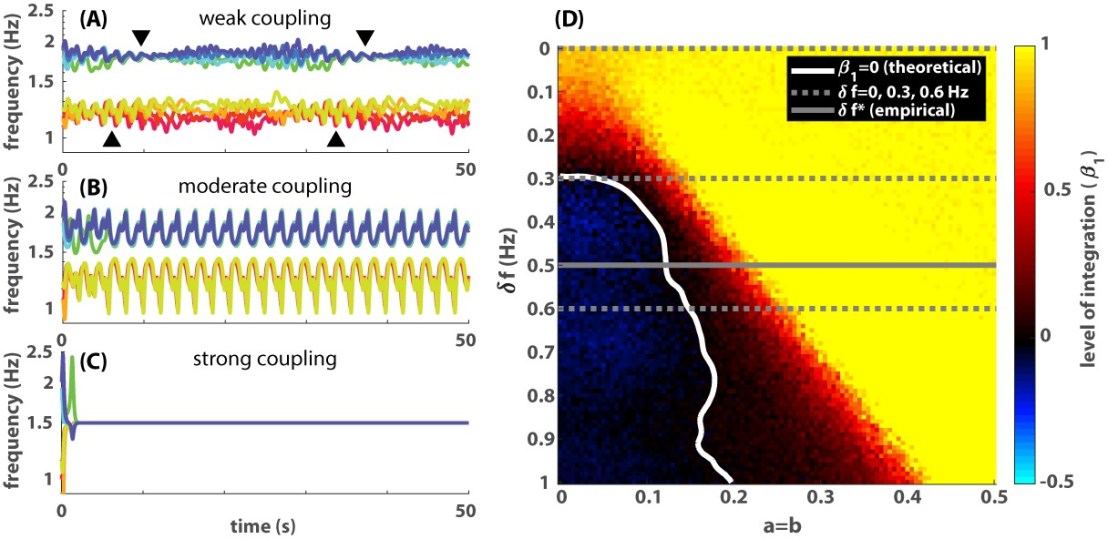
Coordination in living systems—from cells to people—must be understood at multiple levels of description. Analyses and modelling of empirically observed patterns of biological coordination often focus either on ensemble-level statistics in large-scale systems with many components, or on detailed dynamics in small-scale systems with few components. The two approaches have proceeded largely independent of each other. To bridge this gap between levels and scales, we have recently conducted a human experiment of mid-scale social coordination specifically designed to reveal coordination at multiple levels (ensemble, subgroups and dyads) simultaneously. Based on this experiment, the present work shows that, surprisingly, a single system of equations captures key observations at all relevant levels. It also connects empirically validated models of large- and small-scale biological coordination—the Kuramoto and extended Haken–Kelso–Bunz (HKB) models—and the hallmark phenomena that each is known to capture. For example, it exhibits both multistability and metastability observed in small-scale empirical research (via the second-order coupling and symmetry breaking in extended HKB) and the growth of biological complexity as a function of scale (via the scalability of the Kuramoto model). Only by incorporating both of these features simultaneously can we reproduce the essential coordination behaviour observed in our experiment.


Connecting empirical phenomena and theoretical models of biological coordination across scales
Mengsen Zhang , Christopher Beetle , J. A. Scott Kelso and Emmanuelle Tognoli

JRS Interface

Source: royalsocietypublishing.org