Author: cxdig

PHD/Postdoc Openings at Cross Labs

OUR MISSION
Cross Labs’ mission is to bridge between intelligence science and AI technology at the service of human society. At Cross Labs, we focus on pushing fundamental research towards a thorough mathematical understanding of all intelligent processes observable both in nature and in artificial environments.

POSITION
To reach our goals, we are seeking ambitious, highly-skilled researchers to solve open problems on both natural and artificial intelligence fronts. Our current research priorities cover a large range of intelligence science topics, including artificial life, cognitive neuroscience, collective intelligence, deep learning, robotics, and computational linguistics. Other research topics will be seriously considered if you can make a case for their tractability and relevance to intelligence science research as envisioned by Cross Labs.

IDEAL PROFILE
The ideal candidate shares our excitement to understand the fundamental principles of intelligence, has a career interest in our core research questions and aims to eventually develop into a senior research fellow at Cross Labs, or continue these avenues of research at another institution after completing substantial work at Cross Labs.

Source: www.crosslabs.org
Computational Human Dynamics

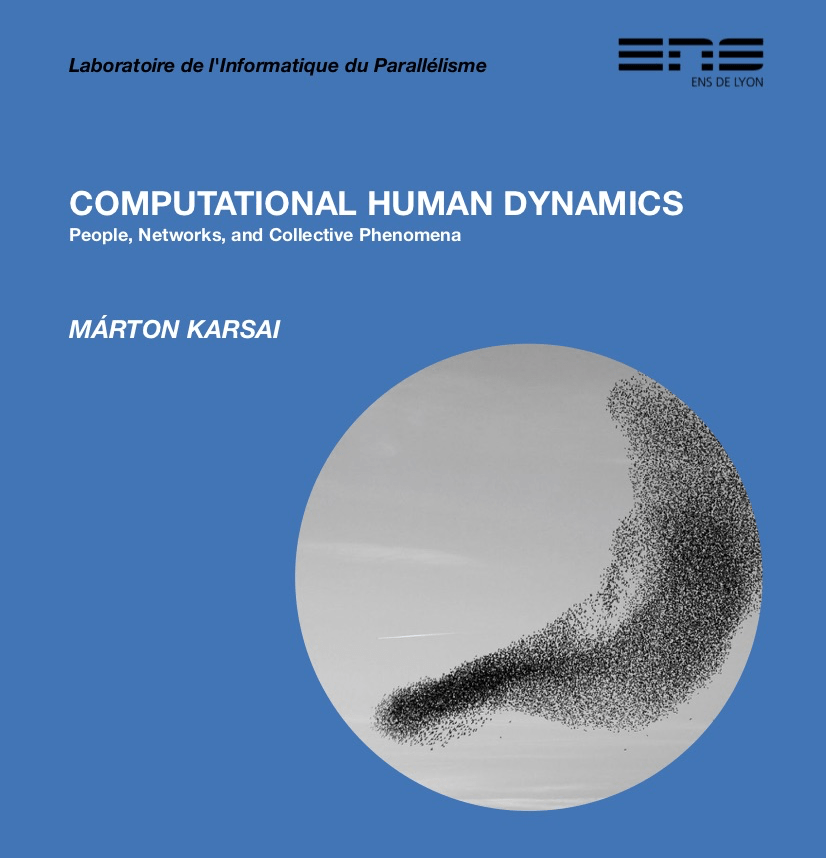
This thesis summarises my scientific contributions in the domain of network science, human dynamics and computational social science. These contributions are associated to computer science, physics, statistics, and applied mathematics. The goal of this thesis is twofold, on one hand to write a concise summary of my most interesting scientific contributions, and on the other hand to provide an up-to-date view and perspective about my field. I start my dissertation with an introduction to position the reader on the landscape of my field and to put in perspective my contributions. In the second chapter I concentrate on my works on bursty human dynamics, addressing heterogeneous temporal characters of human actions and interactions. Next, I discuss my contributions to the field of temporal networks and give a synthesises of my works on various methods of the representation, characterisation, and modelling of time-varying structures. Finally, I discuss my works on the data-driven observations and modelling of collective social phenomena. There, I summarise studies on the static observations of emergent patterns of socioeconomic inequalities and their correlations with social-communication networks, and with linguistic patterns. I also discuss dynamic observations and modelling of social contagion processes.


Computational Human Dynamics
Márton Karsai

Source: arxiv.org

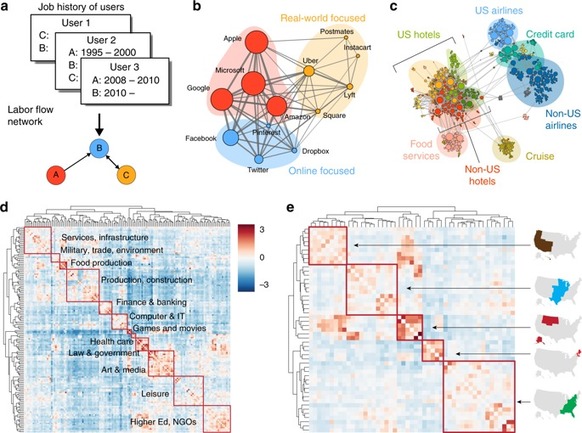
Global labor flow network reveals the hierarchical organization and dynamics of geo-industrial clusters

Groups of firms often achieve a competitive advantage through the formation of geo-industrial clusters. Although many exemplary clusters are the subjects of case studies, systematic approaches to identify and analyze the hierarchical structure of geo-industrial clusters at the global scale are scarce. In this work, we use LinkedIn’s employment history data from more than 500 million users over 25 years to construct a labor flow network of over 4 million firms across the world, from which we reveal hierarchical structure by applying network community detection. We show that the resulting geo-industrial clusters exhibit a stronger association between the influx of educated workers and financial performance, compared to traditional aggregation units. Furthermore, our analysis of the skills of educated workers reveals richer insights into the relationship between the labor flow of educated workers and productivity growth. We argue that geo-industrial clusters defined by labor flow provide useful insights into the growth of the economy.


Global labor flow network reveals the hierarchical organization and dynamics of geo-industrial clusters
Jaehyuk Park, Ian B. Wood, Elise Jing, Azadeh Nematzadeh, Souvik Ghosh, Michael D. Conover & Yong-Yeol Ahn
Nature Communications volume 10, Article number: 3449 (2019)

Source: www.nature.com

Fundamental Structures in Dynamic Communication Networks

In this paper I introduce a framework for modeling temporal communication networks and dynamical processes unfolding on such networks. The framework originates from the realization that there is a meaningful division of temporal communication networks into six dynamic classes, where the class of a network is determined by its generating process. In particular, each class is characterized by a fundamental structure: a temporal-topological network motif, which corresponds to the network representation of communication events in that class of network. These fundamental structures constrain network configurations: only certain configurations are possible within a dynamic class. In this way the framework presented here highlights strong constraints on network structures, which simplify analyses and shape network flows. Therefore the fundamental structures hold the potential to impact how we model temporal networks overall. I argue below that networks within the same class can be meaningfully compared, and modeled using similar techniques, but that integrating statistics across networks belonging to separate classes is not meaningful in general. This paper presents a framework for how to analyze networks in general, rather than a particular result of analyzing a particular dataset. I hope, however, that readers interested in modeling temporal networks will find the ideas and discussion useful in spite of the paper’s more conceptual nature.


Fundamental Structures in Dynamic Communication Networks
Sune Lehmann

Source: arxiv.org

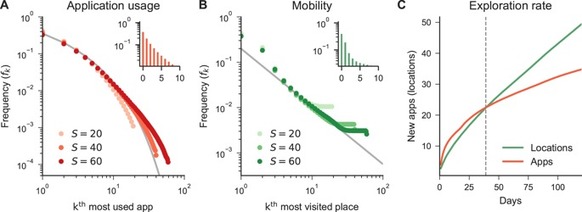
Strategies and limitations in app usage and human mobility

Cognition has been found to constrain several aspects of human behaviour, such as the number of friends and the number of favourite places a person keeps stable over time. This limitation has been empirically defined in the physical and social spaces. But do people exhibit similar constraints in the digital space? We address this question through the analysis of pseudonymised mobility and mobile application (app) usage data of 400,000 individuals in a European country for six months. Despite the enormous heterogeneity of apps usage, we find that individuals exhibit a conserved capacity that limits the number of applications they regularly use. Moreover, we find that this capacity steadily decreases with age, as does the capacity in the physical space but with more complex dynamics. Even though people might have the same capacity, applications get added and removed over time. In this respect, we identify two profiles of individuals: app keepers and explorers, which differ in their stable (keepers) vs exploratory (explorers) behaviour regarding their use of mobile applications. Finally, we show that the capacity of applications predicts mobility capacity and vice-versa. By contrast, the behaviour of keepers and explorers may considerably vary across the two domains. Our empirical findings provide an intriguing picture linking human behaviour in the physical and digital worlds which bridges research studies from Computer Science, Social Physics and Computational Social Sciences.


Strategies and limitations in app usage and human mobility
Marco De Nadai, Angelo Cardoso, Antonio Lima, Bruno Lepri & Nuria Oliver 
Scientific Reportsvolume 9, Article number: 10935 (2019)

Source: www.nature.com