
Author: cxdig

Simplicial models of social contagion

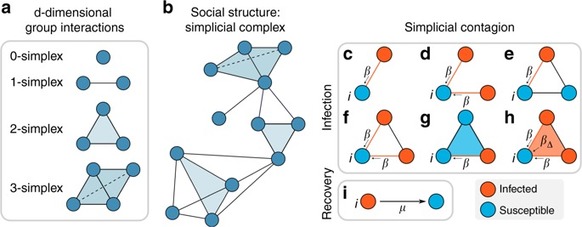
Complex networks have been successfully used to describe the spread of diseases in populations of interacting individuals. Conversely, pairwise interactions are often not enough to characterize social contagion processes such as opinion formation or the adoption of novelties, where complex mechanisms of influence and reinforcement are at work. Here we introduce a higher-order model of social contagion in which a social system is represented by a simplicial complex and contagion can occur through interactions in groups of different sizes. Numerical simulations of the model on both empirical and synthetic simplicial complexes highlight the emergence of novel phenomena such as a discontinuous transition induced by higher-order interactions. We show analytically that the transition is discontinuous and that a bistable region appears where healthy and endemic states co-exist. Our results help explain why critical masses are required to initiate social changes and contribute to the understanding of higher-order interactions in complex systems.


Simplicial models of social contagion
Iacopo Iacopini, Giovanni Petri, Alain Barrat & Vito Latora
Nature Communications 10, Article number: 2485 (2019)

Source: www.nature.com

Proceedings A Special Feature: A Generation of Network Science. Call for papers

On the eve of 20th century, three papers launched the modern Network Science by bringing it to the attention of a wider community of physicists, computer scientists and applied mathematicians. The papers – by Watts and Strogatz [1], Barabasi and Albert [2], and Google founders Brin and Page [3] – introduced “small world networks”, “preferential attachment,” and “PageRank” into the vernacular of network scientists. They showed that simple models could reproduce much of the complexity observed in network structure and that the structure of networks was linked to their function. As we mark the 20th anniversary of the publication of these seminal works, it is time to reflect on the state of Network Science and where the field is headed. What have we learned about networks over the past two decades? How does network structure affect its function? How do we represent networks, predict and control their behavior? How do networks grow and change? What are the limits of our understanding, and finally, what are the important open problems in network science?

Source: royalsocietypublishing.org

An Overview of Open-Ended Evolution: Editorial Introduction to the Open-Ended Evolution II Special Issue

Nature’s spectacular inventiveness, reflected in the enormous diversity of form and function displayed by the biosphere, is a feature of life that distinguishes living most strongly from nonliving. It is, therefore, not surprising that this aspect of life should become a central focus of artificial life. We have known since Darwin that the diversity is produced dynamically, through the process of evolution; this has led life’s creative productivity to be called Open-Ended Evolution (OEE) in the field. This article introduces the second of two special issues on current research in OEE and provides an overview of the contents of both special issues. Most of the work was presented at a workshop on open-ended evolution that was held as a part of the 2018 Conference on Artificial Life in Tokyo, and much of it had antecedents in two previous workshops on open-ended evolution at artificial life conferences in Cancun and York. We present a simplified categorization of OEE and summarize progress in the field as represented by the articles in this special issue.


An Overview of Open-Ended Evolution: Editorial Introduction to the Open-Ended Evolution II Special Issue
Norman Packard, Mark A. Bedau, Alastair Channon, Takashi Ikegami,
Artificial Life
Volume 25 | Issue 2 | Spring 2019 p.93-103

Source: www.mitpressjournals.org

Technology seems open-ended, and it is not living… or is it?

Worlds Hidden in Plain Sight

Over the last three decades, the Santa Fe Institute and its network of researchers have been pursuing a revolution in science.

Ignoring the boundaries of disciplines and schools and searching for novel fundamental ideas, theories, and practices, this international community integrates the full range of scientific inquiries that will help us to understand and survive on a complex planet.

This volume collects essays from the past thirty years of research, in which contributors explain in clear and accessible language many of the deepest challenges and insights of complexity science.

Explore the evolution of complex systems science with chapters from Nobel Laureates Murray Gell-Mann and Kenneth Arrow, as well as numerous pioneering complexity researchers, including John Holland, Brian Arthur, Robert May, Richard Lewontin, Jennifer Dunne, and Geoffrey West.

Source: www.santafe.edu

What is the Entropy of a Social Organization?

We quantify a social organization’s potentiality, that is its ability to attain different configurations. The organization is represented as a network in which nodes correspond to individuals and (multi-)edges to their multiple interactions. Attainable configurations are treated as realizations from a network ensemble. To encode interaction preferences between individuals, we choose the generalized hypergeometric ensemble of random graphs, which is described by a closed-form probability distribution. From this distribution we calculate Shannon entropy as a measure of potentiality. This allows us to compare different organizations as well different stages in the development of a given organization. The feasibility of the approach is demonstrated using data from 3 empirical and 2 synthetic systems.


What is the Entropy of a Social Organization?
Christian Zingg, Giona Casiraghi, Giacomo Vaccario, Frank Schweitzer

Source: arxiv.org